


About This Guide
A comprehensive, step-by-step guide for aspiring entrepreneurs looking to launch a cleaning service business in Illinois. Covers the full startup process from choosing a business structure and registering with the state, through obtaining local licenses and insurance, to estimating costs and finding clients. Illinois is a strong market for cleaning services, particularly in the Chicagoland area with its 9+ million residents. No statewide cleaning license is required, but local business licenses, proper insurance, and tax registration are essential. The guide addresses both residential and commercial cleaning niches, with practical advice tailored to Illinois regulations, tax obligations, and market conditions.
sbb-itb-5b82b38
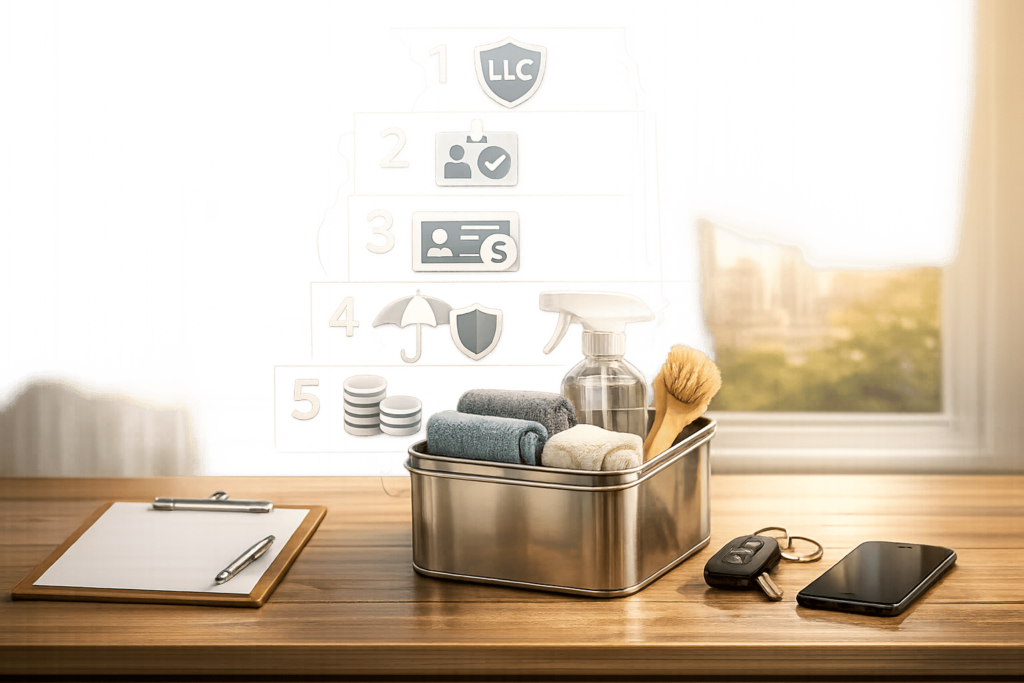
Business Formation Steps
- Choose your business structure — LLC is the most common for cleaning businesses as it protects personal assets; sole proprietorship is simpler but offers no liability protection.
- Choose a unique business name — Must be distinguishable from existing Illinois business names; LLC names must include "Limited Liability Company," "LLC," or "L.L.C."
- Appoint a registered agent — Must have a physical street address in Illinois (no P.O. Boxes); can be an individual resident of Illinois or an entity authorized to do business in the state.
- File Articles of Organization (Form LLC-5.5) with the Illinois Secretary of State — Filing fee is $150; processing takes 1-2 weeks by mail or 5-10 business days online.
- Obtain an Employer Identification Number (EIN) from the IRS — Free and immediate online; required for opening a business bank account, filing taxes, and hiring employees.
- Create an Operating Agreement — Not filed with the state but establishes rules and structure for your LLC; highly recommended for multi-member LLCs.
- File a DBA/Assumed Name certificate if operating under a name different from your LLC legal name — File with the Illinois Secretary of State for LLCs/corporations, or with the county clerk for sole proprietors.
- Register with the Illinois Department of Revenue — Use the MyTax Illinois portal for business tax registration.
- Apply for a local business license with your city or county clerk — Requirements and fees vary by municipality.
- Open a business bank account — Use your EIN and Articles of Organization to separate personal and business finances.
Legal Requirements
No Statewide Cleaning License: Illinois does not issue a statewide cleaning license or general business license. Registration and licensing occur at the local (city/county) level. LLC Formation: Must file Articles of Organization (Form LLC-5.5) with the Illinois Secretary of State. Filing fee is $150. Annual report fee of $75 is due each year on the LLC’s anniversary month. Registered Agent: All LLCs must appoint and maintain a registered agent with a physical street address in Illinois (no P.O. Boxes). The agent must be available during regular business hours to receive legal and state correspondence. Tax Obligations: Illinois has a flat state income tax of 4.95%. Must register with the Illinois Department of Revenue via the MyTax Illinois portal. Cleaning services are generally not subject to Illinois sales tax, though some sources note registration may still be required depending on business activities. DBA/Assumed Name: If operating under a name different from your legal business name, you must register an Assumed Name (DBA) certificate. LLCs and corporations file through the Secretary of State; sole proprietors file with the county clerk. Local Business Licenses: Required by most municipalities. Chicago requires a general business license from the Department of Business Affairs and Consumer Protection (BACP) for most service businesses, including cleaning ($250 fee). Other cities like Aurora, Rockford, Joliet, and Naperville require local business registration. Cook County may require additional documentation for businesses in unincorporated areas. Zoning and Home Occupation: Home-based businesses may need home occupation approval depending on city zoning rules. Check with your local municipality. Compliance: Illinois has strict workers’ compensation requirements with no minimum employee threshold. Penalties for non-compliance can include fines up to $500/day and a minimum $10,000 penalty.
Licensing and Permits
State Cleaning License: Not required — Illinois does not issue a statewide cleaning license. Local Business License: Required by your city or county. Fees and requirements vary by municipality. Chicago requires a general business license from BACP ($250). Other cities (Aurora, Rockford, Joliet, Naperville) require local business registration but no specialty permits. Cook County may require additional documentation for unincorporated areas. DBA/Assumed Name Certificate: Required if operating under a trade name different from your legal business name. File with the Illinois Secretary of State (for LLCs/corporations) or county clerk (for sole proprietors). Sales Tax Registration: Register with the Illinois Department of Revenue via MyTax Illinois portal. Cleaning services are generally exempt from sales tax in Illinois, but registration may still be required for other tax obligations. Home Occupation Permit: May be required depending on your city’s zoning rules — check with your local municipality. Air Pollution Control Permit: May be required by the Illinois EPA if your business uses solvents, cleaning materials, or other chemicals in ways that emit air pollution (more relevant for commercial/industrial cleaning operations).
Insurance Requirements
General Liability Insurance: Not legally mandated by Illinois state law, but practically essential. Most commercial clients, property managers, and government contracts require proof of coverage. Average cost in Illinois is $500-$800/year for a small cleaning business; typical coverage is $1 million per occurrence / $2 million aggregate. Covers property damage, bodily injury, and personal injury claims arising from cleaning work. Workers’ Compensation Insurance: Legally required in Illinois if you have even one employee (including part-time, seasonal, or temporary workers). Illinois has no minimum employee threshold — this is one of the strictest requirements in the U.S. NCCI Code 9014 (Commercial Janitorial): approximately $2.50-$3.50 per $100 of payroll. NCCI Code 0917 (Residential Cleaning): approximately $3.00-$4.00 per $100 of payroll. Penalties for non-compliance: up to $500/day, minimum $10,000 fine, and corporate officers can be held personally liable. Sole proprietors, partners, and LLC members can exempt themselves from coverage. Surety/Janitorial Bond: Not legally required but recommended. Costs $100-$350/year for $1,000-$5,000 coverage. Expected by most commercial clients. Commercial Auto Insurance: Required for vehicles owned by the business. Personal auto policies do not cover business use.
Startup Costs
Starting a cleaning business in Illinois typically costs between $1,425 and $35,150, with a median estimate of approximately $10,450. A solo house cleaner can launch for $2,000-$5,000 covering equipment, insurance, bonding, and a business license. A small residential cleaning company with 2-3 employees and a van requires $10,000-$25,000. A commercial cleaning company with commercial equipment and multiple crews can reach $50,000. Key cost breakdown:
- Cleaning equipment & supplies: $475 (low) to $7,600 (high)
- LLC formation filing fee: $150
- Annual LLC report fee: $75/year
- Local business license: $50-$500+ (Chicago: $250)
- General liability insurance: $500-$1,500/year ($500-$800/year typical in Illinois)
- Janitorial bond: $100-$350/year
- Workers’ compensation: varies by payroll (approx. $2.50-$4.00 per $100 of payroll)
- Marketing & website: $294-$980
- Working capital: $490-$1,960 Illinois’s cost of living is approximately 5% below the national average, which helps reduce operating expenses like commercial rent and labor. Profit margins typically run 25-40% for cleaning businesses in Illinois.
Typical Initial Investments
Cleaning Equipment & Supplies: $475-$7,600 — Commercial vacuums ($200-$600), complete starter kit of quality cleaning products ($200-$800), mops, buckets, microfiber cloths, and specialty tools. LLC Formation: $150 — One-time filing fee with the Illinois Secretary of State. Local Business License: $50-$500+ — Chicago BACP license is $250; other municipalities vary. General Liability Insurance: $500-$1,500/year — $1 million per occurrence / $2 million aggregate is the industry standard minimum. Janitorial/Surety Bond: $100-$350/year — $1,000-$5,000 coverage; expected by most commercial clients. Workers’ Compensation Insurance: Varies by payroll — Approximately $2.50-$4.00 per $100 of payroll depending on classification (residential vs. commercial). Legally required if hiring any employees. Vehicle/Transportation: $0 (use existing) to $8,000+ (used van purchase) — Fuel and maintenance costs $100-$500/month ongoing. Marketing & Website: $294-$980 — Google Business Profile (free), website setup, local advertising. Working Capital: $490-$1,960 — Cover 1-3 months of initial operating expenses during ramp-up. Accountant Consultation: $200-$500 — Recommended for initial tax setup to avoid penalties for incorrect filings.
Estimated Setup Time
Typical Time to Launch: 2–4 weeks. LLC formation with the Illinois Secretary of State takes 1–2 weeks for processing. Obtaining an EIN from the IRS takes about 5 minutes online. Local business license processing varies by city, typically 1–30 business days. Insurance can be secured within a few days. Overall, most new cleaning businesses in Illinois can be fully operational within 2 to 4 weeks.
State Regulations and Compliance
Illinois does not require a state-level cleaning license for basic residential or commercial cleaning. However, local municipalities may require a business license — Chicago requires registration through the Department of Business Affairs and Consumer Protection (BACP) with a $250 fee, and suburbs have their own requirements. Forming an LLC through the Illinois Secretary of State costs $150 with a $75 annual report fee. If operating under a name different from your legal name, you must register an Assumed Name (DBA) certificate — sole proprietors file with the county clerk ($20 fee), while LLCs and corporations file through the Secretary of State. An EIN from the IRS is required if you have employees, are a multi-member LLC, partnership, or corporation. You must register with the Illinois Department of Revenue via the MyTax Illinois portal for tax purposes. Illinois imposes a 4.95% flat state income tax, and Chicago levies additional taxes on some services. Workers’ compensation insurance is legally required for any cleaning business with employees. General liability insurance is essential — many commercial clients and Chicago building managers require proof of insurance before hiring. Profit margins typically run 25–40% for cleaning businesses in Illinois.
Marketing and Growth Tips
Follow a phased marketing rollout: Months 1–3 focus on low-cost lead platforms (Bark, Thumbtack) and free profiles (Google Business Profile, Yelp, Angi, Nextdoor). Months 3–6 add Google Local Services Ads once you have 15+ reviews. Months 6+ introduce Google PPC, Facebook/Instagram ads, and social media content (before/after photos, reels, TikTok). The long-term goal is 50% of leads coming from free channels (organic search, reviews, referrals, social). Invest heavily in reviews — a systematic post-cleaning SMS review request is the fastest way to build a competitive moat. Build city-specific and service-specific website pages (e.g., ‘house cleaning in [City],’ ‘move-out cleaning in [City]’) for local SEO. Default your website and booking flow to recurring service options, with one-time cleaning positioned as the higher-priced option. Use automated re-engagement campaigns and seasonal prompts to retain existing clients. Focus on retention, upsells, and growing average ticket size — that’s where the real profit is.
Client Acquisition Strategies
Start with lead-generation platforms like Bark ($8–10/lead) for affordable volume and Thumbtack for premium-quality leads. Claim your free Google Business Profile immediately — it’s the single highest-ROI marketing asset for local cleaning services. Also set up free listings on Yelp, Angi, and Nextdoor for passive lead flow. For commercial clients, use direct LinkedIn outreach to facility managers and commercial property managers, and build referral relationships with commercial real estate brokers. Once you have 15+ Google reviews, add Google Local Services Ads ($20–30/lead). Implement a systematic post-cleaning SMS review request to build your review count — companies with 200+ reviews and a 4.9+ rating convert at 3x the rate of competitors. Launch a referral program for existing clients, who have an 80% repeat rate and ~$3,600 lifetime value. Use door hangers and flyers targeting specific neighborhoods or buildings.
Helpful Local Resources
- Illinois Small Business Development Centers (SBDCs) — no-cost professional business guidance, training, financial analysis, and support for startups and existing small businesses
- Illinois Business Information Center (First Stop) — free business startup kits, regulatory and permitting information, and searchable knowledge base
- Illinois Secretary of State Department of Business Services — LLC formation, business name registration, and DBA filings
- Illinois Department of Revenue (MyTax Illinois portal) — business tax registration and compliance
- Chicago Department of Business Affairs and Consumer Protection (BACP) — Chicago business licensing and regulation
- Illinois Small Business Environmental Assistance Program (SBEAP) — free confidential assistance for environmental compliance (helpline: 800-252-3998)
- Illinois Procurement Technical Assistance Centers (PTACs) — support for businesses entering government contracting