



Want better local SEO rankings? Start leveraging customer testimonials.
Here’s why:
- Google prioritizes reviews: Positive testimonials boost your business’s "prominence", a key factor in local rankings.
- Keywords in reviews matter: Customers naturally use relevant terms, helping Google match your business to searches like “best pizza in Chicago.”
- Trust drives clicks: A 5-star rating can increase click-through rates by up to 25%.
- Review volume and recency count: Businesses with more recent reviews often rank higher on Google Maps.
To maximize impact, focus on gathering reviews on Google, respond to feedback (positive or negative), and showcase testimonials on your website using structured data.

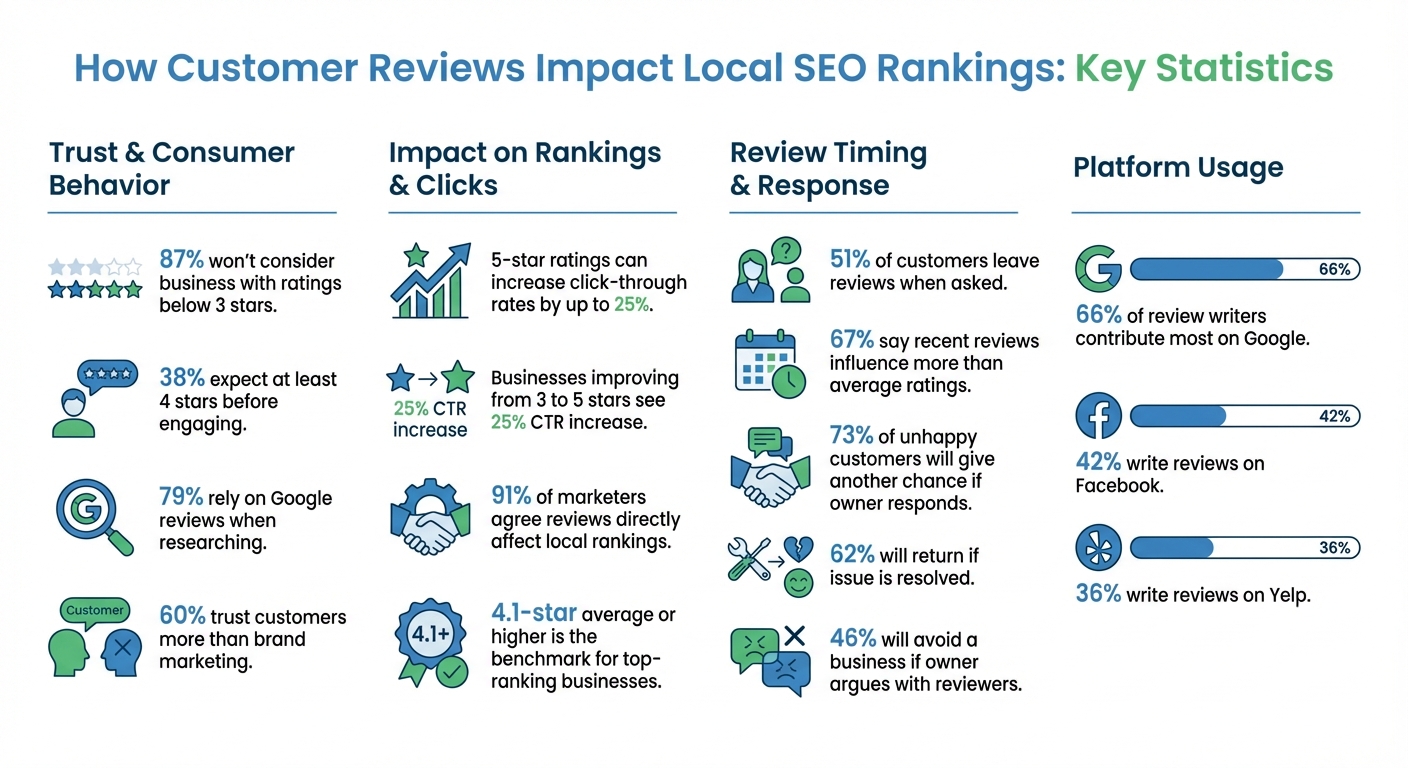
How Customer Reviews Impact Local SEO Rankings: Key Statistics
How Testimonials Affect Local SEO Rankings
Testimonials play a crucial role in local SEO by influencing trust, keyword relevance, and the dynamics of reviews. Google doesn’t just count reviews – it analyzes them to decide which businesses deserve top rankings. Let’s dive into how trust, keyword usage, and review dynamics work together to elevate your local SEO.
Building Trust and Relevance
Customer reviews directly align with Google’s E-E-A-T guidelines (Experience, Expertise, Authoritativeness, Trustworthiness), which help the search engine assess content quality. When customers leave detailed testimonials about their experiences, they’re essentially endorsing your business in a way Google values and rewards.
Trust doesn’t just impact rankings – it influences consumer behavior. 87% of people won’t even consider a business with an average rating below three stars, and 38% expect at least four stars before they’ll engage with a local business. This creates a powerful cycle: positive reviews improve rankings, which boost visibility, encouraging more customers to share their experiences.
Additionally, testimonials enhance user interaction on your website. When visitors spend time reading reviews, it signals value to search engines, further improving your SEO performance.
Keywords in Customer Reviews
Testimonials do more than build trust – they naturally include search-relevant keywords. Essentially, your customers become an unpaid SEO team by writing reviews. These reviews often include long-tail keywords and location-specific details that you might not have thought to target.
Google uses these frequently mentioned terms to create "place topics" on your Business Profile, helping define your relevance for specific searches . Even better, Google highlights "review justifications" in the Local Pack – snippets of review text that match a user’s search query . For instance, if someone searches “gluten-free pizza Chicago” and your reviews mention “amazing gluten-free crust,” Google might showcase that exact phrase, boosting your business’s visibility.
This user-generated content is incredibly influential. 60% of consumers trust what other customers say more than a brand’s own marketing. As Miriam Ellis, a Local SEO expert at Moz, explains:
Your volunteer reviewers can be a more persuasive sales force than your paid marketing department.
Review Volume, Quality, and Freshness
Google evaluates reviews based on three key factors: quantity, quality, and recency. Research shows that the number of reviews impacts Google Maps rankings more than the average rating alone. In fact, businesses in top-ranking positions consistently have more reviews than those ranked second or third.
Quality is equally important. Maintaining a 4.1-star average or higher is critical, as this is the benchmark most top-ranking businesses exceed. 91% of marketers agree that reviews directly affect local rankings, making high-quality feedback essential.
Freshness also plays a big role. 67% of consumers say recent reviews influence them more than the average star rating. New reviews signal to Google that your business is active and serving current customers, prompting more frequent crawling and indexing of your content. This "review velocity" has become a top 20 Google Local Pack ranking factor, giving businesses with consistent, fresh testimonials a clear advantage over competitors relying on outdated feedback.
Where to Display Testimonials for Maximum SEO Impact
The platforms where you collect and showcase testimonials can significantly influence your local SEO performance. Each platform plays a unique role in how Google perceives your business, so knowing where to focus your efforts is crucial. Let’s break down the most impactful platforms and how they contribute to your local search rankings.
Google Business Profile

Your Google Business Profile is hands down the most influential platform for local SEO. A whopping 79% of people rely on Google reviews when researching businesses. These reviews directly affect "prominence", one of Google’s three main factors for local search rankings. Google evaluates your review count, average star rating, and even specific keywords within reviews to determine your search position.
For instance, businesses that improve their ratings from 3 stars to 5 stars can see click-through rates jump by as much as 25%. Additionally, Google often pulls snippets from reviews – called "local justifications" – to display in search results when they align with a user’s query. With 66% of review writers contributing most frequently on Google, this platform should be your top priority for collecting testimonials. And if your business has over 100 reviews and maintains a rating of 3.5 stars or higher, you can unlock Seller Ratings in Google Ads, which extend these SEO benefits into paid search campaigns.
Yelp, Facebook, and Other Review Sites
While Google takes center stage, platforms like Yelp and Facebook also play an important supporting role. They contribute to "review diversity", which helps establish your business’s credibility across the web. For example, Facebook attracts 42% of review writers, while Yelp accounts for 36%. Although these platforms don’t directly influence your Google Maps ranking, they enhance your online reputation and can appear in the "Reviews from the web" section of your Google Knowledge Panel.
For businesses in niche industries, specialized review sites like Healthgrades for healthcare providers or TripAdvisor for restaurants can add another layer of trust. These platforms demonstrate expertise in your specific field, which can resonate with prospective customers and further solidify your reputation.
Adding Testimonials to Your Website
Featuring testimonials directly on your website can also boost your SEO efforts. By using JSON-LD structured data (Google’s preferred schema format), you can enable rich snippets – those eye-catching star ratings that show up in search results. However, it’s important to follow Google’s rules: ratings and reviews must be collected directly from your site’s users, not imported from third-party platforms like Google or Yelp.
Here’s a real-world example: In October 2016, Barbara Oliver Jewelry saw its on-site reviews page account for 9% of total site visits and 5% of landing page search traffic. Visitors spent an average of 4 minutes engaging with the page, showing how impactful on-site testimonials can be. For businesses with multiple locations, it’s a smart move to create individual testimonial sections for each location’s landing page. This approach keeps content locally relevant and avoids duplicate content penalties.
sbb-itb-5b82b38
How to Use Testimonials to Improve Your Local SEO
Let’s dive into how you can gather and use customer reviews to boost your local search rankings.
Getting Customers to Leave Reviews
Here’s an interesting fact: 51% of customers leave reviews when asked, but 30% find the process confusing. Timing is everything. Ask for reviews during the "moment of delight" – right after a successful service or within 24 hours of purchase, while the experience is still fresh. For in-person businesses, train your staff to casually request reviews during checkout or after completing a service. A simple, “We’d love it if you could leave us a review on Google!” works wonders.
To increase response rates, use a multi-channel follow-up strategy. Combining email and SMS can boost review responses by 26%. You can also make it easier for customers by including QR codes on receipts, menus, or business cards that link directly to your Google Business Profile review page. Another smart approach is using Net Promoter Score (NPS) surveys. Identify customers who rate you 9 or 10 out of 10, then encourage them to share their positive experiences publicly.
Here are some effective ways to encourage reviews:
| Strategy | Best Timing | Preferred Channel | Impact on SEO |
|---|---|---|---|
| In-Person Request | Immediately after service | Verbal | High (Authenticity) |
| Email Follow-up | 3–5 days post-purchase | High (Volume) | |
| SMS Request | Within 24 hours | Text/Mobile | High (Response Rate) |
| QR Codes | During checkout/unboxing | Print/Physical | Medium (Convenience) |
Encourage customers to mention specific services or locations in their reviews. For instance, “If you loved our deep-tissue massage, feel free to highlight it in your review!” This naturally incorporates local keywords, helping Google match your business to relevant searches.
Responding to Reviews
Once reviews start rolling in, your job is to engage with them. Responding to reviews not only shows customers you care but also signals to search engines that you’re actively involved. Make it a point to reply to every review – whether it’s glowing or critical. For positive reviews, skip the generic “thank you” and reference specific details from the customer’s experience to make your response feel more personal.
Handling negative reviews is just as important, if not more so. Did you know that 73% of unhappy customers are open to giving a business another chance if the owner responds effectively? Even better, 62% will return if their issue is resolved. When replying to negative feedback, follow this simple formula: apologize, take responsibility, and offer a clear solution, like a refund or replacement. Avoid arguing or accusing the customer of dishonesty – 46% of people will avoid a business if the owner argues with reviewers. For more complex issues, provide a direct way for the customer to contact you offline, like an email or phone number.
Keep in mind that your responses are visible to everyone. How you handle feedback says a lot about how you treat your customers. Plus, responses are an opportunity to naturally include key phrases that align with your business’s focus. This can even inspire future reviewers to use similar terms, further boosting your relevance for important search queries.
"Owner responses represent one of the greatest assets your local business has for becoming an active contributor to your online reputation, rather than a powerless bystander."
– Moz
Using UENI to Optimize Testimonials for Local SEO
Managing reviews and optimizing them for search engines can feel overwhelming, but services like UENI make it much more manageable. UENI simplifies the process by handling tasks like website updates, review integrations, and local SEO. They’ll build a professional, SEO-ready website for you in just seven days, complete with a verified Google Business Profile setup to ensure your reviews are front and center from the start.
With UENI, you get unlimited edits handled by professionals, so adding or updating testimonials on your site is hassle-free. Their marketing support helps you run effective review request campaigns and integrate customer feedback into your online presence. They also take care of advanced technical details, like using JSON-LD structured data to display star ratings in search results.
Conclusion
Customer testimonials play a crucial role in boosting local SEO. The natural, keyword-rich language found in reviews helps align your business with relevant local searches, while higher ratings not only improve visibility but also build trust with potential customers.
Strong ratings do more than just attract clicks – they establish the credibility that people look for when choosing a local business.
"Review acquisition and management belong at the center of almost any local SEO strategy." – Miriam Ellis, Local SEO Subject Matter Expert
To make the most of reviews, ask customers for feedback within 24 hours of providing a service, respond thoughtfully to every review, and prominently display testimonials on your Google Business Profile and website. As highlighted earlier, showcasing reviews across key platforms strengthens your local SEO strategy. Feeling swamped? UENI can step in to simplify the process – from setting up and verifying your Google Business Profile to syncing customer reviews directly to your website – allowing you to focus on running your business.
The businesses that dominate local search results are the ones that actively collect, highlight, and engage with customer reviews. Start building that momentum now.
FAQs
How do customer testimonials help boost local SEO rankings?
Customer testimonials are a powerful asset for boosting local SEO. They provide new, user-generated content that search engines appreciate. Plus, positive and recent reviews act as trust signals, strengthening your business’s credibility and making it more relevant in local search rankings.
When customers leave reviews, they often mention specific keywords tied to your business, location, or services. This helps search engines understand your business better and increases your chances of showing up in the local pack or other prominent search areas. On top of that, testimonials add a layer of authenticity, encouraging more clicks and engagement – which can further improve your visibility.
How can I encourage customers to leave testimonials for my business?
The best moment to ask for a testimonial is when your customer is at their happiest – typically right after a purchase, a completed appointment, or the successful conclusion of a project. A great approach is to send a simple, personalized email or text message thanking them for their business. Be sure to include a clear call-to-action, like a direct link to your review page, to make it easy for them to share their feedback. If you interact with customers face-to-face, consider offering a QR code they can scan to access the review platform instantly.
To make leaving a review even easier, provide a few prompts to guide them. For example, you could ask: What did you enjoy most about our service? or How did we improve your experience? A polite follow-up reminder a few days later can gently nudge those who may have forgotten to leave their feedback.
If you’re a small business owner searching for a hassle-free way to gather testimonials, UENI can help. They create professional websites with built-in tools like automated review requests and review widgets. This not only simplifies the process of collecting testimonials but also helps improve your local SEO and boosts your online visibility.
How can I display customer testimonials on my website to boost local SEO?
To make the most of SEO with customer testimonials, consider adding a dedicated section or page on your website to highlight genuine reviews. Include details like customer names, photos, star ratings, and local information to establish trust and connect with your audience. Use review schema markup to help search engines better understand the content, boosting your visibility in search results.
You can also embed a review widget that pulls in fresh testimonials from platforms like Google or Facebook. This keeps your page dynamic and ensures it stays relevant for both users and search engines. Just be sure to keep the number of testimonials manageable so the page remains easy to navigate and user-friendly.