


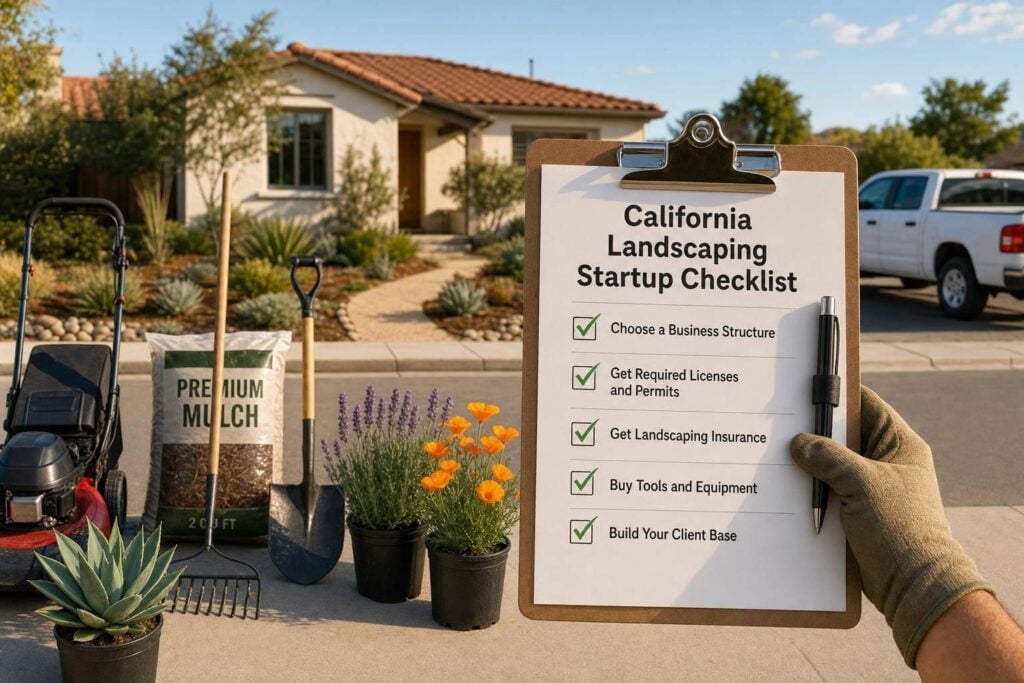
About This Guide
This comprehensive, step-by-step guide outlines the process of starting, operating, and growing a landscaping business in California. It highlights critical California-specific regulatory frameworks, including the Contractors State License Board (CSLB) licensing rules, tax considerations, and environmental regulations like water-efficiency standards.
sbb-itb-5b82b38
Business Formation Steps
- Choose a Business Structure: Decide whether you will operate as a Sole Proprietorship, Partnership, Limited Liability Company (LLC), or Corporation.
- Select and Register Your Business Name: Run a name search on the California Secretary of State website (bizfile Online). If operating as a sole proprietorship under a name other than your own, file a Fictitious Business Name (FBN) statement with your local county clerk.
- Form Your Business Entity: If establishing an LLC, file the Articles of Organization (Form LLC-1) via bizfile Online for a $70 filing fee. File the Statement of Information (Form LLC-12) within 90 days for a $20 fee.
- Obtain a Federal Employer Identification Number (EIN): Apply online through the IRS website for tax and hiring purposes.
- Register with California Tax Authorities: Register with the California Employment Development Department (EDD) if hiring employees, and obtain a seller’s permit from the California Department of Tax and Fee Administration (CDTFA) if selling taxable goods.
- Open a Dedicated Business Bank Account: Keep business finances completely separate from personal assets.
- Apply for local municipal business licenses with the city or county where your business operates.
Legal Requirements
- Business Entity Compliance: Registering the business and maintaining an active standing with the California Secretary of State. LLCs formed in California are subject to an annual $800 minimum franchise tax.
- AB 5 Independent Contractor Compliance: Under California’s strict ‘ABC’ test for employment classification, field crew members, installers, and maintenance workers must almost always be classified as W-2 employees rather than 1099 independent contractors.
- Model Water Efficient Landscape Ordinance (MWELO): Landscaping businesses must comply with MWELO regulations for design and installation projects exceeding 500 square feet (new construction) or 2,500 square feet (rehabilitated landscapes) that require a permit, enforcing strict water calculations and hydrozone planning.
- Registered Agent: All registered corporate entities must maintain a registered agent with a physical address in California.
Licensing and Permits
- C-27 Landscaping Contractor License: Issued by the California Contractors State License Board (CSLB), this license is legally required for any landscaping project where the combined cost of labor and materials exceeds $1,000 (increased from $500 as of January 1, 2025). Candidates must prove 4 years of journeyman-level experience (up to 3 years can be substituted with an accredited degree), pass the Law & Business and C-27 Trade exams, and submit fingerprints.
- Qualified Applicator License (QAL) or Certificate (QAC): Issued by the California Department of Pesticide Regulation (DPR). Required if your business applies restricted-use pesticides, herbicides, or weed control as part of landscape maintenance.
- City/County Business Licenses: General tax certificates required by local municipal governments where your business physically operates or services clients.
- Seller’s Permit: Required by the CDTFA if you sell physical goods (such as plants, sod, or soil) directly to end-consumers.
Insurance Requirements
- Workers’ Compensation Insurance: Mandatory for any business with one or more employees. Under California Labor Code 3700.5, operating without it is a criminal misdemeanor. Workers’ comp is also a prerequisite for active C-27 license status with the CSLB if you employ staff.
- Contractor License Bond: A $25,000 contractor bond filed with the CSLB is required to active your license.
- LLC-Specific Surety Bond (if applicable): If operating as an LLC, California requires an additional $100,000 employee/worker surety bond to protect employees against unpaid wages and benefits.
- Commercial General Liability Insurance: While not universally mandated by the state for all structures, LLC-formed landscaping businesses must maintain a minimum of $1 million in liability insurance (with higher requirements for more than 5 members). It is strongly recommended for all structures to protect against third-party injuries and property damage, and is required for municipal/commercial contracts.
- Commercial Auto Insurance: Protects business vehicles and trucks used to transport heavy landscaping equipment.
Startup Costs
Depending on the scale of operation, typical startup costs range from approximately $13,320 to over $67,600 (or up to $194,550 for larger-scale commercial setups). A modest startup with a reliable used truck, essential commercial mowers, basic tools, business registration, required surety bonds, and licensing exams can expect initial costs of around $13,500 to $16,500. Key mandatory state licensing, business registration, and minimum setup fees include:
- CSLB C-27 Landscape Contractor License Fees: $450 application fee + $200 (sole owner) or $350 (non-sole owner) initial license fee.
- California LLC Filing (Articles of Organization): $70.
- $25,000 Contractor’s License Bond: $100 to $500/year premium (dependent on personal credit).
- General Liability and Commercial Auto Insurance: $1,500 to $4,000/year combined premium.
Typical Initial Investments
A detailed breakdown of significant required investments for launching a landscaping business in California: – Transportation: Commercial truck (used or new: $5,000 – $30,000) and an equipment transport trailer ($1,000 – $5,000).
- Commercial Equipment: Professional zero-turn or walk-behind mowers, trimmers, blowers, and edgers ($3,000 – $15,000).
- Hand Tools and Safety Gear: Shovels, rakes, shears, PPE, and safety equipment ($500 – $2,000).
- State Licensing and Bond Fees: CSLB C-27 application and exam fees ($650 – $800), fingerprinting ($75), and $25,000 Surety Bond premium ($100 – $500/year). If registering an LLC, there is also a $100,000 LLC Employee/Agent Bond premium ($400 – $1,000/year).
- Insurance: Commercial General Liability ($1,000 – $3,000/year), Commercial Auto ($1,500 – $4,000/year), and Workers’ Compensation (typically $4,000 – $9,000 per $100k of payroll).
- Business Formation & Local Permits: California LLC filing fee ($70) and municipal business licenses ($50 – $500 depending on the city).
- Marketing & Brand Setup: Website, local SEO, door hangers, and uniforms ($500 – $2,000).
- Working Capital Reserve: Suggested safety net of $2,700 – $8,100 to buffer cash flow through seasonal revenue cycles.
Estimated Setup Time
Typical Time to Launch: Typically 6 to 9 months. While registering the business entity can be completed in a few days, obtaining the mandatory C-27 Landscape Contractor license from the CSLB usually takes several months due to the application review, exam scheduling, and bonding processes.
State Regulations and Compliance
Starting and running a landscaping business in California involves strict compliance with state regulatory bodies: 1. CSLB C-27 Landscape Contractor License: Required for any landscape job where the combined labor and material cost is $1,000 or more (increased from $500 as of January 1, 2025, under Assembly Bill 2622). Requirements include being 18+ years old, proving 4 years of journeyman-level experience in the past 10 years, passing state Law and Trade exams, and holding a $25,000 Contractor’s License Bond. 2. Pesticide & Herbicide Application: If your business applies chemicals, you must secure a Qualified Applicator License (QAL) or Qualified Applicator Certificate (QAC) Category B (Landscape Maintenance) from the California Department of Pesticide Regulation (DPR). This requires passing exams and completing 20 hours of continuing education every 2 years.
3. Model Water Efficient Landscape Ordinance (MWELO): Under updated regulations, projects involving new landscapes over 500 sq ft or renovations over 2,500 sq ft that require a permit must adhere to MWELO water budget (MAWA) calculations and hydrozone planning.
4. Labor and Tax Compliance: – AB 5 Worker Classification: Landscape crews must be classified as W-2 employees rather than 1099 independent contractors if they carry out core business operations. – Workers’ Compensation: Mandated by the state from the hire of your first employee, with strict criminal and CSLB penalties for non-compliance. – State Taxes: California LLCs are subject to an annual franchise tax of $800. Businesses must register for a CDTFA Seller’s Permit if reselling plants, soils, or hardscape materials, and pay payroll taxes via the Employment Development Department (EDD). – General Liability: If operating as an LLC with a C-27 license, you must carry a minimum of $1 million in general liability coverage.
Marketing and Growth Tips
- Specialize in Drought-Tolerant Landscaping (Xeriscaping): Position your business as a leader in water conservation. Specialize in drought-tolerant designs, native California plant palettes, and smart irrigation systems to align with state water conservation cultures and strict MWELO regulations.
- Invest in Commercial Fleet Branding: High-visibility vehicle wraps on your trucks and trailers act as moving billboards in the local communities you service.
- Offer Multi-Season Packages: Secure predictable, recurring revenue by packaging routine lawn care and seasonal cleanups into flat-rate monthly maintenance agreements.
- Certifications & Memberships: Join the California Landscape Contractors Association (CLCA). Earning specialized water-management certifications through CLCA establishes immediate credibility.
- Digital Estimating and Invoicing: Use modern field service management software to send instant, professional digital quotes and accept credit card payments, streamlining operations and maximizing customer convenience.
Client Acquisition Strategies
- Local SEO and Google Business Profile: Optimize your online profile with photos of completed landscaping projects, physical address, and service area to capture local homeowners searching for landscaping services.
- Direct-to-Consumer Neighborhood Marketing: Use localized flyers, door hangers, and yard signs (with permission) in target high-end neighborhoods.
- Establish Strategic Partnerships: Build relationships with local real estate agents, property management companies, home builders, and general contractors who regularly need landscaping services for their properties.
- Commercial Contract Bidding: Develop professional proposals to bid on recurring commercial maintenance work for office parks, retail centers, and homeowner associations (HOAs).
- Leverage Review Platforms: Solicit positive reviews on Google, Yelp, and Nextdoor from initial clients to build trust.
Helpful Local Resources
- California Contractors State License Board (CSLB)
- California Landscape Contractors Association (CLCA)
- California Office of the Small Business Advocate (CalOSBA)
- California Department of Pesticide Regulation (DPR)
- California Small Business Development Center (SBDC) Network