


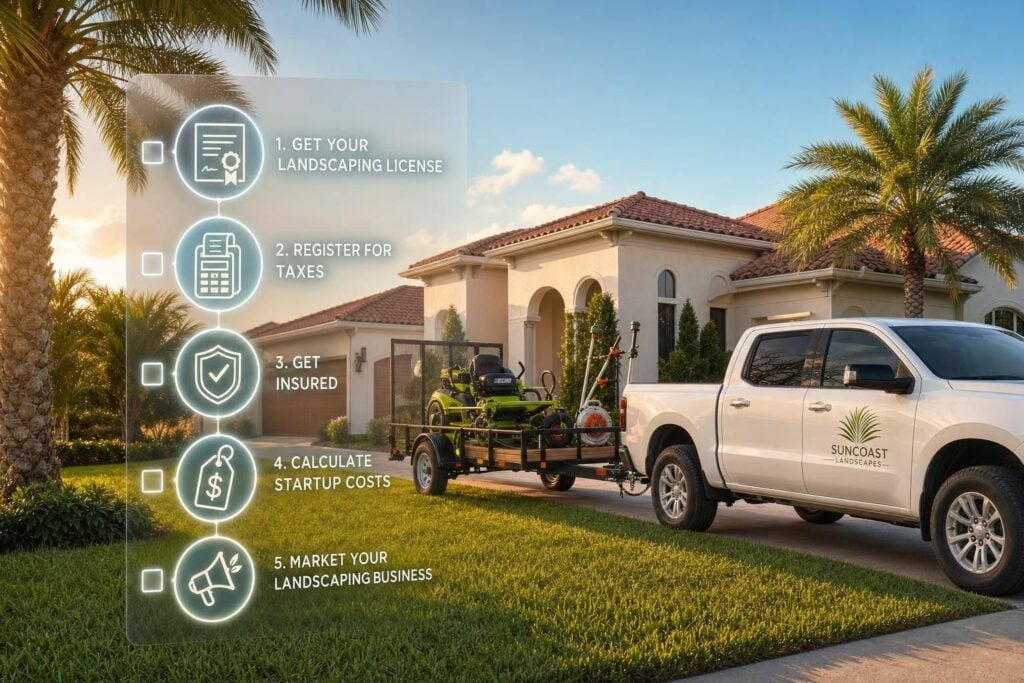
About This Guide
A comprehensive guide to starting and operating a legally compliant, profitable landscaping and lawn care business in Florida. This resource covers entity formation, specific state licensing for pesticide and fertilizer application, insurance mandates, tax rules, and local marketing strategies.
sbb-itb-5b82b38
Business Formation Steps
- Choose a Business Structure: Decide on your business entity type, such as a Sole Proprietorship, Limited Liability Company (LLC), or Corporation. Most new landscaping businesses opt for an LLC to protect personal assets from business liabilities.
- Name Your Business and Register on Sunbiz: Search the official Florida Department of State Division of Corporations database (Sunbiz.org) to ensure your desired business name is unique and available. If registering an LLC, file your Articles of Organization online through Sunbiz. The filing fee is $125.
- Register a DBA (Doing Business As): If you plan to operate under a name other than your legal business name (especially for Sole Proprietorships), file a Fictitious Name Registration on Sunbiz.
- Obtain a Federal EIN: Apply for a free Employer Identification Number (EIN) on the official IRS website. You will need this to open business bank accounts, hire employees, and file federal taxes.
- Register with the Florida Department of Revenue: Register online to establish your state tax accounts. Landscaping services have specific sales tax rules. Lawn mowing, edging, and trimming are generally non-taxable services. However, under Florida tax law, physical plants, trees, and mulch installed in the ground are considered improvements to real property. The landscaper is treated as the final consumer of those materials, meaning you must pay sales tax to your supplier and should not charge sales tax to the customer’s final bill.
- Open a Business Bank Account: Separate your personal and professional finances by opening a dedicated business checking account using your EIN and filing documents.
Legal Requirements
- Business Entity Registration: All structured businesses (LLCs, corporations) must register and maintain an active status with the Florida Division of Corporations (Sunbiz).
- Local Zoning and HOA Laws: Landscaping businesses storing large commercial trailers, mowers, and chemical fertilizers at home must comply with local city/county zoning codes and individual HOA bylaws regarding commercial vehicle parking and chemical storage.
- Local Business Tax Receipt (BTR): Most Florida counties and municipalities require business owners to obtain a local Business Tax Receipt (formerly known as an occupational license) before operating within their jurisdiction.
- Distinction from Landscape Architecture: In Florida, you can design plant plans, install plants, and perform maintenance without a professional state license. However, if your business designs landscape grading, drainage systems to prevent runoff, or erosion control, you are legally performing Landscape Architecture, which requires a professional license from the Florida Department of Business and Professional Regulation (DBPR). Do not use the title ‘Landscape Architect’ unless licensed by DBPR.
Licensing and Permits
Florida does not have a general statewide ‘landscape contractor’ license. However, specific operational licenses are strictly regulated by the Florida Department of Agriculture and Consumer Services (FDACS):
- Limited Urban Commercial Fertilizer Applicator Certification (LF License): Required for anyone applying fertilizer to lawns or landscapes for money. To get this, you must first complete the Green Industries Best Management Practices (GI-BMP) training class (costing $15–$30) and pass the exam with at least 75%. Once certified, you apply to FDACS and pay a $25 fee (valid for 4 years).
- Limited Certification for Commercial Landscape Maintenance (Pesticide License): Authorized under F.S. s. 482.156, this limited pest control license allows you to apply basic herbicides (like Roundup) to weeds in plant beds, driveways, sidewalks, and patios using handheld or backpack sprayers only (no power equipment). Applicants must pass an FDACS exam ($150 fee) and provide proof of qualifying insurance.
- Lawn and Ornamental Pest Control License: If you plan to apply restricted-use pesticides, treat turf/lawns for pests, or use power spraying equipment, you must obtain a full commercial pest control category license from FDACS, which requires passing the Core and Ornamental & Turf exams ($300 exam fee) and acquiring a $300 business pest control license.
- Local County/Municipal Licenses: Some Florida counties require proof of your GI-BMP certificate or local landscaper registration before issuing local business permits.
Insurance Requirements
- Workers’ Compensation Insurance: Florida law mandates workers’ compensation for any non-construction business with 4 or more employees. However, for landscaping and pest control businesses, having even one employee or applying certain chemical certifications requires carrying proof of coverage to protect your crew.
- General Liability Insurance: While not mandated by Florida law for basic lawn care, carrying general liability (typically $1M/$2M limits) is highly recommended. Many commercial properties and high-end residential HOAs will not allow you on-site without a Certificate of Insurance (COI). Furthermore, to obtain certain FDACS pest control certifications, you must show proof of minimum financial responsibility for bodily injury and property damage.
- Commercial Auto Insurance: Personal auto policies do not cover business activities. You need commercial auto insurance for any trucks, trailers, or vans hauling heavy mowers and equipment.
Startup Costs
Lean startup costs typically range from $1,000 to $15,000, while a fully equipped launch with commercial-grade mowers, trailers, and initial overhead usually ranges between $11,200 and $134,400 (with a median estimate around $44,800).
Typical Initial Investments
Typical initial investments include: – Entity Formation & Licensing: $125 for Florida LLC registration; $30 – $190 for County Local Business Tax Receipts; $150 exam fee + $75 renewal for LCLM pesticide license.
- Commercial General Liability Insurance: $600 – $1,500/year (minimum $500,000 coverage required for chemical applications).
- Commercial Auto & Equipment Insurance: $2,400 – $2,500/year for service vehicles; $500 – $1,500/year for inland marine/equipment coverage.
- Equipment & Transportation: Mowers, trimmers, blowers, hand tools, and a trailer (which must be titled with the FLHSMV if over 2,000 lbs): $5,000 – $15,000+ depending on whether commercial-grade and new or used.
Estimated Setup Time
Typical Time to Launch: 2 to 4 weeks. This timeline accounts for filing business entity documents on Sunbiz (typically processed in 1-3 business days online), obtaining an EIN instantly, taking the prerequisite GI-BMP course, obtaining state agricultural licenses, securing business insurance, and opening a commercial bank account.
State Regulations and Compliance
Key state regulations and compliance requirements in Florida include: 1. Business Entity Registration: Registering an LLC or Corporation via Sunbiz.org (Florida Division of Corporations) costs $125.
2. Local Business Tax Receipts: Obtaining local county and municipal tax receipts (ranging from $30 to $190 annually, typically due by September 30).
3. Pesticide & Herbicide Certification: Applying any pesticide or herbicide commercially requires a Limited Certification for Commercial Landscape Maintenance (LCLM) or Commercial Applicator License through the Florida Department of Agriculture and Consumer Services (FDACS). This requires passing an exam (up to $150) and carrying $500,000 in liability insurance.
4. Fertilizer License: Any commercial fertilizer application requires a Green Industries Best Management Practices (GI-BMP) training certificate and a $25 LF license from FDACS.
5. Irrigation Contractor License: Major irrigation installations require certification under the Department of Business and Professional Regulation (DBPR) Construction Industry Licensing Board (CILB).
6. State Taxes: Florida imposes a 6% state sales tax. Basic services like mowing and edging are non-taxable, but installing tangible property (plants, mulch, pavers) makes the landscaper the final consumer, requiring sales tax to be paid to suppliers.
7. Workers’ Compensation: Required if you have 1 or more employees (under construction-related classifications for landscaping in Florida, NCCI 0042).
Marketing and Growth Tips
- Upsell Core Services into Tiered Packages: Instead of offering one-off mows, convert customers into recurring contracts by bundling packages. For example: ‘Bronze’ (mow, edge, blow), ‘Silver’ (adds shrub trimming and weed control), and ‘Gold’ (adds seasonal fertilization, mulch replenishment, and hurricane yard prep).
- Emphasize Florida-Friendly Landscaping: Leverage Florida’s unique climate by marketing water-saving, drought-tolerant native plants. Certifying your designs under the UF/IFAS Florida-Friendly Landscaping program is a great differentiator for eco-conscious homeowners.
- Earn the FCLC Designation: Distinguish your brand by earning the Florida Certified Landscape Contractor (FCLC) credential from the Florida Nursery, Growers and Landscape Association (FNGLA) to prove elite professional standards.
- Maximize Summer Operations: Florida’s rainy summer season means grass grows rapidly, necessitating weekly mows. Optimize your crew scheduling, keep spare mower blades sharp to prevent turf disease, and ensure your team stays hydrated.
Client Acquisition Strategies
- Google Local Services Ads (LSA): Run pay-per-lead ads to acquire the Google Guaranteed badge. It positions your business at the very top of local search results, and you only pay when a customer calls you directly.
- Google Business Profile (GBP): Optimize your free listing with professional photos of your Florida lawns, native landscape installations, and collect positive reviews from early clients to win local map pack views.
- Local Route Density Door-Hanging: Once you secure a client in a neighborhood, hang flyers or knock on neighboring doors. Creating dense routes minimizes travel time, which is critical during hot Florida summers.
- Partner with Real Estate Agents and HOAs: Connect with local realtors who need quick curb-appeal upgrades for homes going on the market, or partner with Homeowners Associations (HOAs) which govern many Florida neighborhoods and require strict lawn maintenance compliance.
- Commercial B2B Networking: Join local business groups (like BNI) to pitch property managers, commercial plazas, and office parks for lucrative recurring maintenance contracts.
Helpful Local Resources
- Florida Small Business Development Center (SBDC) Network (provides no-cost business consulting, financial planning, and advisory boards)
- University of Florida Institute of Food and Agricultural Sciences (UF/IFAS) Extension Offices (offers GI-BMP training and agricultural exam resources)
- Florida Department of Agriculture and Consumer Services (FDACS) (handles pest control, commercial fertilizer, and pesticide licensing)
- Florida Nursery, Growers and Landscape Association (FNGLA) (provides industry networking and the Florida Certified Landscape Contractor professional certification)
- Florida Department of State Division of Corporations (Sunbiz.org) (the official state portal for business registration and fictitious names)