


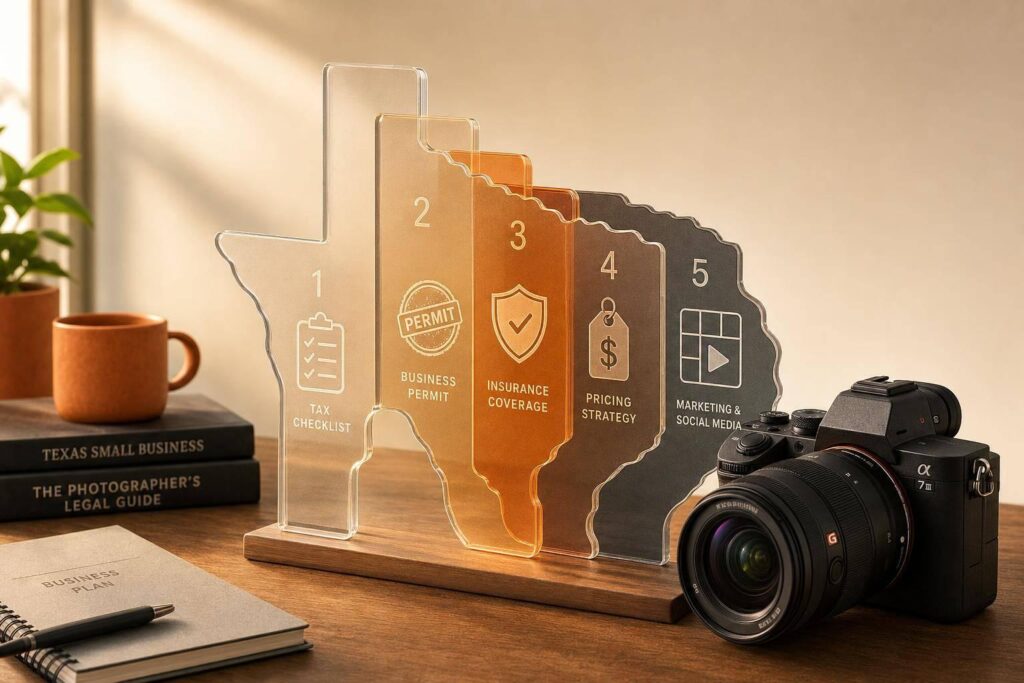
About This Guide
A practical Texas launch guide for a freelance or studio photography business, covering entity selection, assumed-name registration, federal and state tax setup, taxable photography transactions, local compliance, insurance, contracts, startup budgeting, client acquisition, and growth. Texas Comptroller guidance specifically lists photography and videography among taxable services and requires a sales-tax permit for businesses engaged in taxable sales or services.
sbb-itb-5b82b38
Business Formation Steps
- Define the niche, service area, pricing, equipment plan, and startup budget (for example, portraits, weddings, commercial, real-estate, or events).
- Choose a structure: operate as a sole proprietor/partnership, or form an LLC/corporation through the Texas Secretary of State. Sole proprietors and partnerships generally file an assumed name (DBA) with the county clerk; an LLC provides a separate legal entity and requires a certificate of formation.
- Obtain a federal EIN from the IRS if forming an LLC/corporation, hiring employees, or otherwise required; the Texas Secretary of State does not issue EINs.
- Register for a Texas sales and use tax permit with the Comptroller. Texas identifies photography and videography as taxable services in circumstances covered by its taxable-services guidance; the permit itself has no fee, although a security bond may be required.
- Register for any applicable employer, franchise-tax, and other state tax accounts, and maintain bookkeeping for taxable receipts, exemptions, and returns.
- Check city and county requirements for a local business certificate, assumed-name filing, home-occupation/zoning approval, venue permits, and commercial-location rules. Texas has no general statewide business license, but local or activity-specific authorizations may apply.
- Obtain insurance, execute client contracts and model/property releases, set up a business bank account, website, payment processing, backup/storage procedures, and launch.
Legal Requirements
There is no general Texas business license, but the business must identify and satisfy activity-specific and local requirements. Register the chosen entity or file an assumed name as applicable; maintain a Texas registered agent and registered office for an LLC/corporation; obtain an EIN when required; register for and collect/remit sales tax on taxable photography-related sales; keep records and file returns; and comply with federal, state, county, city, zoning, home-occupation, venue, and employment rules. Use written contracts addressing scope, payment, cancellation, delivery, image usage/licensing, copyright ownership, model/property releases, rescheduling, liability, and privacy. Obtain permissions for commercial use of locations and identifiable people/property when appropriate. Texas sales tax can include the 6.25% state rate plus applicable local tax, subject to the Comptroller’s rules and rate locator.
Licensing and Permits
No Texas state professional photography license is generally listed or required for ordinary photography services, and Texas has no general statewide business license. Required or potentially required registrations/permits include: a Texas sales and use tax permit when selling taxable photography services, prints, albums, physical products, or other taxable items; an assumed-name/DBA filing if operating under a name other than the owner’s or entity’s legal name; entity registration if forming an LLC/corporation; and any city/county permits, home-occupation approval, zoning clearance, park/public-property permit, venue authorization, or special-event/vendor permit applicable to the location and assignment. Confirm requirements with the relevant city and county before operating.
Insurance Requirements
Texas generally does not require a solo photographer to carry a particular commercial insurance policy solely because the business operates; workers’ compensation is generally not mandatory for most private Texas employers, but requirements and contractual expectations should be checked. Strongly consider commercial general liability, business-property/equipment coverage, inland-marine or mobile-equipment coverage, professional liability/errors-and-omissions where advice or deliverables create exposure, commercial auto or hired/non-owned auto coverage when applicable, and cyber/data coverage. Venues, landlords, lenders, and clients may require certificates of insurance. If employees are hired, review workers’ compensation and employment-related coverage with a Texas-licensed agent.
Startup Costs
Typical initial investment: approximately $2,800–$9,500 before optional studio rent, vehicle costs, payroll, or marketing. This combines estimated equipment/startup costs of $2,000–$8,000, the $300 Texas LLC formation fee, and approximately $500–$1,200 per year for general liability and equipment insurance.
Typical Initial Investments
Camera bodies, lenses, lighting, computers, storage, software, and other equipment/startup supplies: $2,000–$8,000; Texas LLC formation: $300; general liability plus equipment/inland-marine coverage: approximately $500–$1,200 annually. Add local permit fees, sales-tax registration/compliance, studio lease deposit and rent if applicable, website/branding/marketing, transportation, and optional drone/FAA costs based on the business model.
Estimated Setup Time
Typical Time to Launch: About 2–6 weeks for a lean home-based launch if equipment and portfolio already exist; about 1–3 months for a new studio, substantial equipment purchases, branding, venue relationships, and local approvals. Entity filing, EIN, tax registration, website setup, and insurance can often proceed in parallel. Actual timing varies by city, business structure, financing, and readiness.
State Regulations and Compliance
Texas has no statewide general business license and no state photography-specific license, but local city or county licensing, zoning, and permit requirements may apply. Form the business with the Texas Secretary of State or county clerk, as appropriate; a Texas LLC Certificate of Formation costs $300. Register for a Texas sales-tax permit through the Comptroller and collect/remit tax on taxable photography sales and deliverables; verify whether the particular service or digital/physical product is taxable. Commercial drone work requires the federal FAA Part 107 Remote Pilot Certificate and drone registration. Commercial shoots on state parks, museums, public property, or other controlled locations may require location permits. LLCs are subject to Texas franchise-tax reporting, and local requirements should be checked with the relevant city or county.
Marketing and Growth Tips
Build a recognizable niche and consistent visual brand; publish Texas-city and venue-specific portfolio pages; optimize Google Business Profile and collect verified reviews; use Instagram, TikTok, Pinterest, and local wedding/event or real-estate networks according to the niche; publish useful planning content and behind-the-scenes work; and partner with venues, planners, agents, boutiques, nonprofits, and small businesses. Track inquiries, booking rate, average order value, acquisition source, and repeat/referral rate. Protect margins by pricing editing, travel, assistants, prints, albums, rush delivery, and licensing separately. Add recurring revenue through headshot days, quarterly brand sessions, school/team work, property packages, or commercial retainers, while using SBDC advising to validate the plan and improve sales.
Client Acquisition Strategies
Start with a tightly defined Texas service area and portfolio. Build referral relationships with wedding venues, planners, real-estate agents, event businesses, chambers of commerce, schools, and complementary vendors. Use a Google Business Profile, location-specific service pages, social channels, reviews, and searchable portfolio galleries. Offer introductory mini-sessions or a limited launch package in exchange for permission to publish work and obtain reviews; follow up with referral incentives and repeat-client packages. Use Texas SBDC no-cost confidential consulting to test pricing, develop a business plan, improve sales, and identify financing or market opportunities.
Helpful Local Resources
- Texas Economic Development & Tourism Office / Business Permit Office — statewide business-startup and permit guidance
- Texas Secretary of State — entity formation and registration information
- Texas Comptroller of Public Accounts — sales-tax permit, taxable-services, filing, and local-tax guidance
- Internal Revenue Service — EIN and federal tax information
- Texas Small Business Development Center Network — no-cost confidential advising and affordable training through more than 40 Texas centers
- The city clerk, county clerk, planning/zoning office, and local chamber of commerce in the photographer’s operating location