About This Guide
A practical Florida startup guide for an independent personal trainer, covering entity selection, state and local registrations, credentials, insurance, health-studio-law screening, client acquisition, and launch. Florida does not appear to require a standalone state personal-trainer license, but local business requirements and the business model still matter. Florida law expressly excludes an individual acting as a personal trainer from the statutory definition of “health studio” when the listed conditions apply.
sbb-itb-5b82b38
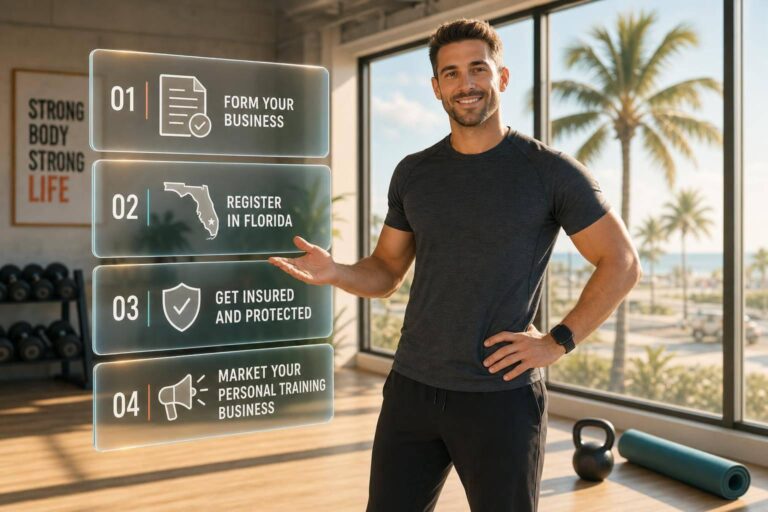
Business Formation Steps
- Define the service model (mobile, in-home, gym-based, studio, or online), target market, pricing, and whether you will operate as a sole proprietor or LLC.
- Choose and search a business name; if forming an LLC, file Florida Articles of Organization through the Division of Corporations/Sunbiz. Florida’s listed LLC filing charges are $100 for Articles of Organization and $25 for registered-agent designation.
- Obtain an IRS EIN if required for the chosen structure, employees, or banking, and open a separate business bank account and bookkeeping system.
- Register with the Florida Department of Revenue when your activities create a state tax-registration obligation; review the Florida Business Tax Application.
- Check the county and city where services are delivered for a local business tax receipt, zoning/home-occupation rules, and any local permits. Florida’s startup guide specifically directs businesses to local governments for these requirements.
- Obtain appropriate personal-training credentials, CPR/AED training, client contracts, informed-consent and health-screening forms, and insurance before accepting clients.
- Confirm whether the operation is exempt from or subject to Florida’s Health Studio Law before selling packages or memberships, then launch only after all applicable registrations and local requirements are complete.
Legal Requirements
Use a compliant business structure and registered agent if forming an LLC, maintain accurate contracts and records, and comply with federal, state, county, and city rules. Confirm local business-tax, zoning, and home-occupation requirements because Florida states that licensing and permit obligations vary by business activity and location. Do not represent yourself as providing medical treatment or physical therapy unless separately licensed. Screen clients appropriately, use informed consent and assumption-of-risk language reviewed by counsel, protect health information, and maintain incident procedures. Florida’s Health Studio Law is the key special issue: a qualifying individual personal trainer is excluded from the definition of health studio, but a business with an established exercise facility or longer-term/prepaid arrangements may not qualify for that exclusion.
Licensing and Permits
No Florida state-issued personal-trainer occupational license is identified in the sources reviewed. Obtain any county or city local business tax receipt and applicable zoning/home-occupation approval; Florida’s official guide says local requirements must be checked directly with the relevant government. CPR/AED certification and a nationally recognized personal-training certification are not the same as a state license, but are important professional and facility requirements. If operating an exercise studio or selling covered health-studio services, investigate FDACS registration, annual fees, disclosures, and security requirements; Florida law requires health studios to register and pay an annual $300 fee per location.
Insurance Requirements
Florida generally does not legally mandate personal-trainer liability insurance based on the sources reviewed, but general liability and professional liability insurance are strongly recommended and are commonly required by gyms or facilities for independent contractors. Consider coverage for participant injury claims, professional advice, products/completed operations, personal and advertising injury, and damage to rented premises. If hiring employees, evaluate Florida workers’ compensation obligations and other employment-related coverage; ask an insurance professional to confirm limits and exclusions.
Startup Costs
Estimated launch costs range from approximately $5,150 to $103,000, with a median estimate around $25,750. A lean mobile or gym-based operation can start near $5,000-$10,000, while a private studio requires substantially more capital.
Typical Initial Investments
Typical investments include: certification and continuing education approximately $500-$1,500 initially (broader estimates reach $515-$5,150); CPR/AED certification about $40-$100; mobile training equipment roughly $500-$3,000, versus $10,000-$50,000 for a private studio setup; Florida LLC filing $125; professional liability insurance commonly about $150-$400 annually or approximately $45-$140 per month depending on coverage; general liability coverage about $60-$180 per month; software and online booking roughly $20-$100 per month plus possible website costs of $500-$2,000; marketing approximately $515-$2,060 for an initial campaign; and working-capital reserves for roughly two to three months. A private studio may add a $1,000-$3,000 monthly lease, while gym rental or partnership fees may range from about $300-$1,000 per month.
Estimated Setup Time
Typical Time to Launch: Approximately 2–6 weeks for a straightforward solo, mobile, or contractor model; allow 1–3 months if leasing a studio, hiring staff, obtaining build-out or local approvals, or resolving Health Studio Law registration questions. The estimate is a practical planning range rather than a statutory processing time: the core LLC filing, local checks, credential/CPR completion, insurance, contracts, and marketing can be completed in parallel.
State Regulations and Compliance
Florida law defines a personal trainer separately from a health studio; an individual acting as a personal trainer is excluded from the statutory health-studio definition. A standalone personal trainer generally does not need a Florida statewide occupational license solely to provide training, but should verify city and county requirements. Most Florida counties require a local business tax receipt, and some cities require an additional city receipt, including for home-based businesses. If the operation qualifies as a health studio rather than an individual personal-training practice, it must register each location with the Florida Department of Agriculture and Consumer Services, pay a $300 annual registration fee per location, file the required security, and maintain active registration before a local business tax receipt can be issued or renewed. Business owners must also handle federal income, estimated-tax, and payroll obligations as applicable; Florida has no personal income tax for pass-through LLC owners. Trainers should maintain current certification and CPR/AED credentials, obtain professional/general liability insurance, use client waivers and service agreements, and check commercial-permit requirements for public-park training.
For the full step-by-step, see our gym and fitness website examples guide.
Marketing and Growth Tips
Create a location-specific website and Google Business Profile, publish educational content addressing local clients’ goals, and make booking and cancellation policies clear. Use before-and-after claims cautiously and secure written consent for testimonials and images. Partner with complementary local businesses, run small introductory workshops or outdoor sessions where permitted, and track consultations, conversion rate, retention, referrals, and revenue per client. Reinvest in continuing education, CPR/AED renewal, scheduling/payment software, and documented programs. As demand grows, add recurring services only after checking whether packages, memberships, a dedicated facility, or advance payments change the Health Studio Law analysis.
Client Acquisition Strategies
Start with a narrowly defined niche—such as beginner strength training, older-adult fitness, weight management, or post-gym coaching—and offer an introductory assessment or limited trial session. Build referral relationships with gyms, apartment communities, physical therapists, wellness providers, employers, and sports clubs; obtain written permission before using testimonials or progress photos. Claim and optimize a Google Business Profile for the service area, publish useful local fitness content, and use neighborhood social groups and referral incentives. A recognized credential and CPR/AED certification can improve credibility with Florida gyms and prospective clients. Avoid prepaid arrangements that could trigger Health Studio Law issues until the legal classification is confirmed.
Helpful Local Resources
- Florida Department of State, Division of Corporations (Sunbiz) — LLC formation and Articles of Organization
- Florida Department of Revenue — business-tax registration and Florida Business Tax Application
- Florida Department of Agriculture and Consumer Services, Division of Consumer Services — Health Studio registration and exemption information
- Open My Florida Business — state startup guide and links to local licensing contacts
- County tax collector and city/municipal government where the trainer operates — local business tax receipt, zoning, and permit checks
- Florida Small Business Development Center Network — no-cost or low-cost startup counseling and local assistance