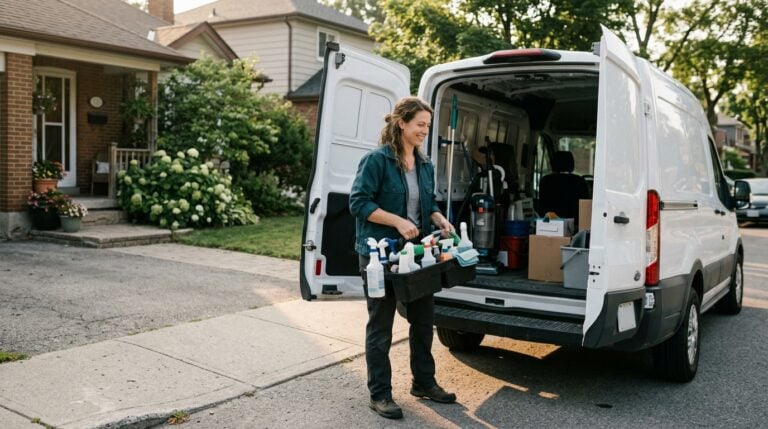
Cleaning is one of the few businesses you can start with a few hundred dollars of supplies and a first paying customer in the same week. The parts that actually stop people are not the mop and bucket. They are choosing a structure, working out which licenses your state wants, getting insured, pricing so the work is worth doing, and finding customers who are not just your neighbors. This is how to start a cleaning business in that order, with the state-specific part handled separately, because that is the part where general advice is usually wrong.
Key takeaways
- Licensing is the part that changes at the state line. The SBA says most small businesses need “a combination of licenses and permits from both federal and state agencies”, and that requirements “vary based on your business activities, location, and government rules”.
- Register the business and get insured before the first paid job, not after it goes wrong.
- Price per job with a target hourly rate behind it, rather than guessing an hourly number and hoping.
- Your first customers come from people who already know you and from being findable locally. Neither needs an ad budget.
- We have step-by-step licensing guides for 14 states, linked in full below.
Decide what kind of cleaning business you are starting
Pick one of residential or commercial before you do anything else, because almost every later decision follows from it.
Residential cleaning means houses and apartments, usually recurring weekly or every two weeks visits, paid by the household. You can start alone, the equipment is cheap, and you can win your first customer without a website. The trade-off is that you are selling to hundreds of individuals, and each one is a small ticket.
Commercial cleaning means offices, retail units, gyms and similar, usually on a contract, usually outside business hours. Contracts are larger and steadier, but the sales cycle is longer, the insurance expectations are higher, and buyers often want to see that you already have staff and a track record.
There are narrower trades inside cleaning too, including carpet, window and pool cleaning. Each needs its own equipment and sometimes its own licensing, so treat those as separate businesses rather than as add-ons on day one.
If you are undecided, start residential. It is the cheapest way to find out whether you like the work and whether you can sell it.
Register the business and pick a structure
Register before you take money, because the structure decides who is liable when something goes wrong. This is the first paperwork step in how to start a cleaning business, and it is quick.
A sole proprietorship is the default if you do nothing: no filing, no separation between you and the business, and personal liability for anything that happens on a job. An LLC puts a legal boundary between your business and your personal assets, and it is what most operators choose, because you are working unsupervised inside other people’s property. Be clear about what it does not do: an LLC does not shield you from claims arising out of your own work. That is what insurance is for, which is the next section and not an optional one.
The practical sequence is to choose the structure, register with your state, get an EIN from the IRS if you will have employees or want to keep business banking clean, and open a separate business bank account. Mixing personal and business money is an easy habit to fall into in a first year, and a tedious one to unpick later.
What licenses are needed to start a cleaning business?
That depends on your state, and there is no honest national answer. It is the one part of how to start a cleaning business where a national guide cannot help you much.
The Small Business Administration puts it plainly: most small businesses need “a combination of licenses and permits from both federal and state agencies”, and the “requirements and fees vary based on your business activities, location, and government rules”.
For cleaning specifically, the things that vary are a general business license or registration, a sales tax permit where your state taxes cleaning services (some do, some do not), a doing-business-as filing if you trade under a name that is not your own, and occasionally a specific vendor or contractor registration at city or county level. Some states add requirements once you hire employees or handle particular chemicals.
Because that list changes materially at the state line, we maintain separate step-by-step guides rather than one national answer that would be wrong in most places. Find yours below.
How to start a cleaning business in your state
Each guide covers registration, licensing and the local specifics for that state.
- Start a cleaning service in Arizona
- Start a cleaning service in California
- Start a cleaning service in Florida
- Start a cleaning service in Georgia
- Start a cleaning service in Illinois
- Start a cleaning service in Michigan
- Start a cleaning service in New Jersey
- Start a cleaning service in New York
- Start a cleaning service in North Carolina
- Start a cleaning service in Ohio
- Start a cleaning service in Pennsylvania
- Start a cleaning service in Texas
- Start a cleaning service in Virginia
- Start a cleaning service in Washington
If your state is not listed, go to your state’s own business licensing portal rather than to a national aggregator, and check whether cleaning services are taxable where you are. It is an easy one to miss.
Get insured before the first job
General liability cover is the one that matters, and it is worth having before you hold anyone’s house keys. Of every step in how to start a cleaning business, this is the easiest one to postpone, and the most expensive to have postponed.
The exposure in cleaning is not theoretical: you are working unsupervised in other people’s property, around their possessions, with chemicals and water. A single damaged floor or broken item can cost more than a month of revenue. Many commercial clients will not sign without seeing a certificate, and some residential clients ask too.
Beyond general liability, operators commonly add a janitorial or care, custody and control endorsement for damage to property you are actively working on, a surety or fidelity bond if you want to advertise as bonded, and workers’ compensation once you hire, which most states require. Premiums vary enough by state, revenue and payroll that any single figure you read online is close to meaningless for your situation, so get two or three real quotes rather than budgeting from an article.
How to price the work when you start a cleaning business
Quote per job, but build every quote backwards from the hourly rate you need.
Hourly pricing punishes you for getting faster, which is the opposite of what you want. Per-job pricing means a quicker, better-equipped cleaner earns more per hour, which is the whole point of getting good at it.
The arithmetic is straightforward. Decide the hourly rate your time is worth, estimate honestly how long the job takes including travel and setup, add your consumables, then add margin for the jobs that overrun, because some will. Where new operators lose money is forgetting unbilled time: driving between jobs, buying supplies, answering messages, chasing invoices. A day with five hours of cleaning in it is rarely a five-hour working day.
Two habits protect the number. Walk through the property before quoting anything recurring, because a first deep clean is not the same job as the visits after it. And set a minimum call-out that makes a short job worth the trip.
How to get clients for a cleaning business
Start with people who already trust you, then make yourself findable, then worry about advertising. Knowing how to start a cleaning business counts for nothing until somebody has paid you to clean something.
Most cleaning businesses begin with a handful of jobs from friends, family, neighbors and former colleagues. That is not a lesser start, it is the fastest route to being paid and to having someone who can vouch for you.
After that, the reliable sources are:
- Referrals from existing customers. Ask directly, once the work has clearly gone well. Cleaning is bought on trust and recurring by nature, so one happy household is worth more than a hundred impressions.
- Local search. People look for a cleaner near them, and if nothing of yours comes up you are invisible at the moment of intent. A simple site and a complete Google Business Profile covers most of this. Our guide to local SEO for small businesses is the practical version.
- Reviews. They do double duty, persuading the person reading and helping you appear at all. Ask every satisfied customer, early, while the job is fresh.
- Neighborhood networks. Local groups and community boards suit cleaning well, because recommendations travel between people who live near each other and want the same visit slot.
Paid advertising can work, but it is the wrong first move when you have no reviews and no site to send people to. Spend the first month getting three happy customers and asking each of them for a review.
Is a cleaning business profitable?
It can be, and the honest answer is that it depends on things you control rather than on the industry. Anyone weighing up how to start a cleaning business deserves a straighter answer than a made-up monthly figure.
We are not going to print a monthly income figure, because any number that ignores your rate, your area, how many recurring clients you hold and whether you employ anyone is closer to decoration than information. What is worth doing is running the arithmetic once with your own inputs, because the structure of it is the same for everyone.
Work it through like this. Decide the hourly rate your time needs to be worth, and call it R. Time a job honestly, door to door, including the drive and the setup, and call that H hours. That job has to bill at least R multiplied by H, plus consumables, before it has earned you anything. Now count how many of those jobs realistically fit in a working week once travel and admin are in it, and call that N. Your weekly revenue is roughly N times the job price, and your monthly figure is about four of those weeks, minus supplies, insurance and fuel.
Two things fall out of that immediately, and they are the reason the arithmetic is worth more than an average. If H is bigger than you assumed, which it usually is on the first few jobs, your effective rate is well below R. And N has a hard ceiling, because there are only so many hours you can physically clean, which is the constraint that eventually forces the choice between raising prices and hiring.
Cleaning is low on fixed costs and high on time. Your revenue is roughly your billable hours multiplied by your effective hourly rate, so profit improves in only three ways: charge more per job, complete jobs faster without cutting quality, or stop giving away unbilled hours. Recurring customers are what turns it from a series of one-off jobs into a business, because you stop paying the acquisition cost every time.
The constraint most people hit is that a solo operator can only clean so many hours a week. Growing past that means hiring, which brings payroll, workers’ compensation in most states, and the harder problem of maintaining quality when you are not the one holding the cloth.
Can you start a cleaning business with no money?
With very little, yes. With literally none, not quite.
The unavoidable costs are your state’s registration or licensing fees and insurance. Both are small next to most business startups, and neither is optional if you want to work legitimately in someone’s home.
Almost everything else can wait. Basic supplies are cheap and many first-time operators start with domestic equipment and upgrade from revenue. You do not need a van, branded uniforms, or commercial machinery to clean a house. Buying those before you have customers is an easy way to spend money you have not earned yet.
Frequently asked questions
What do I need to start a cleaning business?
To start a cleaning business you need a registered business, whatever license your state requires, general liability insurance, basic supplies, a way for customers to find and contact you, and a price you have actually worked out rather than guessed. In that order. The supplies are the cheapest part and the one people over-buy first.
What licenses are needed to start a cleaning business?
It depends on the state. The SBA says most small businesses need a combination of licenses and permits from both federal and state agencies, and that requirements and fees vary by activity and location. For cleaning, the usual pieces are a general business registration, a sales tax permit where cleaning services are taxable, and a DBA if you trade under a different name. Use your state’s guide above.
How to start a cleaning business in my state?
Follow the national steps here for structure, insurance, pricing and customers, then use the state guide above for registration and licensing, since that is the part that genuinely differs. We cover 14 states. If yours is not among them, go to your state’s own licensing portal rather than a national list.
How do I get clients for a cleaning business?
Start with people who already know you, then make sure you appear when someone nearby searches for a cleaner, then ask every happy customer for a review and a referral. Cleaning is bought on trust and repeats by nature, so a small number of delighted regulars beats broad reach. Leave paid ads until you have reviews and somewhere to send people.
How to start a house cleaning business?
The same sequence as any cleaning business, with the residential emphasis: recurring weekly or every two weeks visits, pricing per job rather than per hour, and a first deep clean priced separately from the visits that follow. Residential is usually the cheaper and faster of the two to start.
Is a cleaning business profitable?
It can be. It is low on fixed costs and high on time, so profitability comes from your rate, how efficiently you work, and how many recurring customers you hold rather than from the industry itself. The ceiling for a solo operator is the number of hours you can physically clean, which is the point at which people either raise prices or hire.
How much does a cleaning business make a month?
It depends on your rate, how many jobs fit in your week, and how much of the work is recurring, so a national average would not tell you anything about your own business. Use the method above: set the hourly rate your time needs to be worth, time one job door to door, price that job from those two numbers, then count how many fit in a week and subtract supplies, insurance and fuel. The number that comes out is yours rather than an average.
How much is cleaning business insurance?
It varies by state, revenue, payroll and the cover you choose, so published figures are close to meaningless for any individual business. Get two or three quotes for general liability, and ask specifically about damage to property you are working on, which the base policy may not cover.
Can you start a cleaning business with no money?
Almost. Registration or licensing fees and insurance are the costs you cannot skip. Supplies can start domestic and upgrade from revenue, and a van, uniforms and commercial machines can all wait until customers are paying for them.
Sources
- US Small Business Administration, Apply for licenses and permits, read 31 August 2026.
- UENI cleaning-service state guides, 14 states, linked in full above.