



Want to make your service business unforgettable? Start with your story.
Brand storytelling isn’t just a buzzword – it’s a proven way to connect emotionally with your audience, differentiate yourself in crowded markets, and build trust. Here’s why it works:
- Stories make people feel. They’re 22x more memorable than plain facts.
- Customers trust brands with a clear "why." 81% say trust influences their spending.
- Real-life examples, like Drift and Grado Labs, show how storytelling turns businesses into market leaders.
This guide breaks down how to craft and share your brand story effectively. You’ll learn how to:
- Define your purpose and mission.
- Structure your story using the problem-solution-transformation framework.
- Leverage customer success stories for credibility.
- Share your story consistently across platforms like your website design, social media, and emails.
- Measure your story’s impact with metrics like engagement, loyalty, and conversions.
Bottom line: A strong brand story isn’t just marketing – it’s your edge in a competitive world.

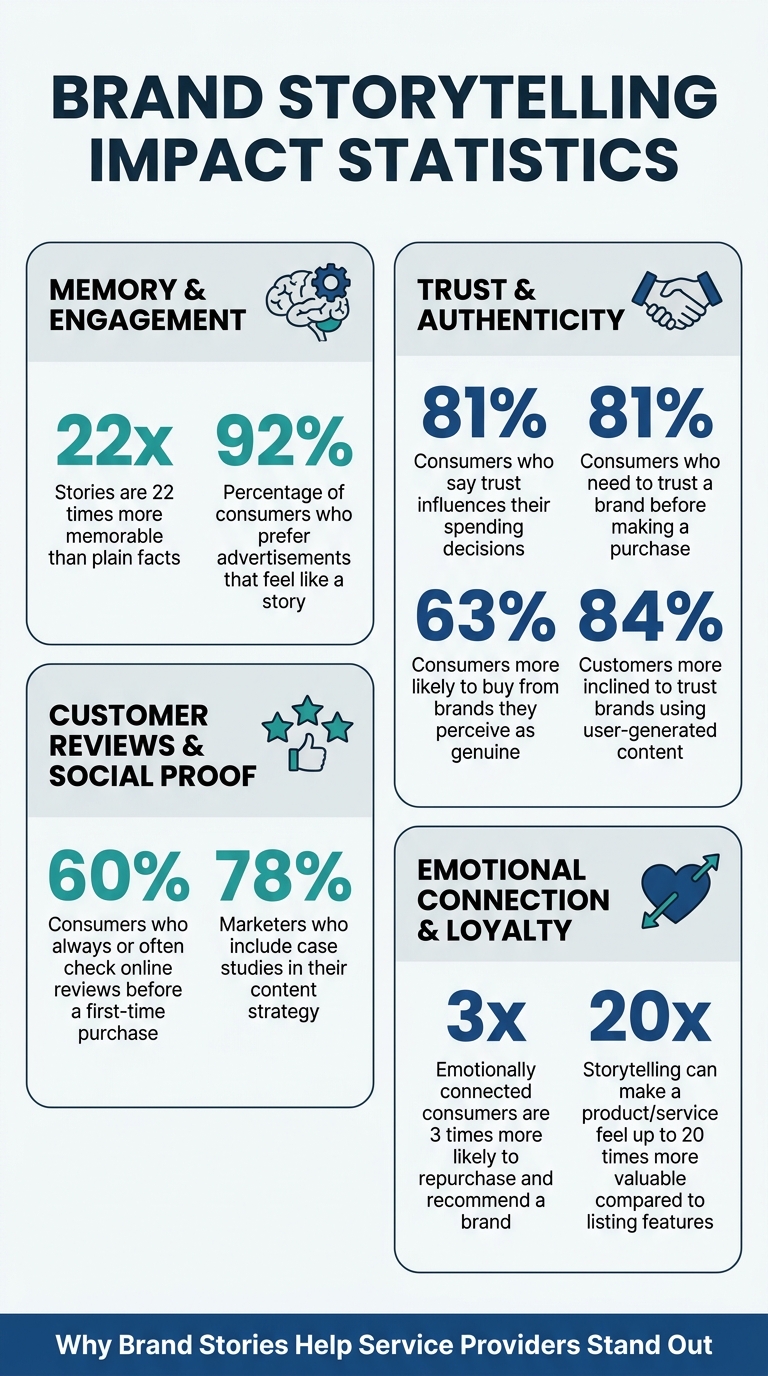
Brand Storytelling Statistics: Impact on Trust, Memory, and Consumer Behavior
Core Elements of a Strong Brand Story
A powerful brand story resonates emotionally with your audience, giving them a reason to care about what you do. To create that connection, three essential elements need to work together seamlessly.
Defining Your Purpose and Mission
Every great brand story begins with your "why" – the deeper reason your business exists beyond just generating revenue. As Focus Lab’s Verbal Identity Lead, Idoia Gorosabel-Gkikas, puts it, try completing this sentence: "The reason our organization gets out of bed in the morning is because…". That answer becomes the emotional foundation for your story.
Your purpose should reflect your history, principles, or the people you serve. And it’s not just fluff – 81% of consumers consider trust a key factor when choosing where to spend their money. Without a clear "why", your business risks blending into the crowd.
To uncover your purpose, start with these six questions: Who are you? What do you provide? Why do you exist? How do you achieve your goals? Who benefits from your work? Where do you operate?. Then, position your customer as the hero and your business as their guide. Harvard Business School Professor Jill Avery explains it perfectly:
"Through storytelling, brands bridge the gap between customers’ actual state of being (‘what is’) and their desired state (‘what could be’)".
Once you’ve established your purpose, craft your narrative to show how you help your customers move from challenges to success.
The Problem-Solution-Transformation Structure
With your purpose in place, shape your story into three acts: the Setup (introducing the problem and your "why"), the Conflict (highlighting challenges and obstacles), and the Resolution (offering the solution and envisioning the future).
Start by identifying your customers’ core problem. Then, demonstrate how your product or service provides the solution and overcomes the hurdles. Finally, paint a picture of the transformation – what life looks like after they’ve worked with you. Here’s why this works: people are 22 times more likely to remember a fact when it’s told through a story rather than as standalone information.
Why Authenticity Matters
Authenticity is the key to creating a brand story that sticks. Being transparent about your struggles, setbacks, and breakthroughs makes your story relatable and builds trust. Customers connect more deeply with a genuine narrative than with a polished, overly perfect one.
Your story should feel like an emotional journey – one that invites customers to care. Vulnerability is a big part of that. Instead of vague statements like "we value quality", back it up with specifics: "We test every product 47 times before it reaches you". Details like that make your claims believable.
Consistency is another cornerstone of authenticity. Define 3–5 adjectives that capture your brand’s personality, and ensure your tone reflects those traits across all platforms – your professional website, social media, emails, and even customer interactions. When your story aligns with your actions, it stands out. This alignment doesn’t just build trust; it turns casual buyers into loyal advocates who connect with your purpose, not just your product.
sbb-itb-5b82b38
Using Customer Success Stories
Why Customer Stories Work
Customer success stories provide tangible proof of your value. When potential clients see how you’ve helped others in similar situations, it builds trust. The stats back this up: 60% of consumers always or often check online reviews before making a first-time purchase, and 84% of customers are more inclined to trust a brand that uses user-generated content.
These stories offer validation straight from the customer, which can cut through skepticism. Let your clients get specific about their achievements. For example, instead of saying "we save time", they could mention saving 15 hours a week and explain how that impacted their operations. That level of detail connects in ways that generic marketing claims simply can’t.
Next, let’s break down how to craft these stories for maximum effect.
How to Structure a Customer Success Story
A good success story has three parts: Before, Turning Point, and After.
- Before: Highlight the specific challenges your client faced.
- Turning Point: Share how they worked with you and what made the difference.
- After: Showcase measurable results with clear timelines.
Here’s an example from Andrew Wilkinson, CEO of MetaLab:
"Before Slack, our team was drowning in email. Now we ship products 30% faster because everything is in one place".
This hits all three points: the problem (email overload), the solution (Slack), and the outcome (30% faster product delivery). Another example is Deloitte’s use of Asana for better project visibility, which led to a reduction in weekly status meetings from 5 hours to just 30 minutes. These stories work because they include real names, specific results, and concrete timelines.
Collecting and Presenting Testimonials
Once you’ve structured your story, timing is everything. Ask for a testimonial when your customer is experiencing peak success – like after hitting a major milestone or solving a big problem. Frame the request as a way to celebrate their achievement, saying something like, "We’d love to highlight the amazing results you’ve achieved" instead of simply asking for a testimonial.
Use open-ended questions to uncover the full story during interviews. For example, ask: "What were you doing before?", "What specific challenges were you facing?", and "What surprised you most about the results?". You can also mine customer emails, social media comments, and resolved support tickets for authentic feedback.
Once you’ve collected these testimonials, make them work across multiple platforms. Add them to your homepage, turn them into social media content, include quotes in sales proposals, or create one-pagers for your sales team. It’s no surprise that 78% of marketers include case studies in their content strategy to grow their business, with over half rating them as one of their most effective formats.
Sharing Your Brand Story Across All Channels
Where to Share Your Brand Story
Your brand story isn’t just a one-off announcement – it’s woven into every interaction customers have with your business. Every touchpoint gives you a chance to reinforce who you are and what you stand for.
Start with your website as the foundation. A dedicated "About Us" page is perfect for showcasing your origin story with a mix of text, visuals, and videos. From there, tailor your story for different platforms. For example, Instagram reels are great for behind-the-scenes moments, while email campaigns work well for sharing founder letters or stories of customer success. And don’t forget in-person interactions – whether it’s a consultation or a casual chat, share the "why" behind your business and position customers as the heroes, with your product or service as their guide.
Once your story is aligned across platforms, the next step is maintaining a consistent tone and voice to build trust and connection.
Keeping Your Message Consistent
Consistency is the foundation of trust. To keep your message clear and steady as your business grows, create a brand guide. This should outline your mission, voice, and tone. Choose a few adjectives – like "friendly", "entrepreneurial", or "approachable" – to define your personality and guide content creation.
Karlee Bedford, Brand Director at Maple Leaf Sports & Entertainment, emphasizes the importance of storytelling:
"Storytelling is an opportunity to emotionally connect with consumers. It offers the consumer more than just a product or service – it offers them an experience."
Train your team to communicate your story consistently across all channels – whether they’re replying to social media comments, handling customer service calls, or designing marketing materials. A short, focused version of your brand story can also serve as a quick reference for crafting content tailored to different platforms.
Adding Storytelling to Your Website
Once your message is consistent across platforms, bring storytelling to life on your website to inspire action. Research shows that storytelling can make a product or service feel up to 20 times more valuable compared to simply listing features and benefits. Use photos of your team, videos showing your services in action, and infographics paired with clear, relatable language. Avoid technical jargon that might confuse or alienate visitors.
If you’re a service provider looking for a professional website quickly, UENI offers a solution. They can create a fully functional business website within 7 days, as long as you provide complete information. Their platform allows you to highlight your brand story through sections for customer testimonials, your mission, and service details – all optimized for mobile and search engines. Starting at $24.99 per month, you’ll get a custom domain, secure hosting, and unlimited editing support through their concierge service. This ensures your story can adapt and grow alongside your business.
Measuring the Impact of Your Brand Story
Metrics to Track
Once your brand story is out in the world, it’s time to see how it’s performing. Start by looking at brand awareness and reach through metrics like website traffic, social media engagement, and media mentions. These indicators reveal how far your story is spreading. Next, evaluate brand perception using tools such as the Net Promoter Score (NPS) and customer satisfaction surveys. These tools help you determine whether your audience’s emotional response matches the message you intended to convey.
Keep a close eye on customer loyalty metrics like retention rates and repeat purchases. Why? Storytelling that resonates emotionally can deepen customer connections – studies show emotionally connected consumers are three times more likely to repurchase and recommend your brand. Also, track conversion rates and revenue growth to measure how effectively your story inspires action. Don’t forget to monitor digital interactions such as likes, shares, and comments on your content. After all, 92% of consumers prefer advertisements that feel like a story. Combining these metrics with qualitative insights will give you a fuller picture of your story’s impact.
Gathering Customer Feedback
Numbers tell part of the story, but direct audience feedback reveals the rest. Use surveys and feedback forms to learn which parts of your narrative resonate most with customers. Tools like Hotjar and Crazy Egg can provide heatmaps and user journey data, showing where visitors engage with your website’s storytelling and where they drop off.
You can also analyze social media mentions and reviews using sentiment analysis tools. This is important because 81% of consumers need to trust a brand before making a purchase, and 63% are more likely to buy from brands they perceive as genuine. Don’t underestimate the value of personal conversations – whether through email, phone calls, or face-to-face interactions. These exchanges often uncover the most actionable insights about what’s working in your story and what needs improvement.
Improving Your Brand Story Over Time
Refining your brand story is an ongoing process, driven by real data and feedback. Break your story into three key elements: the hook (beginning), the conflict (middle), and the resolution (end). Use engagement data to pinpoint which part needs the most improvement and focus your efforts there.
Some businesses have seen incredible results by applying this approach. For example, in 2024, MyVitalC partnered with EWR Digital to promote a new product through a storytelling-driven podcast strategy. Chris Burres, the company’s owner, shared their narrative on 13 podcasts, including the Dr. Gundry show. With a budget under $4,000, they generated $234,000 in revenue, increasing monthly sales of the new product from $4,000 to $12,500. Similarly, Manning Pool Service revamped its website to better communicate its brand story. The result? A 52% increase in organic traffic, a 58% rise in page views, and a 45% boost in average session duration year-over-year.
To keep your story relevant, set up custom Google Analytics dashboards to track traffic, user behavior, and conversions on story-focused pages. Review this data quarterly to ensure your narrative remains authentic and continues to resonate as your business evolves.
Conclusion
Key Takeaways
Brand storytelling goes beyond being just another marketing tool – it’s a way for service providers to stand out by focusing on value instead of price. When you share genuine stories about your business’s purpose and how it impacts people’s lives, you engage with the emotional side of consumer choices. Stories stick with people far better than a list of features or facts, making them a powerful tool for building brand recall.
The best brand stories share three key traits: genuineness, consistency, and emotional appeal. Sharing challenges your business has faced adds credibility. Highlighting customer success stories brings in an extra layer of trust, while maintaining a consistent message across all platforms – whether it’s your website, social media, or in-person interactions – ensures your story resonates deeply.
By defining your mission and sharing meaningful experiences, you can strengthen your brand’s presence in the market. These strategies not only help your business stand out but also lay the foundation for steady, long-term growth.
How Storytelling Drives Small Business Growth
Storytelling isn’t about quick wins – it’s about building something that lasts. Each story you tell contributes to your brand’s identity and strengthens its position over time. This approach helps your business adapt to market changes and fosters lasting customer loyalty.
The good news? You don’t need a huge budget or an elaborate plan to get started. Focus on your "why", craft stories that follow a Problem-Solution-Transformation structure, and share them consistently across your channels. If you’re looking for a way to bring your storytelling online, UENI offers a professional online presence in just 7 days. Their service includes SEO optimization for small business owners and mobile-friendly design, giving you the tools to effectively share your story and connect with the right audience.
As Clay once said, "The brands that thrive tomorrow will be those that master storytelling today."
FAQs
How do I find my brand’s “why”?
To uncover your brand’s “why”, start by thinking about the core purpose and values that drive your business. What inspired you to start it? What problems are you solving, and how is your approach different from others? Use these insights to craft a compelling story that resonates emotionally with your audience. A well-told story not only builds trust but also helps your brand stand out in a crowded market, creating stronger connections with your customers.
What makes a brand story feel authentic?
A brand story resonates when it highlights the brand’s real history, core values, and heartfelt experiences. The key is sharing stories that only your brand can tell – stories tied to its beginnings, the way it operates, or the people behind it. To make these stories impactful, they need to be honest, consistent, and meaningful. This means paying attention to what employees have to say, understanding what customers truly need, and staying aligned with the brand’s identity. Doing so helps build trust and creates stronger connections with your audience.
How can I tell if my story is working?
You can gauge the success of your story by examining how well it connects emotionally with your audience. Signs to watch for include higher levels of engagement, growing trust, and increased loyalty. When your audience shares your values and your customer relationships deepen, it’s a strong signal that your brand storytelling is hitting the mark.