New small business owners used to hit the same wall before launch: the website was almost done, but the photos were not.
That missing piece usually forced an awkward choice. Book a photographer before the business has steady revenue. Buy stock images and hope nobody notices the same smiling call-center team on three other websites. Dig through phone photos and pray the lighting does not make the whole brand look improvised.
For years, the cheap local photoshoot was the respectable answer. A few hundred dollars could cover owner headshots, a storefront, product photos, and a couple of usable hero images. Those photos gave business proof that it existed, which still matters.
Now that default is behavior is changing.
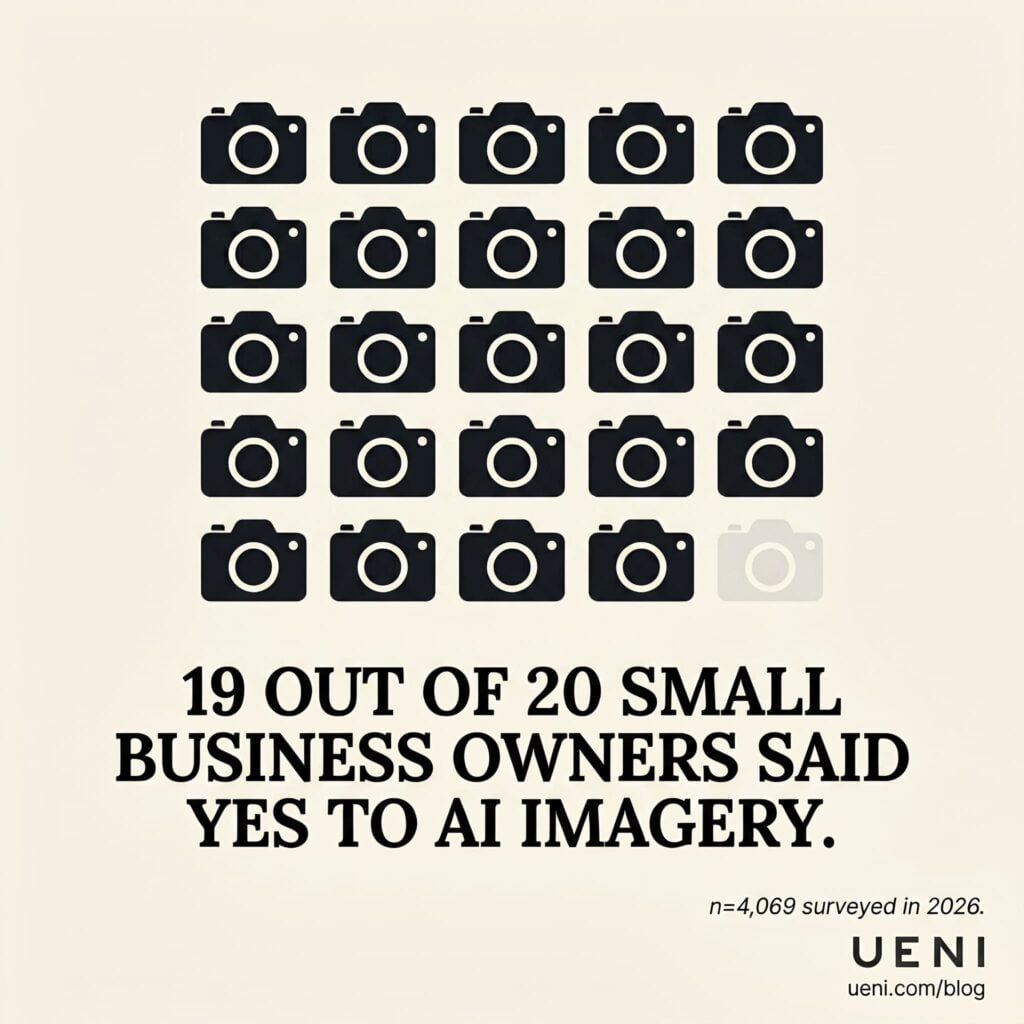
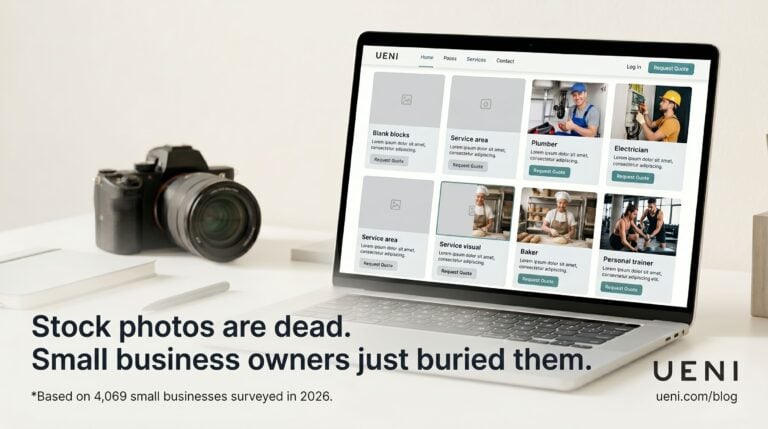
Across 4,069 newly launched small businesses surveyed in 2026, 95% said yes to AI-generated images being used on their website. They were not asking AI to fake the entire business. Instead, they were accepting AI as part of the visual mix, alongside uploaded photos and licensed stock imagery.
That one detail changes the story. Owners are not sitting around debating AI in theory. They are trying to finish a credible website before the budget runs out. For many, AI images for small business websites solve the image gap before it becomes a launch delay.
For photographers, the uncomfortable part is obvious. The bottom end of the small-business photo market is under pressure. For website builders and SaaS tools, the signal is just as clear. AI images for small business websites are no longer a bonus feature. Customers now expect help solving the visual asset problem before launch.
What the Survey Question Actually Measured
The survey did not ask owners whether they trusted AI, admired AI, or wanted a fake-looking brand identity.
Owners were asked a practical question: could AI-generated images be used on the website, alongside any photos they uploaded and the licensed stock library already available?
That wording matters because a yes does not mean the owner wants imaginary staff photos, a made-up storefront, or a fantasy version of the company. It means they are open to AI filling visual gaps when the real assets are not ready.
As we mentioned before, out of 4,069 owners, 219 said no. That leaves 3,850 who said yes, which rounds to 95%. For a customer group that is often cautious, underfunded, and short on time, that is not a small preference. It is a new default behavior.
The old assumption was simple: small business owners would reject AI imagery because it feels impersonal. The response shows a more practical tradeoff. When AI helps the website get finished faster and cheaper, most owners say yes.
Why The 95% Number Should Make the Cheap Photoshoot Nervous
A 95% acceptance rate does not mean every small business owner has stopped caring about real photos. It does mean the low-cost launch photo-shoot has lost its automatic place in the process.
The most vulnerable job is not the premium brand shoot, the restaurant menu session, or the product catalog where accuracy matters. The most vulnerable area is the basic launch package: a few headshots, a storefront, a handful of generic service photos, and enough website filler to stop the homepage from looking empty.
That package used to be one of the first marketing purchases for many new owners. AI now covers enough of that need for many businesses to delay the shoot, shrink the scope, or skip it completely. That is why the AI vs. photographer debate can be misleading at the entry level.
This is the part that should provoke a reaction, especially among photographers. AI does not need to produce better photography than a professional. At the low end of the market, it only needs to be usable, immediate, and cheap enough to remove a launch delay.
The 5% Resistance Was Too Scattered to Build a Story Around
The 5% who refused AI imagery looked promising at first. We expected a few obvious groups to stand out.
Photographers might reject AI because it competes with their work. Churches might avoid it because community trust matters. Medical clinics might worry about accuracy or patient confidence. Lawyers might prefer safer, more traditional visuals.
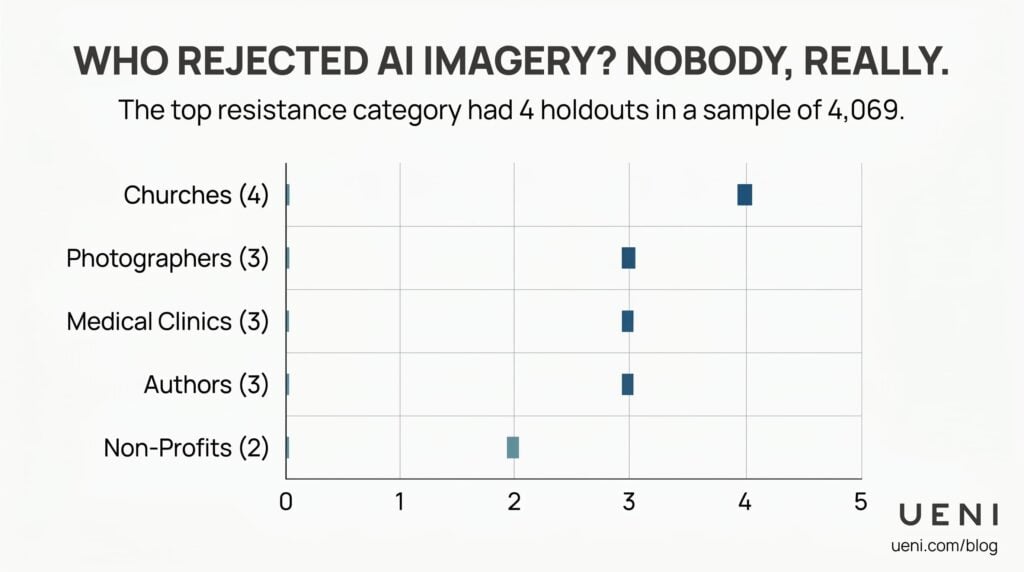
The breakdown did not support our initial hypothesis. Among the 219 owners who said no, the top categories were tiny.
Category among AI refusers: | Owners who said No: |
Churches | 4 |
Photographers | 3 |
Medical clinics | 3 |
Authors | 3 |
Non-profits | 2 |
The largest group had four owners in a sample of 4,069 businesses. That is not a resistance movement. It is a tiny pocket of individual refusal.
The scattered pattern makes the finding more interesting. AI imagery is not being accepted by one obvious type of founder while everyone else holds back. It has crossed into the default toolkit for ordinary new businesses.
The Budget Story Is Doing Most of the Work
The photography industry should pay close attention to the budget data.
Across the same group of 4,069 small businesses, the small business marketing budget data is clear: 26% planned to spend zero dollars on marketing this year. Another 64% planned to spend less than $200 a month across every marketing channel combined.
A professional photoshoot can cost anywhere between $300 and $800. Stock photo subscriptions can run $30 to $100 a month. For many new businesses, those costs are not competing with cheaper visuals and AI image generators. They are competing with rent, supplies, insurance, software, payroll, and the owner’s own unpaid time.
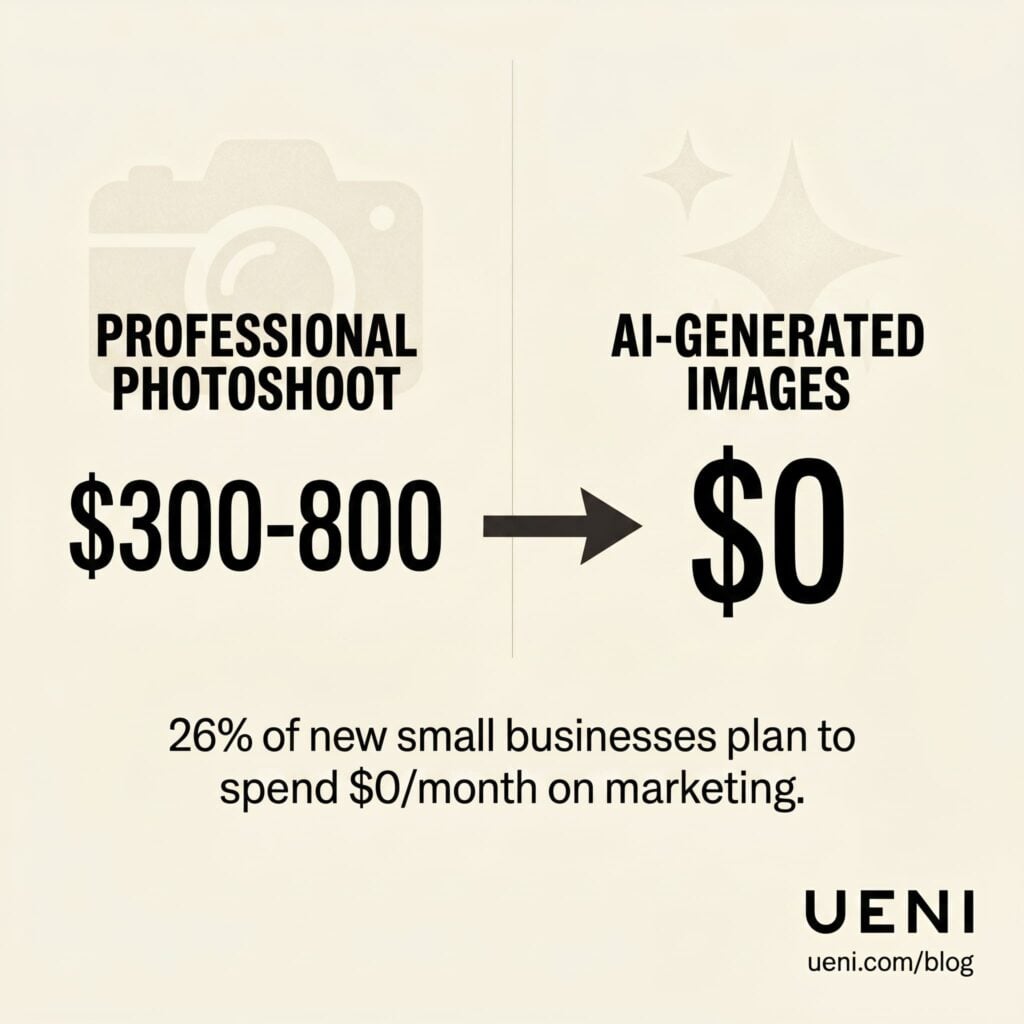
That is why the decision often ends before one’s own opinion even gets considered. AI images for small businesses provide a budget-friendly solution. A real photographer can capture the owner, the actual space, real products, real staff, and the details that make a business believable. In many cases, AI is not close to that level of proof.
However, AI is available at the exact point where the owner needs the site to look finished. For a business with no marketing budget, free and good enough can beat better and unaffordable.
The professional photography market for new small businesses is not losing only because taste is changing. It is being squeezed by the price floor. When the alternative costs almost nothing and removes a launch blocker, the budget option wins early.
AI Is Not Beating Photographers. It Is Beating the Blank Slot.
The strongest competitor to AI imagery is often not the photographer. It is the empty image slot on the website.
Many owners are not choosing between a polished professional shoot and AI-generated visuals. They are choosing between AI images, generic stock, weak phone uploads, or no image at all.
That is why the acceptance rate is so high. AI does not need to win a craft comparison. It needs to beat the choices a new owner can actually make on a tight budget and a short timeline.
Industry debates often frame the decision as a pure quality contest. At the bottom of the market, the customer is making a completion decision. The homepage needs a hero image. The services page needs visual support. The blog needs thumbnails. The site needs to stop looking unfinished.
AI wins that moment because it turns a blank slot into something usable.
The Holdouts Are Not Automatically Photo Buyers
The 5% holdout group deserves attention, but it should not be mistaken for a hidden pool of photography buyers.
In the dataset, AI refusers were 30% more likely to plan zero marketing budget than the average small business owner. Many of the people rejecting AI are not replacing it with photographers, custom illustration, or premium brand work. They are often not spending on marketing at all.
That makes the refusal less commercially useful than it first appears. A no to AI does not automatically translate into a yes to a paid shoot.
Higher-value small business customers may still hire photographers for staff photos, products, food, interiors, events, and trust-sensitive work. Those same businesses may also accept AI-generated images for background visuals, blog graphics, or generic service pages.
The market is not splitting neatly into AI users and photography buyers. It is splitting into businesses that can afford real visual production and businesses that cannot. AI is spreading across both groups for different reasons.
What This Means for Photographers
The small-business photography business model is not disappearing evenly. The low end experiences the most exposure.
Corporate work, weddings, luxury brands, food shoots, product photography, events, and premium local businesses still have strong reasons to pay for real images. They need accuracy, taste, trust, and details AI cannot reliably invent.
The weak spot is the basic website starter package. For that job, AI images for small businesses can feel good enough to start. That work used to be protected by necessity. If the owner needed images, a photographer was one of the few realistic options. AI breaks that necessity.
Photographers who want to keep small business clients need to sell outcomes AI cannot touch: owner personality, product accuracy, team credibility, location authenticity, proof of completed work, and image planning tied to conversions.
The debate cannot stop at “AI looks fake.” Sometimes it does. Sometimes it looks good enough. What photographers need to understand is that customers trust what they can recognize, and some businesses cannot afford to look generic.
What This Means for Website Builders and SaaS Tools
For website platforms, AI imagery is now a customer expectation.
A 95% acceptance rate is not a quiet feature signal. It means new owners expect the website builder to help solve the visual asset problem automatically. Small business website is useful when it removes that first blank-page problem instead of adding another toy to the dashboard. A blank media library now feels outdated for a tool aimed at new businesses.
The opportunity is bigger than image generation. Small business owners need guidance. They need to know which visuals can be AI-generated, which should come from the business, and which should never be faked.
A useful AI imagery on the website should feature background visuals, service illustrations, editorial graphics, and industry-themed hero images. A better one can also tell the owner when a real photo matters more: the owner’s face, the actual storefront, signature products, completed work, staff, vehicles, menus, and anything tied to trust.
The winning product treats visuals as a launch bottleneck. AI removes that bottleneck when used well, without making the business look dishonest.
What This Means for Small Business Owners
For new owners, this change is mostly a welcome one. The image problem no longer has to block the website launch.
Still, the smart approach is not to use AI everywhere. The best use of AI images for small businesses is to support the business without pretending to be proof of the business.
AI can help with: | Use real photos for: |
Abstract service visuals and industry-themed hero images | Owner, team, and staff photos |
Backgrounds, textures, blog graphics, and simple explainers | Products, food, location, vehicles, and menus |
Conceptual scenes that explain an idea | Completed work, client results, medical or trust-sensitive claims |
That line protects the business from looking generic or misleading. Customers may tolerate AI in a background image. They are less forgiving when the image pretends to show a real product, real staff, or real results.
What This Data Does Not Prove
This data does not prove that AI imagery is better than professional photography.
It also does not prove that small business owners no longer care about authenticity. The survey measured whether owners were comfortable using AI-generated images as part of the website image mix. That is a narrower and more useful claim.
Restaurants still need real food photos. Contractors benefit from real project images. Salons, clinics, coaches, and local service providers often need real human presence to build trust. Premium brands still need taste and control that AI cannot guarantee.
The shift is practical, not total. When a new business owner has limited money, limited images, and a website to finish, AI images for small businesses become an easy yes for almost everyone.
The shift is practical rather than total. When a new business owner has limited money, limited images, and a website to finish, AI-generated visuals are an easy yes for almost everyone.
The Takeaway: Why AI Won the Bottom of the Market First
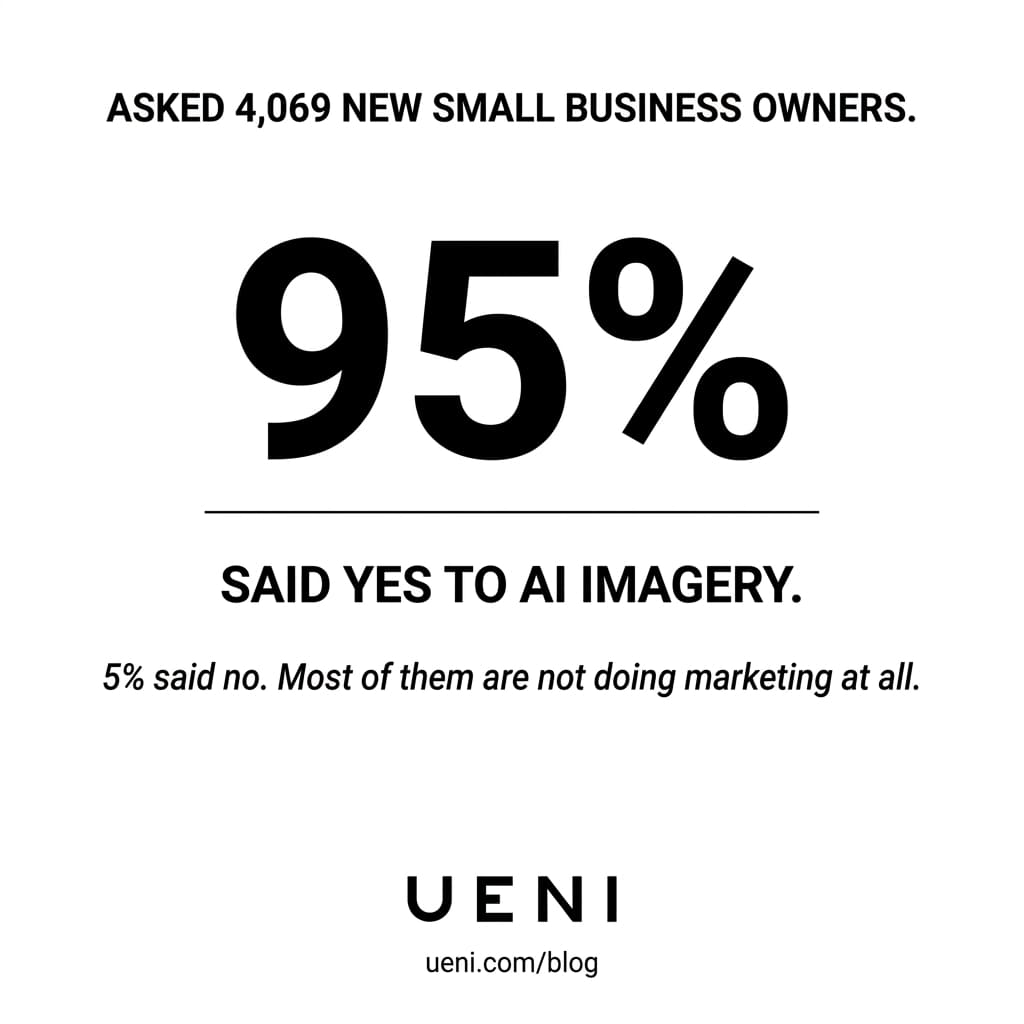
The revealing part is not only that 95% of new small business owners said yes to AI imagery. The sharper question is why they said yes.
AI did not kill this part of the market by becoming more beautiful than a professional photoshoot. It won by being available at the exact moment a budget-constrained owner needed the website to look finished.
For photographers, the low-cost launch package is under real pressure. The work that survives will be the work AI cannot credibly replace: real people, real places, real products, real proof, and higher-stakes brand moments.
For website builders, the conclusion is direct. AI images for small businesses belong inside the website workflow, not as a novelty but rather as a basic customer expectation.
For small business owners, the benefit is simple. The image problem no longer has to delay a website launch.
Stock photos are not dead everywhere. Photographers are not dead either. Still, the old small-business photoshoot as a default first spend has been badly wounded.
Nineteen out of 20 owners have already moved on.
For the full step-by-step, see our small business marketing budget guide.