About This Guide
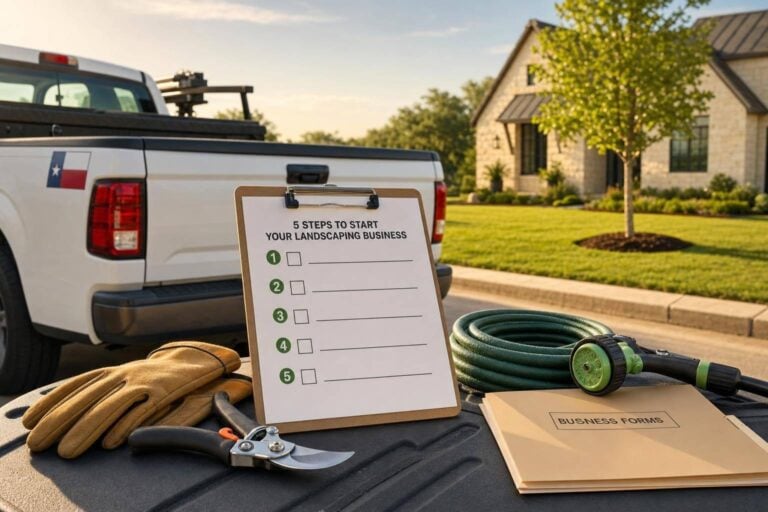
A step-by-step startup guide outlining the complete legal, regulatory, tax, licensing, and marketing landscape required to successfully launch and run a landscaping and lawn care business in the state of Texas.
sbb-itb-5b82b38
Business Formation Steps
- Form a Business Entity: Choose a structure like an LLC to isolate personal assets from landscaping liabilities. File a Certificate of Formation (Form 205) with the Texas Secretary of State ($300 state fee).
- Obtain an Employer Identification Number (EIN): Apply for a free EIN online from the IRS.
- Register for a Texas Sales and Use Tax Permit: Register through the Texas Comptroller. Under Texas law, basic landscaping and lawn care services are taxable at the full state-plus-local sales tax rate (up to 8.25%).
- Draft an Operating Agreement: If establishing an LLC, create an operating agreement to layout company ownership, voting rights, and internal management.
- Open a Business Bank Account: Separate your business financials from personal accounts using your EIN and LLC filing documents.
- Set Up Tax Filing Procedures: Prepare to file the annual Texas Public Information Report (and franchise tax reports if gross receipts exceed the no-tax-due threshold) by May 15 each year.
Legal Requirements
- Business Entity Rules: You must register a formal legal entity with the Texas Secretary of State. LLCs must file a Public Information Report by May 15 annually to maintain good standing.
- Sales Tax Collection: Per Comptroller Publication 94-112, most lawn care and landscaping services (mowing, trimming, planting, fertilizing, weeding, and residential/commercial tree trimming) are taxable. You must collect state and local sales tax (typically 8.25%) unless you qualify for the self-employed exemption of $5,000 or less in rolling gross income over four quarters.
- Texas 811 Dig Notification: Under Texas Utilities Code Chapter 251, you must contact Texas 811 or Lone Star 811 at least 48 hours (excluding weekends and holidays) but no more than 14 days prior to any excavation work (including planting trees, grinding stumps, or installing fences/irrigation).
Licensing and Permits
- General Business License: Texas does not have a statewide general contractor or landscape contractor license.
- Local/City Permits: Check with local municipal offices (e.g., the city business portal) to ensure compliance with local zoning ordinances or city-specific vendor permits.
- Commercial Pesticide Applicator License: Required by the Texas Department of Agriculture (TDA) if you apply any restricted-use or state-limited-use pesticides (including herbicides/weed control) for hire. This requires passing a General Standards exam plus specific category exams (like Category 3A Lawn and Ornamental) and paying a $200 annual fee.
- Landscape Irrigator License: Required by the Texas Commission on Environmental Quality (TCEQ) if you design, install, maintain, or alter landscape irrigation systems in Texas. Individuals must complete required training, pass a comprehensive exam, and pay a $111 licensing fee.
- Nursery/Floral Certificate: If you sell or distribute nursery stock (plants, trees, shrubs), you may need a Nursery/Floral Certificate from the TDA depending on the scale and type of sales.
Insurance Requirements
- General Liability Insurance: A standard $1,000,000 per occurrence / $2,000,000 aggregate policy is highly recommended to protect against property damage (such as rocks thrown by lawnmowers through windows), chemical drift, or trip-and-fall claims.
- Commercial Auto Insurance: Essential because personal auto policies generally exclude business use. Landscape trucks and trailers require a dedicated commercial auto policy.
- Inland Marine Insurance (Equipment Coverage): Strongly recommended to cover high-value mowers, blowers, trimmers, and trailers against theft or damage in transit.
- Workers’ Compensation: Texas is the only US state where workers’ comp is optional (non-subscribers must file Form DWC-005). However, due to high physical risk factors (chainsaw injuries, falls, heavy lifting), subscribing through Texas Mutual or private insurers is highly encouraged to mitigate severe liability.
Startup Costs
Estimated total startup costs range from $25,000 to $75,000 to launch a standard one-truck landscaping operation in Texas. This includes business formation, necessary licensing, equipment, vehicles, insurance, and initial marketing.
Typical Initial Investments
- Texas LLC Formation: $300 (one-time fee).
- Used Truck and Trailer: $15,000 to $45,000.
- Commercial-Grade Equipment (mowers, blowers, trimmers, hand tools): $5,000 to $15,000.
- General Liability Insurance: $500 to $2,000 per year ($1M/$2M limits).
- Commercial Auto Insurance: $2,000 to $4,000 per year per vehicle.
- Inland Marine Insurance (tool and equipment coverage): $300 to $800 per year.
- Initial Marketing and Website: $1,500 to $5,000.
- Initial Supplies (mulch, fertilizer, plants): $1,000 to $5,000.
Estimated Setup Time
Typical Time to Launch: 2 to 8 weeks. This accounts for entity filing processing (2-3 business days online), Comptroller sales tax permit processing (2-3 weeks), obtaining equipment, securing insurance, and scheduling necessary exams (e.g., pesticide applicator or irrigation licensing) if specialty services are offered.
State Regulations and Compliance
Texas does not require a general state-level landscape contractor license. However, key compliance elements include:
- Sales and Use Tax Permit: Required by the Texas Comptroller. Landscaping, mowing, trimming, and plant care services are subject to the full state-plus-local sales and use tax (typically 8.25%).
- Texas LLC Formation: Filing Certificate of Formation (Form 205) with the Texas Secretary of State ($300 fee) and filing an annual Public Information Report by May 15.
- TDA Commercial Pesticide Applicator License: Required by the Texas Department of Agriculture if applying restricted-use pesticides or weed-control chemicals ($200/year plus exam fees and annual CEU requirements).
- Texas 811 Locate Notification: Under Texas Utilities Code Chapter 251, business owners must contact Texas 811 at least 48 hours before any excavation or digging.
- Workers’ Compensation: Optional in Texas, but if opted out, a DWC-005 form must be filed annually.
Marketing and Growth Tips
- Achieve Route Density: Target homes and businesses in close proximity to minimize windshield time and fuel costs. Offer neighbor-to-neighbor discounts to build localized density.
- Separate Taxable and Nontaxable Services: Under Texas tax laws, if taxable and nontaxable services are bundled together on an invoice, the entire charge is taxable if the taxable portion exceeds 5%. Always list services separately on your estimates and invoices to save your clients money where possible.
- Maintain Branded Vehicles & Uniforms: Your crews, trucks, and trailers act as moving billboards. Clean, branded equipment builds trust and establishes a professional local brand.
- Upsell Seasonal Services: Use the off-season to market higher-margin jobs like aeration, winter mulching, leaf cleanup, or holiday lighting installations to maintain cash flow year-round.
Client Acquisition Strategies
- Local SEO & Google Business Profile: Optimize for localized keywords (e.g., "lawn care in Austin") and build out a reviews portfolio to rank in local search results.
- Door-to-Door Flyers & Door Hangers: Target specific residential neighborhoods where you already have a client to establish route density, saving travel time and fuel.
- B2B Networking for Commercial Contracts: Establish relationships with local property managers, HOAs, and real estate agents to secure recurring maintenance contracts.
- Co-Marketing: Partner with complementary home services, such as local pool cleaners or pest control companies, to cross-refer clients.
Helpful Local Resources
- Texas Nursery & Landscape Association (TNLA) – Offering certification programs (such as TCLA), networking, advocacy, and CEUs.
- Texas Department of Agriculture (TDA) – Regulator for pesticide applicator licensing.
- Texas Commission on Environmental Quality (TCEQ) – Licensing agency for landscape irrigators and technicians.
- Texas Small Business Development Centers (SBDC) – Providing free business advising, business plan assistance, and startup consulting across various Texas regions.
- Texas 811 / Lone Star 811 – The state-certified notification systems for utility locating before any digging or excavation.