


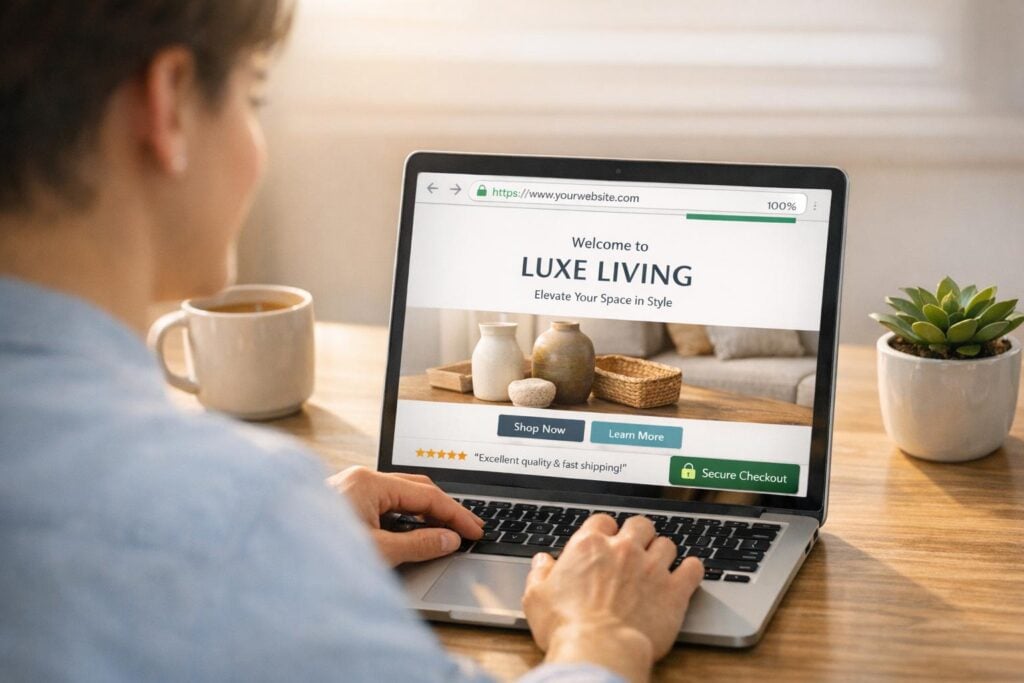
Your website’s design is the first thing visitors notice, and it takes just 50 milliseconds for them to form an opinion. A professional, clean design can make or break trust with potential customers. Here’s why design matters and how it influences trust:
- 94% of first impressions are based on design.
- 75% of users judge credibility by how a website looks.
- 38% of visitors leave if the design or content is unappealing.
- 53% of mobile users abandon sites that take over 3 seconds to load.
Key elements that build trust include:
- Visual appeal: Simple, clean layouts and consistent branding signal reliability.
- Typography: Easy-to-read fonts convey professionalism.
- Navigation: Intuitive layouts make users feel comfortable.
- Technical performance: Fast loading times, mobile-friendly design, and SSL certificates enhance user confidence.
Investing in professional website services can simplify the process while ensuring your site meets these trust-building standards. Services like UENI offer tailored setups, ensuring your website is polished and optimized for customer trust from day one.

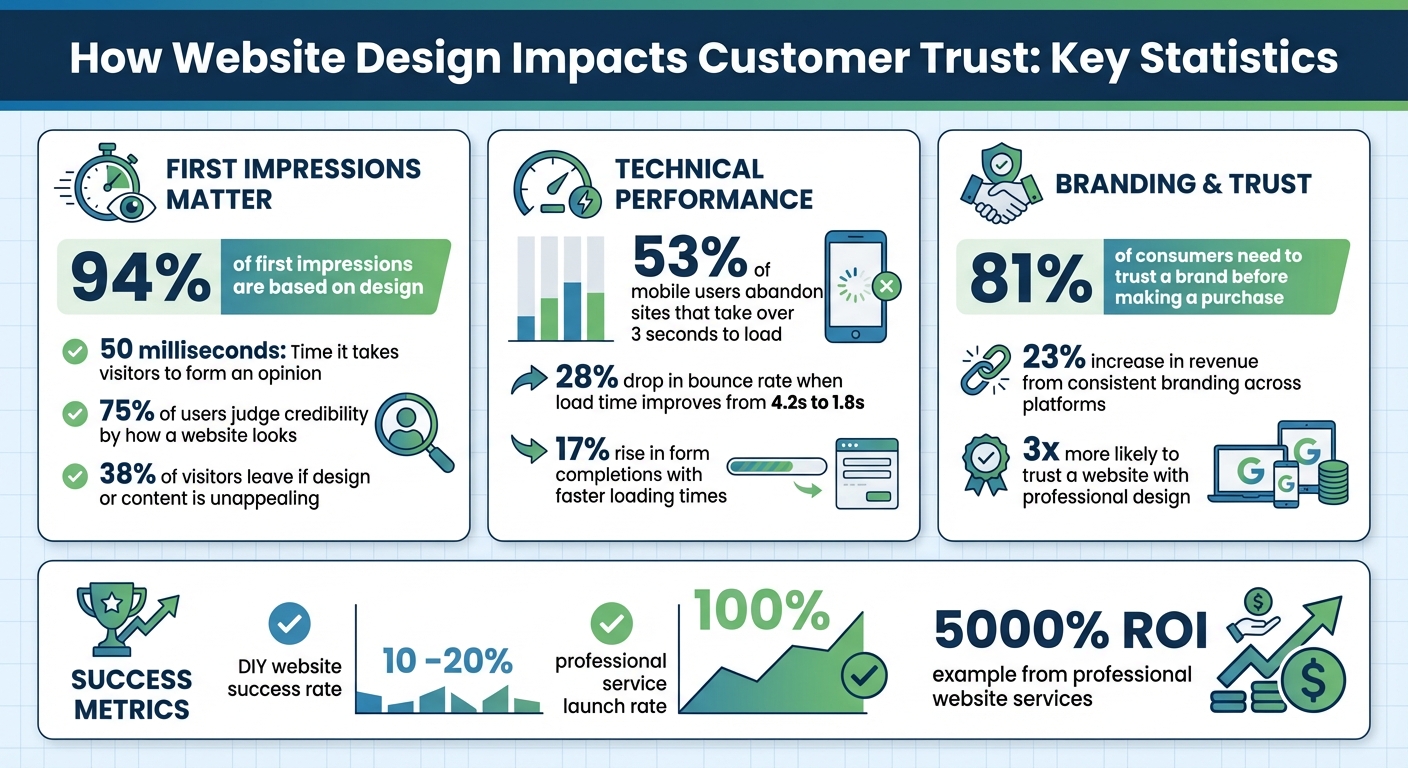
How Website Design Impacts Customer Trust: Key Statistics
How First Impressions Shape Customer Trust
These elements combine to turn initial positive reactions into lasting confidence from customers.
Why Visual Appeal Affects Trust
The way your website looks has a direct influence on whether visitors perceive your business as trustworthy. A well-designed website creates an expectation of quality in your products or services. This is tied to a psychological concept known as the halo effect.
Trust begins as a feeling, not a thought. The halo effect happens because people make emotional judgments about the quality of a design and then extend that impression to the entire business. Alongside this, cognitive fluency – how easily the brain processes information – plays a big role. Websites that are simple, clean, and easy to navigate naturally feel more reliable than ones that are cluttered or confusing. If visitors struggle to understand your site, their brain might interpret that as a red flag.
An outdated or messy design can send the wrong message. Research shows that users are three times more likely to trust a website with a professional design. As Kyle Bianchi from Jungl Studio explains:
Your design isn’t just a coat of paint. It’s your handshake – the first glimpse your customers get into your world.
On top of a polished design, consistent branding can strengthen that initial trust.
How Consistent Branding Builds Confidence
A strong visual design is just the beginning – consistent branding takes it further by reinforcing trust. It’s not about simply looking neat; consistency sends a message of dependability. When your website uses the same colors, fonts, and design elements throughout, it signals reliability. On the other hand, inconsistencies can feel chaotic and raise doubts.
This becomes even more important when your website aligns with the look and feel of your other platforms. For example, if someone clicks an ad or a social media link and lands on a site that looks completely different, it can create confusion and mistrust. Humans are wired to recognize patterns, and familiarity often translates to trust.
The benefits are clear. Companies that maintain consistent branding across platforms can see up to a 23% increase in revenue. Plus, with 81% of consumers saying they need to trust a brand before making a purchase, branding consistency isn’t just about aesthetics – it directly impacts your bottom line.
To achieve this, keep your visual identity consistent. Use one or two font families, stick to a defined color palette, and ensure logo placement and button styles are uniform across all pages. As Oren Inditzky from Wix puts it:
Visual consistency across colors, fonts and imagery signals that your business is the real deal, even before a single word is read.
sbb-itb-5b82b38
Design Elements That Build Trust
Consistent small business website design is just the beginning. The design elements you choose – colors, fonts, and layout – play a big role in shaping how visitors perceive your website. Let’s break down how these elements work together to create trust.
Color Choices and Customer Emotions
The colors on your website aren’t just for decoration – they evoke emotions that can directly impact trust. Take blue, for instance. It’s often associated with reliability and professionalism, which is why many banks, healthcare providers, and tech companies use it to ease user anxiety. Green suggests calmness and growth, while red can create urgency and excitement. But too much red? That can come off as aggressive.
Matching your color palette to your industry and audience expectations makes it easier for visitors to process information and feel at ease. As Jordan White from Jordan Builds Websites explains:
Your website’s color palette is silently shaping how visitors feel, what they think, how long they stay, and whether or not they take action.
Stick to two or three colors to avoid overwhelming your audience. High contrast between text and background is also key – especially when you consider that about 8% of men and 0.5% of women experience some form of color blindness.
But color is just one piece of the puzzle. Typography also plays a critical role in building trust.
Font Selection and Readability
The fonts you choose can instantly signal professionalism – or the lack of it. If you’re starting from scratch, you can get a professional website in one week by following a structured approach. Clean, simple fonts like Helvetica or Arial are great for body text because they’re easy to read and convey credibility. On the other hand, serif fonts like Georgia can give headlines an authoritative, traditional feel, which works well for industries like law or finance.
To keep things consistent and easy on the eyes, limit yourself to two font families – one for headlines and one for body text. Generous spacing between lines and letters also improves readability. As Michael Xeus aptly puts it:
Typography isn’t decoration. It’s communication. And right now, your fonts might be communicating that you don’t know what you’re doing.
Layout and Navigation Design
A clean, intuitive layout can make all the difference in how visitors perceive your website. When navigation is effortless, it projects professionalism and builds trust. Designs that are easy to understand – what’s called cognitive fluency – are naturally more reliable in the eyes of users.
Visual hierarchy is another key factor. Highlight important elements, like call-to-action buttons, by using size and contrast to draw attention. Adding ample whitespace prevents your site from looking crowded, while sticking to familiar navigation patterns – like placing your logo in the top-left corner – helps users feel more comfortable and confident.
As Online Thinkers Technology puts it:
Trust is currency in the digital space.
These design principles create a strong foundation for the technical features and services that come next.
Technical Features That Build Credibility
While design helps establish trust, a website’s technical performance solidifies it. A site that runs smoothly reassures visitors and keeps them engaged.
Mobile-Friendly Design and Accessibility
With most users now browsing on mobile devices, your site must adapt effortlessly to smaller screens. A site that fails to do so sends the message that your business isn’t keeping up with the times. On the other hand, a responsive design shows you’re aligned with modern expectations.
To enhance mobile usability, focus on touch-friendly buttons, readable text, and quick loading times. Incorporating accessibility features like screen reader compatibility and keyboard navigation demonstrates inclusivity and professionalism. As Jewel Lincoln from OneWebCare explains:
Visitors interpret slow loading as technical incompetence or cheap hosting.
This shift is no longer optional – it’s essential. With Google’s mobile-first indexing, your site’s mobile performance directly impacts both its search rankings and visitors’ perception of your business.
Fast Loading Times and Site Performance
More than half of users will leave a site if it takes longer than 3 seconds to load. That’s not just a missed opportunity – it can harm your credibility. Slow pages suggest outdated technology, low-quality hosting, or a lack of attention to detail.
Quick loading times, on the other hand, convey professionalism and reliability. Visitors often equate a fast website with a well-run business. Green House Sales and Marketing puts it this way:
Speed isn’t just a technical issue – it’s a credibility issue.
To keep load times under 2-3 seconds, compress images, minimize code, and use a Content Delivery Network (CDN). Regularly monitor your site’s performance with tools like Google PageSpeed Insights to catch and resolve issues before they drive users away.
Security Features and Clear Policies
SSL certificates are non-negotiable today. That little padlock icon in the browser signals that your site encrypts data, making it secure for visitors. Without it, browsers may display warnings that can instantly erode trust – no matter how credible your business might be.
Transparency also builds confidence. Display your physical address and phone number prominently instead of hiding behind a contact form. Include links to your privacy policy, terms of service, and return guarantees in the footer, where users expect to find them. As Aurora Harley from Nielsen Norman Group points out:
You wouldn’t trust someone who’s hiding something from you, would you? On the web, like in real life, people appreciate when sites are upfront with all information that relates to the customer experience.
Trust seals from well-known security providers or payment processors add an extra layer of assurance. Just as a polished design creates a strong first impression, these technical elements reinforce your commitment to quality. Together, they ensure your site exudes credibility and professionalism.
Professional Website Services for Small Businesses
Benefits of Done-for-You Website Services
Creating a website from scratch can feel overwhelming for many small business owners. Statistics show that only 10–20% of DIY website launches succeed, while professional services boast a 100% launch rate. The difference lies in expertise – professionals handle everything from design and content to technical optimization, allowing you to focus on running your business.
UENI takes the hassle out of website creation by addressing the common pain points that often derail DIY efforts. Their team delivers a fully optimized website in just seven days for a one-time setup fee of $79, followed by $24.99 per month. This package includes features like custom domains, professional email addresses, mobile-friendly design, and robust security measures. Wagner Krohling, owner of Princess Flock, saw a 5000% ROI and achieved the #1 ranking for "eggs Kissimmee" on both Google Search and Google Maps within six months. He shares:
"The website has played a pivotal role in elevating our reach and visibility to unprecedented levels. We’ve witnessed a significant increase in customer inquiries and engagement since listing on UENI."
Additionally, UENI offers a one-on-one launch call where their specialists guide you through your new site and make final tweaks based on your input.
The service also includes technical enhancements that boost your business’s online credibility right from the start.
Features That Create a Professional Online Presence
Professional website services incorporate essential design and technical features that immediately establish trust with your audience. These include SEO-optimized content, commission-free e-commerce payment processing, automated booking systems, secure high-performance hosting, and professional email addresses to strengthen your brand’s authority.
These features work together to create the trust signals today’s consumers look for. For example, ABC Handyman saw their business climb to the #1 spot on Google Maps for "Handyman Aiken" after launching a professionally designed website with SEO optimization for small businesses.
Beyond the initial setup, UENI’s concierge service ensures your site stays updated with ongoing edits and improvements, helping your business maintain credibility and grow its online presence over time.
Conclusion
Website design plays a crucial role in building customer trust. In fact, 94% of first impressions are directly tied to design, shaping how visitors view your business’s credibility and reliability.
To make a strong impression, focus on essential website features: ensure your site loads in under three seconds, use consistent colors and fonts across all pages, provide clear contact details and security badges, and incorporate genuine, high-quality visuals. For instance, a financial services firm with multiple locations saw a 28% drop in bounce rate and a 17% rise in form completions simply by improving their load time from 4.2 seconds to 1.8 seconds.
As Seven Koncepts aptly puts it, "trust is experienced, not explained." When users encounter a fast, intuitive, and visually polished website, they instinctively view your business as reliable and capable. By aligning design, speed, and security, you can turn first impressions into long-term customer loyalty.
The best part? You don’t have to navigate this alone. Services like UENI handle the technical side – everything from mobile responsiveness to robust security features – helping your website build trust from day one. Considering that 81% of consumers need to trust a brand before making a purchase, investing in design isn’t just smart – it’s essential for growing your business.
FAQs
What design changes boost trust the fastest?
The fastest way to build trust through design is by keeping your layout and visual hierarchy straightforward. A clean, professional, and user-friendly website instantly communicates confidence and reliability. Prioritize clear typography, a consistent color palette, and intuitive navigation to leave a strong, positive impression right away.
How can I tell if my site looks untrustworthy?
A website can lose credibility when it suffers from issues like a cluttered layout, confusing navigation, broken links, slow loading speeds, inconsistent design elements, or poorly written content. These problems can make your site feel unreliable, discouraging visitors from trusting your business.
Which trust signals matter most for small business sites?
When it comes to small business websites, first impressions matter – a lot. Certain elements can instantly boost credibility and make visitors feel confident about engaging with your business. Here are some of the most impactful trust signals:
- Clear visual design: A clean, organized layout immediately communicates professionalism and reliability.
- Consistent branding: Cohesive use of colors, logos, and messaging reinforces your business identity.
- Security indicators: Features like payment icons, SSL certificates, and secure checkout badges show your site is safe for transactions.
- Customer reviews: Displaying testimonials or ratings builds trust by showcasing real experiences from others.
- Transparent contact information: An easy-to-find phone number, email, or physical address assures visitors they can reach you if needed.
- Professional layout: A polished, user-friendly interface makes your site look credible and easy to navigate.
These elements work together to establish trust and encourage visitors to take action – whether that’s making a purchase or reaching out for more information.