If you own a small business, building an email list is one of the smartest moves you can make. Why? Because email marketing gives you direct access to your audience, is cost-effective, and helps build lasting customer relationships. Unlike social media, where algorithms control visibility, emails go straight to your customers’ inboxes, ensuring your message gets delivered.
Here’s why email lists are essential for small businesses:
- You Own the Channel: Unlike social platforms, your email list is yours. No algorithms, no sudden policy changes – just direct communication with your audience.
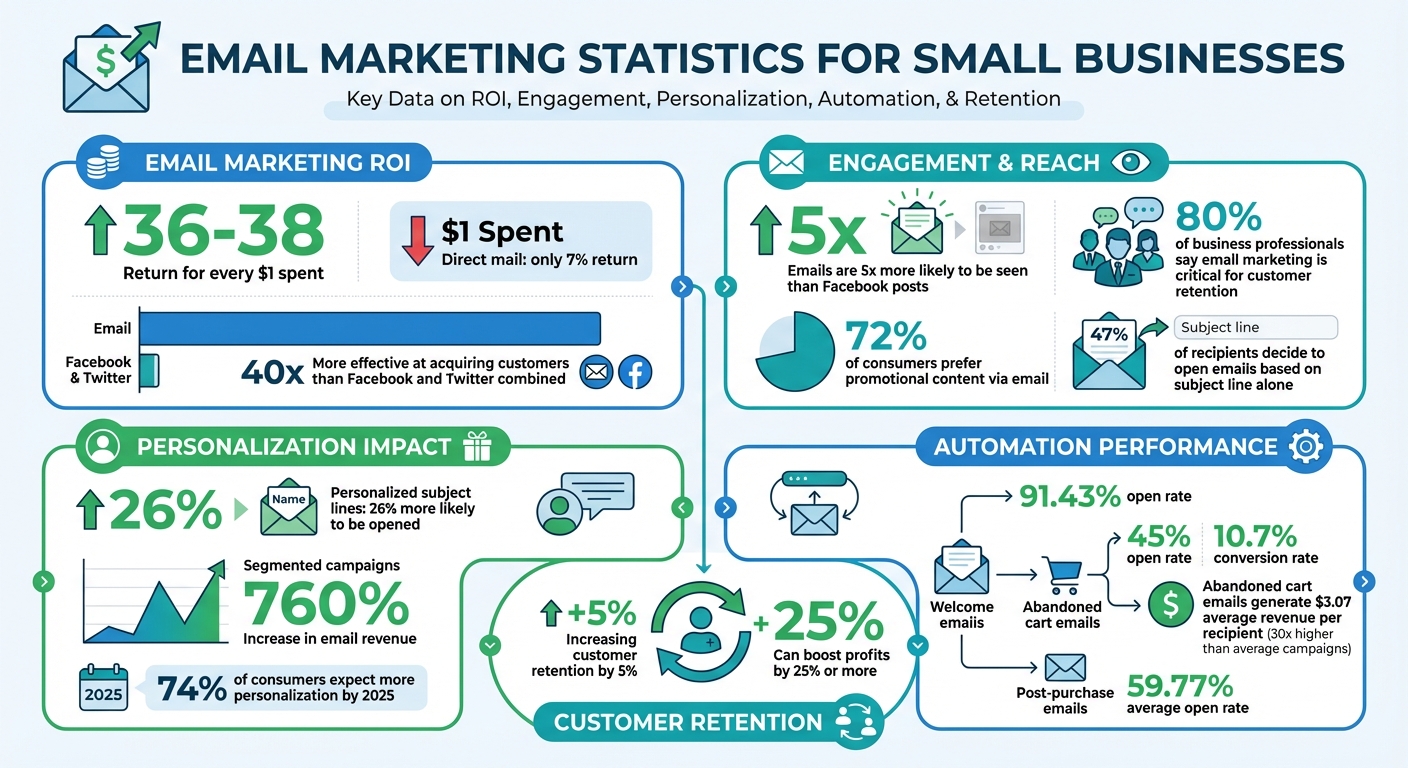
- High ROI: Email marketing delivers an average return of $36 for every $1 spent, making it one of the most affordable marketing strategies.
- Stronger Customer Relationships: Emails are 5x more likely to be seen than Facebook posts, and 72% of consumers prefer promotional content via email over social media.
Whether you’re looking to drive sales, increase engagement, or nurture customer loyalty, email marketing is a reliable and powerful tool. Start by adding sign-up forms to your website, offering a lead magnet like a discount or free resource, and sending personalized, valuable content to your subscribers. The sooner you start, the faster you’ll see results.
Email Marketing ROI and Engagement Statistics for Small Businesses
Why Small Businesses Need Email Lists
Here’s a closer look at how email lists can give your business a serious advantage.
You Own Your Marketing Channel
Social media platforms might feel like a great way to connect with your audience, but they come with a catch – they’re not really yours. These platforms control who sees your content, how often they see it, and sometimes, if they see it at all. And let’s face it, algorithms change, accounts get restricted, and suddenly, your audience could vanish overnight.
An email list, on the other hand, is entirely yours. You can take it with you across email service providers, and it’s always under your control. When you send an email, it goes straight to your subscribers’ inboxes. Grant Galuppi, owner of Galuppi’s Restaurant, grew his email list to 7,000 subscribers over five years. This list now allows him to promote events and specials directly, eliminating the need for costly $500 newspaper ads.
Lower Costs Than Traditional Marketing
Email marketing is one of the most budget-friendly strategies out there. Compare this: direct mail offers just a 7% return on every dollar spent, while email marketing delivers an incredible $38 for every $1 invested. Aside from a monthly subscription to an email platform, there’s little else to pay for – far cheaper than print or broadcast advertising.
Take Irene Schmoller, founder of Cotton Clouds, for example. Switching from print newsletters to email doubled her sales per outreach and boosted her average order value from $50 to $100. Plus, email marketing is nearly 40 times better at acquiring new customers than Facebook and Twitter combined. These cost savings make it easier to focus on building meaningful, long-term customer relationships.
Building Customer Relationships Over Time
Email provides a direct, personal connection with your audience. Subscribers have actively chosen to hear from you, which makes their inbox a space where real relationships can grow. Victor Terrazas, owner of Rejuvenate Therapeutic Massage, relies heavily on email to stay in touch with his customers:
"Email is our prime mode of communication. We rely really heavily on it because whenever I send something out, I’ll get a flood of telephone calls."
The stats back this up: 80% of business professionals say email marketing is critical for keeping customers engaged. Even more impressive, increasing customer retention by just 5% can lead to a profit boost of 25% or more. By consistently sending valuable content – like helpful advice, exclusive deals, or industry updates – you position yourself as a trusted expert. When your customers need what you offer, you’ll be the first name they think of.
How Email Lists Increase Engagement and Sales
An email list isn’t just a collection of addresses – it’s a direct line to your audience. Used wisely, it can transform casual subscribers into loyal customers.
Personalized Messages for Each Customer
When it comes to email marketing, one size doesn’t fit all. Tailored emails are far more effective because they speak directly to the recipient’s interests or behaviors. In fact, 74% of consumers expect more personalization by 2025. By segmenting your list – think high spenders, recent visitors, or even location-specific groups – you can craft messages that feel relevant and personal.
Consider this: Emails with personalized subject lines are 26% more likely to be opened. Even more impressive, segmented campaigns can lead to a 760% increase in email revenue. A great example comes from Campaign Monitor, which tested location-specific images for subscribers in the UK, USA, and Australia. That simple tweak led to a 29% boost in click-through rates.
One standout example of personalization comes from Manly Bands, a wedding band retailer. Instead of sending generic abandoned cart emails, they asked a straightforward question: “Why didn’t you want to buy?” Customers who responded received a personalized follow-up and a coupon, resulting in an order rate 4.8 times higher than the industry median. This shows how segmentation and personalization can directly impact sales.
Automated Emails Save Time
For small business owners, time is often the most limited resource. That’s where automation comes in. Automated emails not only save time but also maintain consistent communication with your audience.
Take welcome emails, for instance. These have an incredible 91.43% open rate, making them an excellent way to leave a strong first impression. ZURB, a product design company, implemented automated welcome emails and achieved 70-80% open rates and 40-45% click-through rates.
Abandoned cart emails are another way to leverage automation. These reminders have a 45% open rate, and 10.7% of those lead to completed purchases. Even better, they generate an average revenue per recipient of $3.07, which is 30 times higher than the average email campaign. Post-purchase emails are equally effective, boasting an average open rate of 59.77%. These can be used to cross-sell products or request reviews, keeping customers engaged long after their purchase.
Bringing Customers Back
Sometimes, the key to boosting sales lies in re-engaging past customers. Whether it’s a targeted promotion, a loyalty reward, or a simple update, a well-timed email can reignite interest.
Take TGI Golf, for example. By using Campaign Monitor’s analytics and targeted content, they achieved a 58% average open rate and a 21% average click-through rate across their campaigns. Numbers like these highlight the power of strategic re-engagement.
Josh Rosenblat, Senior Editor at Shopify, sums it up best:
"Email marketing is both an art and a science. The science of it is picking and choosing how you’d like to segment your audience, and the art of it is being able to write and create emails that stand out."
How to Build and Grow Your Email List
A strong email list is essential for boosting customer engagement and driving sales. To grow your list effectively, you need clear strategies that make signing up easy and worthwhile.
Add Sign-Up Forms to Your Website
Your website is the cornerstone of email list growth, so placing sign-up forms strategically is key. Position them in high-traffic areas like your homepage, blog sidebars, and footer. Pop-ups can also be highly effective when timed right. For instance, try a 5-second delay on pages with quick exits or a 20-second delay on pages where visitors spend more time. Exit-intent pop-ups, which appear when a user is about to leave, have been shown to increase subscription rates by an average of 50.8%.
A great example is Gouchev Law, a New York City-based law firm. By introducing pop-ups on their site, they saw their email subscription rate jump from 12% to 45% – a 250% increase.
Keep your sign-up forms simple. Ask for just the essentials, like a name and email address, to reduce friction. If you’re using a service like UENI to build your website, you can seamlessly integrate sign-up forms, making it easy for visitors to subscribe.
Once you’ve captured a visitor’s email, the next step is to offer something valuable in return.
Give Subscribers Something in Return
People are more likely to sign up if they feel they’re getting something valuable. Lead magnets – such as free ebooks, checklists, webinars, or discount codes – are excellent tools for providing immediate value. For example, Paradise Pen Co. collected emails at their physical store and managed to gather contact information for 80% of their customers at the point of sale.
Offering discounts (like 10%-20% off) is another effective strategy. Fat Stone Farm partnered with Webistry on a giveaway campaign and successfully added over 15,000 new leads to their email list. The key is to tailor your offer to your audience and deliver it instantly after sign-up.
Once you’ve established these incentives, it’s time to expand your reach by tapping into social media.
Use Social Media to Promote Your Email List
Social media can be a powerful tool to grow your email list. Use it to promote your lead magnets, run contests, and include subscription links in your profiles. While social platforms are great for visibility, they’re not permanent – algorithms change, and your reach can disappear overnight. An email list, on the other hand, is a resource you own and control.
Share your lead magnets on platforms like Facebook, Instagram, and LinkedIn. Contests or giveaways that require email sign-ups to enter can also bring in new subscribers. Even small changes, like adding a subscription link in your Instagram bio or emphasizing benefits exclusive to subscribers in your posts, can make a big difference. Plus, emails are five times more likely to be seen than Facebook messages.
sbb-itb-5b82b38
Keeping Your Email List Healthy and Engaged
Keeping your email list in great shape improves delivery rates, boosts engagement, and drives sales. A healthy email list leads to better inbox placement, higher interaction, and more conversions. Here’s how you can keep your list performing well.
Remove Inactive Subscribers Regularly
Inactive subscribers can hurt your email performance. When recipients don’t open or click your emails, providers like Gmail and Outlook take notice. They use engagement levels to decide if your emails land in the inbox or get flagged as spam. Considering nearly 50% of emails sent in 2022 were classified as spam, protecting your sender reputation is critical.
"A smaller, engaged list always outperforms a larger, uninterested one." – Mailchimp
Experts often define inactivity as no opens or clicks over 3–6 months. Before removing these subscribers, try a win-back email with an eye-catching subject line like "We Miss You" and an incentive, such as a discount code. A good reactivation campaign can recover 5% to 15% of inactive subscribers, while a great one might win back up to 25%. For example, in 2021, the American Heart Association regained 500,000 inactive subscribers and raised over $250,000 with a targeted reactivation campaign.
If subscribers remain unresponsive, it’s time to say goodbye. You can offer an "opt-down" option first, allowing them to receive fewer emails, like weekly instead of daily. Then, perform a deep clean every 3 to 6 months, removing hard bounces and persistent non-responders. Since most email platforms charge based on subscriber count, trimming inactive users can also reduce your costs.
Once your list is clean, segmentation can help you refine your strategy even further.
Segment Your List by Customer Type
Breaking your list into smaller, targeted groups helps keep your emails relevant and prevents fatigue. Segmentation involves organizing your list based on factors like purchase history, location, or website activity. This ensures your messages address specific needs.
For example, track data such as which pages subscribers visit, what they’ve purchased, or whether they’ve abandoned a shopping cart. You can also send surveys to learn more about their preferences.
Start with two or three impactful segments, like "frequent customers" and "one-time buyers". Personalized emails can deliver a massive return – on average, $36 for every $1 spent. Let subscribers choose their email frequency or interests during signup to reduce unsubscribes. Then, create automated sequences for each segment. For instance, after a purchase, you could send a three-email series with tips and product recommendations.
Segmentation not only keeps your emails relevant but also makes it easier to track performance and fine-tune your approach.
Track Your Email Performance
Regular tracking is key to improving your email campaigns and maintaining list quality. It’s hard to improve what you don’t measure. Focus on metrics like open rate, click-through rate, and conversion rate to understand what’s working and what needs tweaking.
| Metric | What It Measures | Why It Matters |
|---|---|---|
| Open Rate | Percentage of delivered emails opened | Indicates how effective your subject lines and brand recognition are. |
| Click-Through Rate | Percentage of recipients who clicked a link | Shows how engaging your content and calls-to-action are. |
| Bounce Rate | Percentage of emails that didn’t reach the inbox | High rates harm your sender reputation and signal list quality issues. |
| Unsubscribe Rate | Percentage of people who opt out | Helps identify if your content or frequency is turning subscribers away. |
Since 47% of recipients decide to open an email based on the subject line alone, testing different approaches is crucial. Use A/B testing for subject lines, call-to-action buttons, and visuals to find out what resonates most with your audience. On average, email click-through rates hover around 1.4%, while a good click-to-open rate falls between 10% and 15%.
Clean your email list at least twice a year to remove inactive subscribers who haven’t opened an email or made a purchase in six months. Also, ensure your templates are mobile-friendly, as many people check email on their phones. Consistently tracking these metrics helps you maintain a high-performing email list and maximize your return on investment. With email marketing yielding an average return of $36 to $40 for every $1 spent, tracking performance is well worth the effort.
Conclusion
Building an email list is one of the smartest moves a small business can make. Unlike social media, where algorithms dictate your reach, an email list is entirely yours to control. Plus, it’s incredibly effective – email is 40 times better at bringing in new customers than Facebook and Twitter combined. On top of that, 72% of consumers say they’d rather get promotional messages through email than social media. These numbers make it clear: email is still one of the most powerful channels out there.
Emails also play a key role in fostering loyalty and keeping customers engaged. By staying in regular contact, you ensure your brand stays fresh in their minds. Whether it’s personalized product suggestions, reminders about abandoned carts, or exclusive deals, email helps you build stronger connections with your audience.
Getting started doesn’t have to be complicated. Add a sign-up form to your website, offer something valuable – like a discount or free resource – in return for their email, and start sharing content that helps or excites your audience. The earlier you begin, the faster you’ll see the benefits.
Take the first step today. Build your list, nurture those relationships, and watch your business grow.
FAQs
What are the best ways to grow my small business’s email list?
Growing your small business’s email list begins with giving your audience something they’ll find worthwhile. Think exclusive guides, special discounts, or free resources – these are the kinds of perks that make people excited to hand over their email addresses. Collaborating with other businesses for giveaways or promotions can also help you tap into fresh audiences.
Don’t forget the basics: add an email sign-up form or popup to your website. If you’re still working on getting a site up and running, platforms like UENI can help you create a professional, mobile-friendly website that includes built-in tools for capturing emails. The secret to success? Consistency. Keep delivering content that your subscribers find useful, and you’ll see your email list grow steadily over time.
What are some effective email marketing strategies for small businesses?
For small businesses, email marketing can be a powerful way to connect with customers and drive growth. A few smart strategies can make all the difference in keeping your audience engaged and loyal.
One tried-and-true approach is sending regular newsletters. These keep your customers informed about updates, promotions, or news related to your business. Another effective tactic? Offering exclusive discounts or perks to encourage people to sign up for your email list. And don’t underestimate the power of a well-crafted automated welcome email – it’s your chance to make a strong first impression and set the tone for your relationship.
Personalization is another game-changer. By tailoring emails based on customer preferences or past purchases, you can create messages that feel relevant and meaningful. This not only boosts engagement but also helps build loyalty over time.
Looking to deepen the connection? Share customer success stories to build trust and credibility. You can also invite subscribers to join loyalty programs or add interactive elements like polls and quizzes to your emails. These features make your messages more engaging and fun for your audience.
Finally, consistency and segmentation are crucial. Sending emails regularly and tailoring them to specific audience segments ensures your content stays relevant. This approach can significantly improve open rates and click-through rates, making your campaigns more effective.
By thoughtfully applying these strategies, small businesses can strengthen customer relationships and drive sales while keeping their audience excited about what’s next.
Why is email marketing more effective for customer engagement than social media?
Email marketing stands out as a powerful tool for customer engagement because it offers businesses a direct and personalized way to connect with their audience. With an impressive average delivery rate of about 96%, emails are far more likely to land in front of your customers compared to social media posts, which often get lost in the shuffle due to algorithms and limited visibility.
Unlike social media, which is excellent for building brand awareness, email marketing provides a reliable channel for consistent communication. It helps nurture stronger relationships by offering tailored content and leveraging automation. By delivering messages directly to your customers’ inboxes, email campaigns are more effective at driving meaningful engagement and boosting conversion rates.