About This Guide
A Georgia-specific startup guide for launching a cleaning service, covering business formation, local licensing, taxes, insurance, startup costs, compliance, and practical launch steps for aspiring entrepreneurs.
sbb-itb-5b82b38
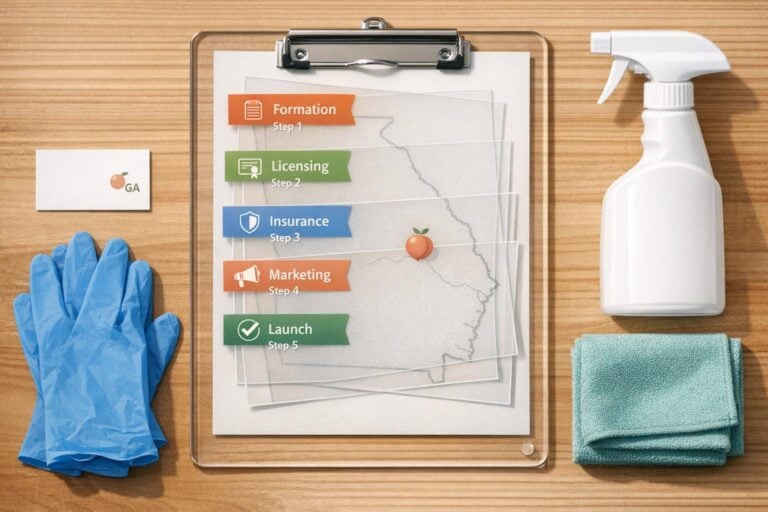
Business Formation Steps
- Choose a business structure, with LLCs commonly used for cleaning businesses for liability protection and flexibility.
- Register the business with the Georgia Secretary of State if forming an LLC, corporation, or other registered entity.
- Select a Georgia registered agent and file Articles of Organization for an LLC.
- Obtain an EIN from the IRS if needed for banking, payroll, or tax registration.
- Register with the Georgia Department of Revenue through the Georgia Tax Center for any required tax accounts (for example, withholding if you hire employees).
- Apply for local occupational tax certificates/business licenses with the city or county where you operate.
- Set up payroll and unemployment registrations if you hire workers, then open business banking and launch operations.
Legal Requirements
Georgia requires LLCs and other formal entities to register with the Secretary of State, use a Georgia registered agent, and file annual registrations each year by April 1; LLCs are subject to the same annual filing cycle described by Georgia.gov and the SOS rules. Businesses may also need to register for state tax accounts and, if they hire employees, withholding and unemployment-related registrations. Local zoning and home-occupation rules can apply to home-based operations, and city/county occupational tax certificates are commonly required. If you have three or more employees, Georgia law requires workers’ compensation insurance coverage.
Licensing and Permits
Cleaning services in Georgia generally do not need a state-issued cleaning-specific license for residential work, but they commonly need a city or county business license/occupational tax certificate where they operate. Some localities may also require a home occupation permit or other local approvals. If the business sells taxable goods or is otherwise required to register for sales and use tax, it must register with the Georgia Department of Revenue through the Georgia Tax Center. Commercial or specialized cleaning jobs may require additional permits depending on the service scope and locality.
Insurance Requirements
General liability insurance is strongly recommended for a cleaning business to cover property damage and bodily injury claims. Georgia requires workers’ compensation insurance when an employer regularly employs three or more persons, including part-time workers; exempt LLC members or corporate officers do not reduce the headcount threshold. Commercial auto insurance is also advisable if business vehicles are used. Some operators also add bonding as a client-trust measure, though it is not generally a Georgia statewide requirement for residential cleaning.
Startup Costs
Typical startup costs for a Georgia cleaning service are often in the low thousands for a solo launch, but a more complete setup can range roughly from about $2,000 to $15,000+ depending on equipment, licensing, insurance, and whether you buy a vehicle or hire staff early. State entity filing is relatively low-cost, while insurance, local licensing, supplies, and marketing can drive the total upward.
Typical Initial Investments
- LLC filing fee: about $100 online or $110 by mail, plus annual registration fees.
- Local occupational tax certificate/business license: commonly about $50–$400+ depending on the city or county.
- General liability insurance: often a few hundred to over a thousand dollars per year depending on coverage and risk.
- Workers’ compensation: required once the business has three or more employees.
- Cleaning equipment and starter supplies: typically a few hundred to a few thousand dollars.
- Marketing/branding: website, flyers, and local ads often add several hundred to a few thousand dollars.
- Vehicle and transport: if you need a dedicated vehicle, this can become one of the largest early expenses.
Estimated Setup Time
Typical Time to Launch: 2-4 weeks for a simple solo launch; 1-2 months if you need local licensing, insurance, tax setup, and employee onboarding.
State Regulations and Compliance
In Georgia, a cleaning service usually does not need a statewide cleaning-specific license, but you should form the right business entity with the Georgia Secretary of State if you choose an LLC/corporation and file the annual registration each year by April 1; failing to do so can lead to dissolution or revocation. You may need to register with the Georgia Department of Revenue for business taxes and withholding if you hire employees, and local city or county business licensing/Occupation Tax Certificate rules can apply depending on your business location. Georgia also requires workers’ compensation coverage for employers with three or more employees, and local OTC applications can require SAVE and E-Verify affidavits in some jurisdictions. Georgia does not tax janitorial/cleaning services as sales tax on labor, though taxable supplies and any separately sold products remain subject to sales tax.
Marketing and Growth Tips
For a new Georgia cleaning business, prioritize a Google Business Profile, local SEO for city-specific searches like Atlanta, Augusta, and Savannah, and review-building to win the local map pack. Use a simple website, before-and-after photos, and social proof, then expand with paid search or local service ads once your reviews and conversion process are working. Networking with property managers, landlords, real estate agents, and other local service businesses can also create recurring work and referrals. Georgia-based training and support programs such as SBAC workshops can help with pricing, bookkeeping, marketing, and AI tools.
Client Acquisition Strategies
Best early client channels in Georgia include Google Business Profile, local SEO, Google Ads for high-intent terms like ‘cleaning service near me’ plus city names, and directory profiles on platforms such as Yelp, Angi, Nextdoor, Bark, and Thumbtack. For B2B and recurring contracts, target property management companies, landlords, real estate agents, commercial offices, and short-term rental hosts. In-person local outreach, flyers, community networking, and referral partnerships can help fill the pipeline while reviews are still low.
Helpful Local Resources
- Georgia Secretary of State
- Georgia Department of Revenue (Georgia Tax Center)
- Georgia.gov Starting a Business Guide
- Georgia Department of Labor
- Small Business Assistance Corporation (SBAC)
- SCORE Georgia
- Georgia SBDC network