About This Guide
This comprehensive guide provides a step-by-step roadmap for starting a personal training business in California in 2026. While California does not mandate a state-level occupational license for personal trainers, launching a successful, legally compliant fitness business requires navigating local zoning laws, city business tax certificates, strict consumer contract regulations, and standard industry certifications. This article walks entrepreneurs from initial certification through official entity registration, client acquisition, and growth.
sbb-itb-5b82b38
Business Formation Steps
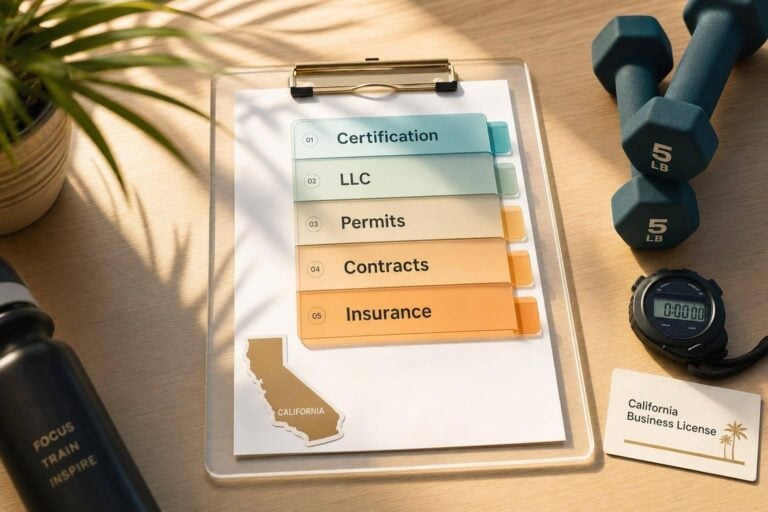
- Earn a Certification & CPR/AED: Although not legally mandated by the state, obtaining an NCCA-accredited certification (like NASM, ACE, or NSCA) and a CPR/AED certification is necessary to buy professional liability insurance and work in any capacity.
- Choose a Business Entity: Decide whether to operate as a Sole Proprietorship, Partnership, or Limited Liability Company (LLC). Most trainers select an LLC to protect personal assets.
- Register the Business Entity with the State: If forming an LLC or Corporation, file the Articles of Organization with the California Secretary of State (online portal: bizfile Online).
- File a Fictitious Business Name (DBA): If you are operating under a name other than your legal surname, file a Fictitious Business Name Statement with the county clerk where your business is located and publish it in a local newspaper.
- Obtain an Employer Identification Number (EIN): Apply for an EIN for free on the IRS website.
- Register for State Taxes: Register with the California Employment Development Department (EDD) if hiring employees, and obtain a Seller’s Permit from the California Department of Tax and Fee Administration (CDTFA) if you plan to sell physical merchandise like supplements or apparel.
- Open a Business Bank Account: Separate your personal finances from business revenues and expenses by opening a dedicated business checking account.
Legal Requirements
- Health Studio Services Contract Law: Under California Civil Code Section 1812.80-1812.97, personal training falls under ‘health studio services’. All contracts must contain a mandatory 5-day cancellation clause written in at least 10-point bold font, cannot exceed a term of 3 years, and must explicitly list fees, hours of access, and refund terms.
- Nutrition Scope of Practice Limits: Under California law, unlicensed trainers are strictly forbidden from writing individualized meal plans, diagnosing medical conditions, or prescribing therapeutic diets. You can only share general, non-medical nutritional guidelines.
- Local Zoning and Home Occupancy Laws: If running a home-based training studio, you must ensure compliance with local ordinances regarding commercial activity, parking, and clients visiting residential zones.
- Liability Waivers: In California, a clear, attorney-drafted Liability Waiver (Assumption of Risk) signed by every client is legally required by most insurers to mitigate the risk of injury claims.
Licensing and Permits
- State Licensing: There is no state-level personal trainer license required by the State of California.
- Local Business License / Business Tax Certificate: Required by virtually all California municipalities (e.g., Los Angeles, San Diego, San Francisco) where you conduct business, regardless of whether you train in a gym, outdoors, or in clients’ homes.
- Outdoor Commercial Park Permits: If you train clients in public city parks or beaches, most major California municipalities (e.g., San Francisco, San Diego, Los Angeles) require a commercial activity permit. Operating without one can result in steep municipal fines ($50 to $500 per incident).
Insurance Requirements
- Professional Liability Insurance (Errors & Omissions): This is crucial as it protects you against claims of physical injury resulting from your instruction or workout plans. Standard policies offer $1M to $2M in coverage and are often bundled through certifying agencies.
- General Liability Insurance: Protects against third-party bodily injury and property damage (e.g., a client slipping and falling on a wet floor in your studio or during an outdoor session).
- Workers’ Compensation Insurance: Mandated by California state law the moment you hire your first employee (even part-time).
- Product Liability Insurance: Recommended if you sell or distribute fitness equipment, supplements, or dietary products.
Startup Costs
Typical startup costs for a solo personal trainer in California range from $1,500 to $5,000 for their first year. Major initial startup costs include: – NCCA-Accredited Certification: $400 – $1,000 (e.g., NASM, ACE, or ISSA)
- CPR/AED Certification: $40 – $80 (via American Red Cross or American Heart Association)
- California LLC Formation: $70 Secretary of State filing fee, plus the $800 annual minimum Franchise Tax (which applies to the first year for LLCs formed in 2026 as the historical waiver has expired)
- Statement of Information: $20 (filed within 90 days of LLC formation)
- Business License / Local Permits: $50 – $300 (varies by city/county)
- Commercial Park Permit: $50 – $500 (required by major cities like Los Angeles and San Francisco for outdoor park training)
- Liability Insurance: $160 – $350 annually (general and professional liability)
- Basic Equipment & Marketing: $300 – $1,500+ (depending on whether training in-home, online, or at a commercial gym)
Typical Initial Investments
Breakdown of significant required investments: – Professional & General Liability Insurance: $160 – $350 per year (essential for independent contractors training clients in third-party facilities or homes, covering injury claims up to $1M-$2M per occurrence).
- LLC Formation & State Taxes: $890 (incorporates the $70 filing fee, $20 Statement of Information, and the mandatory first-year $800 minimum franchise tax).
- Fitness & Training Equipment: $500 – $2,500 (resistance bands, adjustable dumbbells, kettlebells, mats, and mobile fitness gear for on-the-go training).
- Rent / Facility Floor Fees: $500 – $1,500/month (if renting space or paying floor access fees as an independent contractor inside a local commercial gym).
- Marketing & Software: $300 – $1,000 (website setup, booking and scheduling software like Mindbody or Trainerize, and local advertising/business cards).
Estimated Setup Time
Typical Time to Launch: 1 to 3 months (Highly dependent on whether the owner is already certified. Obtaining an NCCA-accredited certification and CPR/AED typically takes 6 to 12 weeks of self-study, while the legal registration, business license, and insurance setup can be finished in 1 to 2 weeks.)
State Regulations and Compliance
Key state regulations, compliance requirements, and taxes in California include: – No State-Issued License Required: California does not mandate a state-issued professional license for personal trainers. However, standard professional NCCA certification (NASM, ACE, etc.) and CPR/AED credentials are required by commercial gyms and insurance carriers.
- Health Studio Services Contract Law (Civil Code § 1812.80 et seq.): Applies to personal training services and contracts in California. Key constraints include: – Contracts cannot exceed a term of 3 years. – The maximum total contract amount allowed by law is $4,400. – Mandatory refund and cancellation rights must be outlined in the contract (e.g., a 20- to 45-day right to cancel depending on contract value).
- Franchise Tax Board (FTB) Taxes: Every active California LLC must pay an annual minimum franchise tax of $800. This tax is due by the 15th day of the 4th month after registration. Additional graduated fees apply if gross California income exceeds $250,000.
- Statement of Information (Form LLC-12): Must be filed with the California Secretary of State within 90 days of LLC formation, and then biennially (every 2 years), accompanied by a $20 fee.
- Local Business Tax & Registration: Fitness businesses must register and obtain a local business license or tax certificate from their specific city or county.
- Sales and Use Tax (CDTFA): Personal trainers must register for a Seller’s Permit with the California Department of Tax and Fee Administration (CDTFA) if they sell tangible goods (such as fitness equipment, branded apparel, or supplements).
- Employment Regulations: If hiring trainers or staff, businesses must register with the California Employment Development Department (EDD), pay state payroll taxes, and carry Worker’s Compensation Insurance.
Marketing and Growth Tips
- Utilize California’s Year-Round Climate: Run outdoor boot camps, beach workouts, or park training sessions to eliminate studio rental overhead while attracting bypassers who see you training in public.
- Offer Hybrid Online Training: Many tech-centric and busy California workers prefer a hybrid approach. Combine in-person sessions with online programming through apps like TrueCoach, Trainerize, or My PT Hub.
- Niche Down with Specialties: Stand out in competitive urban markets by earning specialized credentials (e.g., Prenatal Fitness, Youth Sports Performance, Corrective Exercise, or Senior Fitness).
- Partner for Cross-Referrals: Build relationships with local physical therapists, chiropractors, and massage therapists in your neighborhood to cross-refer clients.
Client Acquisition Strategies
- Offer Free Assessments & Consultations: Partner with local community groups, corporations, or housing complexes to host free fitness evaluations. This builds trust and lowers the barrier to entry for prospective clients.
- Leverage Client Referrals & Testimonials: Fitness in California is heavily image-driven and social. Offer active clients incentives (like a free session) for referring friends, and always document transformations (with client consent) via before-and-after photos.
- Partner with Local Gyms & Co-Working Spaces: Network with local independent gyms that allow outside trainers to bring clients for a flat floor fee or split commission, or market directly to local office parks and tech offices.
- Build an Active Social Media Presence: Showcase your expertise through short-form video content on Instagram and TikTok targeting California locations. Post form tips, workout clips, and local healthy lifestyle content.
Helpful Local Resources
- California Office of the Small Business Advocate (CalOSBA) – offers specialized tools, guides, and updates on state compliance.
- California Small Business Development Center (SBDC) – provides free, confidential, one-on-one advising for business planning, financing, and marketing.
- CalGOLD (www.calgold.ca.gov) – the official state database that generates localized permit requirements based on your specific city/county and business category.
- California Department of Tax and Fee Administration (CDTFA) – resource for obtaining seller’s permits and understanding state sales tax requirements.