Want to rank higher in local search results? Focus on reviews.
Reviews play a significant role in local SEO rankings, influencing how businesses appear in Google’s Local Pack. Here’s what you need to know:
- Reviews contribute 20–25% to Map Pack rankings, second only to proximity.
- Google prioritizes review velocity (how often you get new reviews), recency, and keywords in reviews.
- Businesses with 3–5 new reviews per month often rank in the top 3, while those with fewer reviews drop to lower positions.
- Ratings below 4.0 stars can hurt visibility, and AI tools often exclude businesses with low ratings.
If your review profile is weak – too few, outdated, or negative reviews – you risk losing visibility to competitors. The solution? Build a system to consistently gather and respond to reviews.
Key takeaways:
- Aim for 30–50 total reviews to stay competitive, with 3–5 new reviews monthly.
- Respond to all reviews within 24–48 hours to improve engagement and rankings.
- Encourage customers to mention specific services in reviews for better keyword alignment.
Reviews aren’t just about attracting customers – they directly impact your local SEO performance.
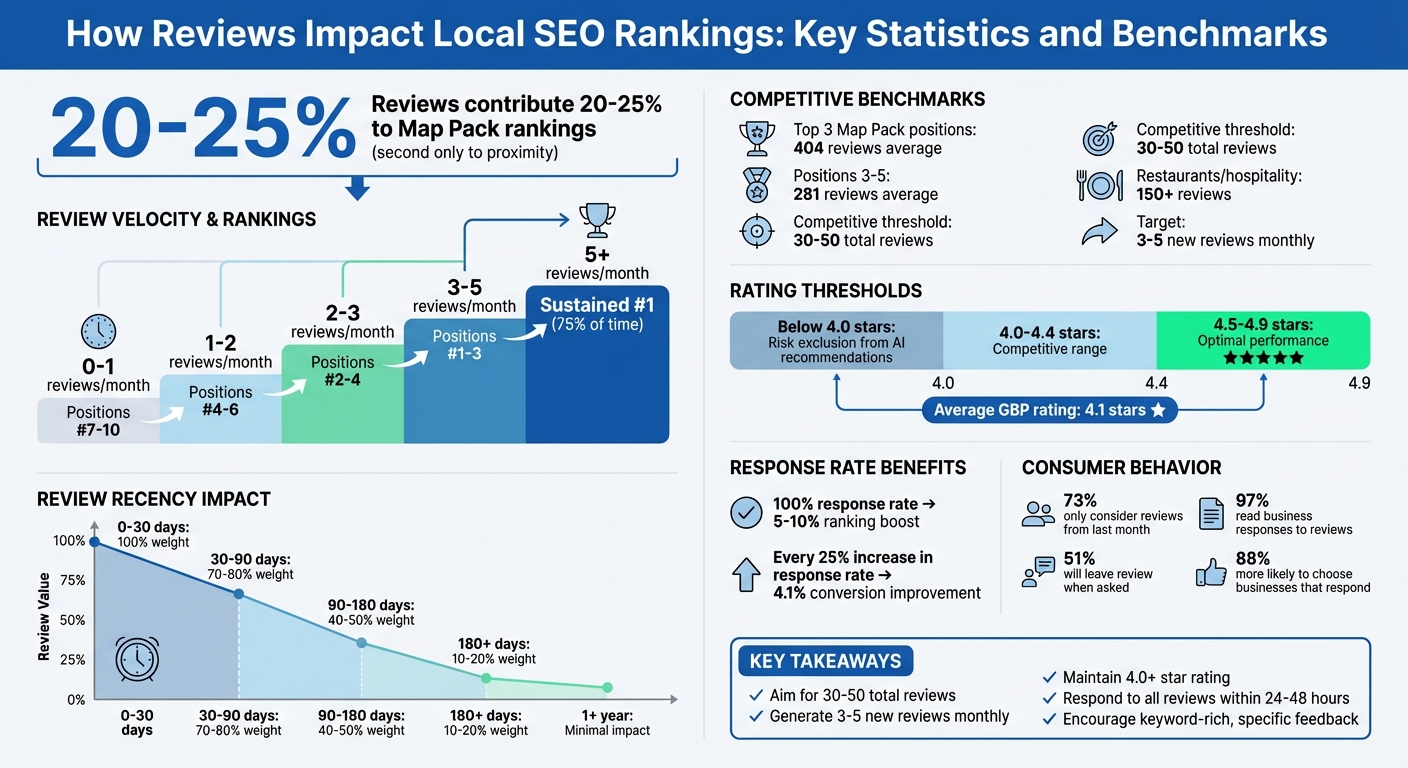
How Reviews Impact Local SEO Rankings: Key Statistics and Benchmarks
The Problem: Weak Review Profiles Hurt Rankings
A weak review profile can seriously impact your rankings and visibility. Google’s algorithm treats missing, outdated, or negative reviews as red flags, signaling that a business might be inactive, unreliable, or declining in quality. The result? Competitors with stronger review profiles pull ahead, capturing the customers who might have chosen you instead.
Too Few Reviews
If your business has fewer than 10 reviews, Google flags it as unverified. Profiles with 0-10 reviews are assigned a "Low Authority" signal, which often lands them in Map Pack positions between #8 and #12. Even with a fully completed Google Business Profile, a low review count can act as a major barrier to competing effectively.
Today’s market demands higher review numbers than ever before. While 10–15 reviews might have been enough five years ago, businesses now need 30–50 reviews to stay competitive. For industries like restaurants, that number often climbs to 150+. To put it in perspective, businesses in the top three Map Pack positions average 404 reviews, while those ranked three through five average 281. Without enough reviews, you’re also missing out on keyword-rich content from customer feedback.
"Crossing 10 reviews triggers a noticeable ranking boost… The algorithm seems to treat 10+ reviews as a trust validation checkpoint." – RatesOnTap
And it’s not just the number of reviews that matters – ratings play a critical role too.
Low Ratings and Negative Reviews
Ratings below 4.0 can hurt your trustworthiness and send negative signals to Google, impacting both your click-through rate (CTR) and ranking. Users tend to avoid listings with low ratings, which increases your bounce rate. Google interprets this as a sign that your business isn’t relevant or reliable, pushing your listing even further down the search results.
AI tools often apply a "4.0-star floor", meaning businesses with ratings below 4.0 are frequently excluded from AI-generated recommendations. On top of that, Google’s AI doesn’t just look at overall ratings – it analyzes specific review attributes. If multiple reviews mention issues like "slow service" or "rude staff", your business might be filtered out of searches for terms like "quick service" or "friendly staff", even if your overall rating is decent. With the average Google Business Profile rating sitting at 4.1, falling below this threshold makes it much harder to compete in local searches.
But even good ratings won’t save you if your reviews are outdated.
Old or Outdated Reviews
73% of consumers only pay attention to reviews written in the last month. Google also gives less weight to older reviews, so a five-star review from two years ago won’t help your rankings as much as a four-star review from last week. Reviews older than a year carry minimal ranking influence, serving more as legacy signals than active contributors to your visibility.
A stagnant review profile can make your business look inactive. When businesses stop generating new reviews, their Map Pack rankings often drop from the top three to positions #7–10 as their review activity slows to a halt. Even if you have 500 older reviews, a competitor with just 50 recent ones may outrank you. As Ross Cohen, CEO of GetPhound, puts it:
"Every fresh review is proof that your business continues to deliver great experiences today, not years ago".
These factors – too few reviews, low ratings, and outdated feedback – all contribute to weaker local SEO performance, setting the stage for the next steps in improving your review management strategy.
sbb-itb-5b82b38
How Reviews Directly Impact Local SEO Rankings
Google doesn’t just count reviews – it uses them to determine where your business ranks in local search results. Reviews influence rankings in two main ways: through prominence signals that establish credibility and user engagement metrics that reflect customer interaction.
Google’s Prominence Signals
Prominence, as Google defines it, measures how well-known and credible your business appears online. Reviews are a major factor here, contributing about 20–25% of Map Pack ranking authority, second only to proximity.
But not all review metrics are created equal. The most influential is review velocity, or how many new reviews your business gets each month. This accounts for 40–45% of the overall review factor. Businesses that consistently earn 3–5 new reviews per month often rank in the top 3 of the Map Pack, while those with only 0–1 new reviews tend to drop to positions 7–10.
"Review velocity – how many new reviews you receive monthly – is the single strongest review metric Google prioritizes."
– Danielle Birriel, Founder, D&D SEO Services
The age of reviews also matters. Reviews less than 30 days old carry full weight, while their influence declines as they age. For example, reviews that are 30–90 days old retain 70–80% of their value, while those 90–180 days old drop to 40–50%. After 180 days, their impact dwindles to 10–20%, and reviews older than a year have minimal effect.
Average ratings are another critical factor. Businesses with ratings between 4.5 and 4.9 stars perform best in local SEO. Falling below 4.0 stars can result in being excluded from searches for terms like "best" or "top-rated". Additionally, AI tools often filter out businesses with lower ratings from recommendations.
Total review volume builds credibility and serves as social proof. However, its influence levels off after about 50–75 reviews, at which point review velocity becomes more important. Keywords and specific service mentions within reviews also help Google align your business with relevant search queries.
User Engagement with Reviews
How users and businesses interact with reviews adds another layer to ranking signals. Google monitors how businesses respond to reviews and how users engage with them. Responding to reviews signals that your business is active and customer-focused, reinforcing its credibility. In fact, businesses that respond to 100% of their reviews can see a 5–10% ranking boost over those with lower response rates.
Response speed is equally important. Replying within 24–48 hours maximizes engagement signals and shows you’re managing your profile actively. For every 25% increase in response rate, conversion rates improve by about 4.1%, and 65% of consumers are more likely to choose a business that responds to its reviews.
Owner responses also create fresh, indexable content in your Google Business Profile, which strengthens activity signals. Combined with a steady stream of new reviews, this creates a positive feedback loop. High ratings and an engaged review profile improve click-through rates (CTR), which Google interprets as a sign of relevance, further boosting rankings.
Visual content in reviews – like photos or videos – tends to stay at the top of profiles longer and is prioritized by Google’s "Most Relevant" filter. Google’s natural language processing also scans review text for specific keywords, which it uses as "justifications" in search results. For example, Metro Flow Plumbing in Dallas, TX, ranked #1 for "emergency plumber to clear clog in a ranch" because a customer review mentioned "clear a mainline clog at our ranch" and "roots", even though those phrases weren’t on their website. These justifications allow businesses to rank for niche queries based solely on authentic customer feedback.
| Monthly Review Velocity | Average Map Pack Position |
|---|---|
| 0–1 reviews/month | #7–10 |
| 1–2 reviews/month | #4–6 |
| 2–3 reviews/month | #2–4 |
| 3–5 reviews/month | #1–3 |
| 5+ reviews/month | Sustained #1 (75% of time) |
The combined impact of prominence and user engagement signals highlights why reviews are such a powerful factor in local search rankings. Maintaining a steady flow of fresh, high-quality reviews is key to staying competitive. Up next, we’ll dive into the specific review factors that can further elevate your local SEO performance.
Key Review Factors That Improve Local SEO Rankings
If your business struggles with a weak review profile, focusing on the right balance of review quantity, quality, and recency can make a big difference. These three elements are key to how Google evaluates and ranks your business locally.
Review Quantity
The number of reviews your business has is one of the fastest ways to signal credibility to both Google and potential customers. It’s a core part of "Prominence", one of Google’s main local ranking factors, and accounts for about 20% of local pack ranking factors. For example, businesses in the top Google local pack positions average 404 reviews, while those ranked third to fifth average 281 reviews.
Interestingly, the impact of review quantity isn’t linear. A 2025 study by Sterling Sky found that local businesses significantly improved their rankings in Google Maps simply by increasing their review count from three to sixteen – without running ads or making other SEO changes. Doubling review counts while maintaining good ratings led to ranking improvements of 3 to 5 positions in local search results.
However, the number of reviews required varies by industry and location. In competitive areas like Manhattan, dry cleaning businesses in the top three positions had a median of 255 reviews – with individual businesses ranging from 107 to 400 reviews. In contrast, hotels average 309 reviews, while professional services or trades may only need 20–30 reviews to stay competitive.
The bar for visibility is rising. Five years ago, 10–15 reviews might have been enough, but most markets now require 30–50 reviews to be competitive. In industries with higher competition, 100+ reviews are often necessary. To stay ahead, aim to match or exceed the median review count of your top three competitors in your industry and area.
| Business Type | Monthly Review Target | Minimum Total Reviews |
|---|---|---|
| Small Local Service | 3–5 reviews | 20–30 reviews |
| Multi-Location Retail | 7–10 reviews/location | 100+ per location |
| Restaurants/Hospitality | 15+ reviews | 150+ reviews |
| Professional Services | 2–3 reviews | 20–30 reviews |
While the total number of reviews matters, their content and authenticity are just as important.
Review Quality
Google doesn’t just count reviews – it evaluates their content. Detailed, keyword-rich reviews help search engines better understand your business, which can improve rankings for niche or long-tail searches. High-quality, authentic reviews also align with Google’s E-E-A-T guidelines (Experience, Expertise, Authoritativeness, Trustworthiness), which are part of its 2026 ranking criteria.
The sweet spot for ratings is between 4.2 and 4.5 stars. Businesses in the top local pack positions typically have an average rating of 4.1 or higher. Even a small rating gap – just 0.3 to 0.5 stars – compared to competitors can hurt visibility and click-through rates. Interestingly, a perfect 5.0 rating can seem suspicious, and 87% of customers are comfortable engaging with businesses rated between 3 and 4 stars, as long as the reviews are genuine.
"A steady stream of high-quality, authentic reviews not only boosts your website’s authority but also increases click-through rates (CTR) and conversions by instilling confidence in potential customers."
– Ross Cohen, GetPhound
Google’s algorithm now highlights key themes from reviews directly in Business Profiles, making detailed feedback more visible. It also pulls snippets, or "justifications", from reviews into Local Pack results to explain why a business matches a search query. About 38% of these justifications are explicitly positive. When users mark reviews as helpful, it further signals value to Google and strengthens your ranking potential.
Review Recency
Recent reviews show that your business is active and reliable. Google views recency as a strong indicator of relevance, which can directly influence your placement in the Local 3-Pack. This is especially important since 73% of consumers dismiss reviews older than three months as irrelevant.
"Review recency is not just another local SEO myth, but a critical factor for visibility."
– Vicinus
A business with 50 reviews, 10 of which are from the current month, often appears more trustworthy to Google than a competitor with 200 reviews but no recent activity. In fact, 20 fresh reviews from the last three months can outperform a competitor with 50 older reviews. The impact of new reviews can be seen within days or weeks.
Consistency is key. A steady flow of 2–4 reviews per month looks more legitimate to Google than sudden spikes, like gaining 30 reviews in two days after months of inactivity, which can trigger spam filters. Aiming for 7–10 reviews per month per location shows ongoing engagement and helps maintain competitive rankings. Monitoring how frequently your competitors gain reviews is also important – if they’re outpacing you, your rankings could slip.
Solutions: Using Reviews to Boost Local SEO
Once you know which review factors matter most, it’s time to create a system for consistently gathering, managing, and showcasing reviews. Top-ranking businesses don’t leave this to chance – they follow repeatable processes to encourage customer feedback.
Getting More Customer Reviews
The easiest way to get more reviews? Just ask. Research shows that 51% of customers will always or usually leave a review when asked. However, 30% don’t because the process feels confusing, and 26% assume their feedback doesn’t matter.
Make it simple. Share a short link or QR code that directs customers to your Google Business Profile’s review section. You can do this via email, SMS, or even during in-person interactions [20,22,23]. SMS tends to work particularly well, boasting a 98% open rate compared to email’s 20%. Using both channels together can achieve a 26% response rate [25,20].
Timing matters, too. Aim to send review requests within 24–48 hours of a positive interaction, while the experience is still fresh. If you use Net Promoter Score (NPS) surveys, focus on your "Promoters" (those who scored 9 or 10) and encourage them to share their feedback publicly. You can even suggest they highlight specific services, like "emergency plumbing" or "brake repair", to improve your keyword relevance.
Equip your team to ask for reviews confidently. Provide simple scripts to address common objections such as "I don’t have time" or "I’m not sure how." Encourage them to capture "photo moments" during service that customers might want to share. Remember, offering rewards for reviews violates Google’s policies, but you can motivate employees with incentives like cash prizes or gift cards for positive mentions [2,20].
| Channel | Customer Preference | Response Rate |
|---|---|---|
| 54% | 15% | |
| SMS/Text | 29% | 20% |
| Combined (Email + SMS) | N/A | 26% |
"The best way to get reviews is still the simplest. You ask. Politely. After something good happens with satisfied customers."
– SEO Locale Content Team
Once you start receiving reviews, engaging with them becomes just as important.
Responding to Reviews
Managing reviews actively not only builds trust but also signals to Google’s local algorithm that your business is engaged and reliable [24,26]. This can directly impact rankings. In fact, 97% of people who read reviews also look for business responses, and 88% are more likely to choose a business that replies to all reviews [22,29].
For positive reviews, respond within 24–48 hours. Thank the customer by name, mention a specific detail from their review, and match their tone. You can even reference a related service or promotion to encourage repeat visits [24,29]. Signing off with a real name adds a personal touch.
Negative reviews require quicker action – respond within 12–24 hours. Use the "3 R’s" approach: Read with empathy, Reflect on the issue, and Respond professionally. Apologize publicly and provide a direct contact method to resolve the issue offline [24,27,29]. A thoughtful response can make a big difference – 62% of customers who leave negative reviews are willing to give a business a second chance if their issue is addressed.
For example, a multi-location automotive repair shop in Utah improved its review response strategy in 2025 by implementing a 24–48 hour response policy and tailoring replies for each location. This led to a 34% boost in local pack visibility, a 22% increase in calls from Google Maps, and a 44% jump in appearances in Google’s AI Overviews.
"Review responses are no longer optional for small businesses. In 2025, review responses influence AI Overview visibility, local pack rankings, and brand reputation signals."
– Dan Vance, Founder, Advanced Local
Displaying Reviews on Your Website
Showcasing customer reviews on your website does more than build visitor trust – it also improves your search engine rankings. Add reviews to your homepage, service pages, and checkout pages to establish credibility and reduce cart abandonment [35,32]. For businesses with multiple locations, featuring location-specific reviews on individual city pages boosts relevance and avoids duplicate content [32,35]. A dedicated review page can also consolidate testimonials and provide keyword-rich content for search engines to index [32,33].
To maximize SEO benefits, use structured data (Schema markup) to tag reviews with Review, LocalBusiness, and AggregateRating schemas. This helps Google display rich snippets – like star ratings and quotes – in search results, which can significantly increase click-through rates [32,35]. If you include video testimonials, be sure to add transcripts so spoken keywords are indexed.
A professional, mobile-friendly website makes it easier to display reviews effectively. For instance, UENI builds websites for small businesses in just seven days, complete with built-in SEO features, custom domains, and secure hosting. Their concierge service even allows unlimited edits, so you can keep your review pages up-to-date without needing technical expertise.
Featuring reviews on your website not only reinforces your credibility but also strengthens your local SEO performance.
"Google considers reviews and testimonials as part of its E-E-A-T (Experience, Expertise, Authoritativeness, and Trustworthiness) framework."
– SeeResponse
Conclusion: The Long-Term Impact of Reviews on Local SEO
Online reviews don’t just provide a temporary boost – they create a lasting advantage that builds over time. Fresh reviews not only attract more clicks but also signal relevance to Google, which can lead to improved rankings. And, of course, better rankings bring in more customers, who, in turn, leave more reviews. It’s a continuous cycle that strengthens your online presence.
One thing to keep in mind is that the quality and consistency of reviews matter more than sheer volume. A steady flow of 3–5 new reviews each month can outperform hundreds of old ones. Businesses that prioritize this steady review pace often dominate local search results.
The rise of AI tools like Gemini and ChatGPT has upped the game even further. These platforms rely heavily on reviews as a trust signal. Many apply a hard cutoff at 4.0 stars for recommendations, and they cross-check reviews on platforms like Google, Yelp, and Facebook for consistency. On top of that, the keywords customers use in their reviews can help your business rank for niche, long-tail searches. Google’s "Review Justifications", those snippets that highlight specific features or services, are a perfect example of this.
Key Takeaways
- Make review management a regular habit. Aim for 3–5 new reviews every month and respond to all feedback, including how to handle negative reviews, within 24–48 hours. This can boost conversions by an average of 4.1% for every 25% of reviews you respond to.
- Encourage specific feedback. Ask customers to mention particular services or locations in reviews to increase your relevance for specialized searches.
- Maintain a strong average rating. Keeping your rating above 4.0 stars is crucial for visibility in AI-powered search results.
- Focus on Google, but don’t ignore other platforms. Dedicate about 70% of your efforts to Google reviews while ensuring consistent ratings on Yelp, Facebook, and others to avoid data conflicts that could hurt AI-driven recommendations.
FAQs
How long does it take for new reviews to improve rankings?
Consistently gathering new reviews can noticeably improve your local SEO rankings, often within about six months. Businesses that generate 3-5 reviews each month could see a 40-60% boost in rankings compared to competitors who aren’t actively gaining reviews. The key factors driving this improvement? Quantity, quality, and recency of reviews all play a significant role.
How can I get more Google reviews without breaking policies?
To gather more Google reviews the right way, concentrate on methods that make it easier for customers to share their feedback. Timing is key – ask for reviews when customers are most satisfied with your service. Simplify the process by providing clear instructions or direct links to your review page.
Avoid offering incentives or buying reviews, as this goes against Google’s rules and could lead to penalties. Instead, focus on creating a positive experience so happy customers feel motivated to leave genuine reviews on their own. Transparency and ease are your best tools here.
What should I do if my rating drops below 4.0 stars?
If your rating dips below 4.0 stars, prioritize improving both the quality and quantity of your reviews. Make it a habit to respond quickly to reviews – this shows you’re engaged and care about customer feedback. Also, encourage satisfied customers to leave detailed, up-to-date reviews. These actions can enhance your overall rating and strengthen important local SEO factors, such as review recency and content quality.