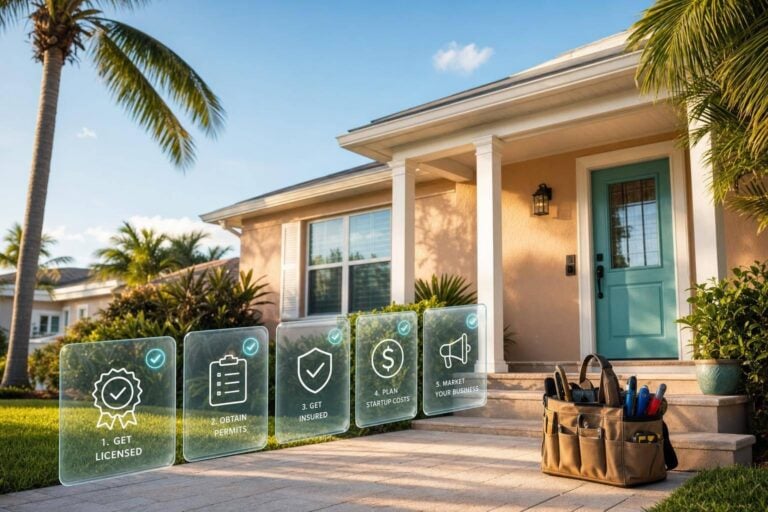
About This Guide
A practical Florida startup guide for launching a residential home-repair and handyman service. The central compliance issue is scope: Florida generally requires a person engaging in contracting to be certified or registered, while narrowly defined handyman work may be exempt. As of the current statutory framework, qualifying casual, minor, or inconsequential work under $2,500 may fall within the exemption, but work requiring a permit is not exempt and the exemption cannot be used to evade contractor licensing by splitting a larger project.
sbb-itb-5b82b38
Business Formation Steps
- Define the service scope: limit the initial offering to non-licensed handyman work, or identify any electrical, plumbing, HVAC, roofing, structural, or other regulated work that must be performed by an appropriately licensed Florida contractor.
- Choose a structure—often a sole proprietorship or LLC—and check the business name. If forming an LLC, file Articles of Organization through Florida’s Division of Corporations (Sunbiz) and designate the required registered-agent and company information.
- Obtain an EIN from the IRS if applicable, open a separate business bank account, and maintain separate business records.
- Register with the Florida Department of Revenue if the business will conduct activities subject to Florida taxes or fees; register before beginning those activities.
- Check the county and city where the business is based and where work will be performed for local business-tax receipts, zoning/home-occupation rules, and permit procedures.
- Purchase insurance, establish written estimates/contracts, and create a system for documenting customer approvals, change orders, invoices, and completed work.
- Confirm each job’s license and permit status with the relevant local building department before quoting or starting work.
Legal Requirements
Florida contractor law is scope-sensitive. A person generally must be certified or registered to engage in contracting. Qualifying handyman work under $2,500 may be exempt only when it is casual, minor, or inconsequential; the exemption does not apply to work requiring a permit, work that is part of a larger operation being divided to avoid the law, or a person advertising or representing themselves as a contractor. Avoid unlicensed regulated trades and subcontract those scopes to properly licensed contractors. Verify permits, inspections, building-code requirements, and any local rules with the project’s building department. If hiring, comply with workers’ compensation, reemployment-tax, new-hire reporting, wage, and safety obligations.
Licensing and Permits
There is no blanket Florida ‘home repair’ license that authorizes every type of repair. Determine whether each service falls within a DBPR contractor category or specialty license. Electrical, plumbing, HVAC, roofing, structural, and permit-required work should be performed only under the appropriate Florida certification/registration or by a properly licensed contractor. For a narrow handyman operation, Florida’s exemption may cover qualifying jobs under $2,500, but the job must be casual, minor, or inconsequential; permit-required jobs are excluded. Check the local building department before work. Florida law also limits local governments from requiring a state or local contractor license for certain non-contractor job scopes such as painting, flooring, cabinetry, specified interior remodeling, handyman services, pressure washing, and similar scopes, but this does not eliminate permit, code, or state-trade-license requirements where applicable.
For the full step-by-step, see our plumbing website design examples guide.
Insurance Requirements
Florida-specific workers’ compensation rules depend on industry, employee count, and entity structure. Construction-industry employers generally need coverage when they have one or more employees, including qualifying corporate officers or LLC members; available exemptions have conditions. Obtain workers’ compensation before hiring where required, and verify classification with the Division of Workers’ Compensation. Even when not legally mandated, carry commercial general liability insurance, completed-operations coverage, commercial auto coverage for business vehicles, tools/equipment coverage, and bonding where a customer or contract requires it. Consider professional liability only if the business provides design, inspection, or advisory services beyond physical repairs.
Startup Costs
Estimated initial startup cost: approximately $2,275–$11,825 for a lean Florida handyman/home-repair operation, including business formation, tools, insurance, vehicle setup, branding, and initial marketing. This estimate assumes the owner starts without purchasing a full work vehicle; buying a dedicated used van or truck can increase the total substantially.
Typical Initial Investments
Typical lean launch budget: basic hand tools $500–$1,500; ladder $150–$400; vehicle use/setup $0–$5,000; vehicle organization system $200–$500; general-liability insurance $500–$1,200 initially; uniforms and branding $100–$300; initial marketing/Google Business Profile support $200–$800; and Florida LLC formation $125. Total modeled investment: $2,275–$11,825. If purchasing a dedicated vehicle, budget separately for a used cargo van or truck; vehicle acquisition is the largest potential cost swing. If operating as an LLC, also plan for the recurring Florida annual report fee of $138.75.
Estimated Setup Time
Typical Time to Launch: Approximately 2–6 weeks for a basic, owner-operated handyman launch after confirming the service scope: entity/name filing, tax registration if required, insurance, tools, contracts, local checks, and marketing. Allow substantially longer if pursuing a Florida contractor certification/registration, specialty credentials, or permit-dependent work. This is a planning estimate, not a state-published processing-time promise.
State Regulations and Compliance
Florida does not issue a general state “handyman” license for minor, casual, or inconsequential work when the aggregate contract price for labor, materials, and other items is less than $2,500; jobs may not be split to evade the threshold, and the exemption does not apply if the business advertises or represents itself as a contractor. Work involving structural alterations, load-bearing walls, plumbing, electrical, air-conditioning, or other regulated contractor scopes generally requires the appropriate Florida DBPR contractor license, and permitting is typically a sign that the work is outside the minor-work exemption. Check the applicable city or county building department, zoning/home-occupation rules, permits, and local business-tax-receipt requirements before operating. Form an LLC or register a fictitious name with the Florida Division of Corporations (Sunbiz), obtain an EIN when hiring employees or opening a business bank account, and maintain appropriate general-liability insurance; licensed contractors must meet DBPR insurance and workers’ compensation requirements. Register with the Florida Department of Revenue when the business sells taxable parts, materials, or other tangible personal property and collect/remit applicable sales tax and discretionary surtax; labor-only repair charges may be treated differently depending on the transaction. An LLC annual report is due each year, with the standard filing fee listed by Sunbiz at $138.75 and a $400 late fee after May 1.
Marketing and Growth Tips
Lead with trust and compliance: publish an exact service list, service area, insurance information, written estimates, warranties, and a clear statement that licensed subcontractors handle regulated work. Optimize local search for terms such as ‘handyman near me,’ ‘rental turnover repairs,’ and neighborhood names; maintain profiles on Google and relevant local directories; collect verified reviews and project photos. Create recurring maintenance plans for landlords, short-term-rental operators, homeowners’ associations, and property managers. Track lead source, close rate, average ticket, callbacks, and gross margin. Grow by hiring carefully, verifying insurance/licensing of subcontractors, standardizing checklists, and pursuing contractor licensing if larger or permit-based projects become part of the strategy.
Client Acquisition Strategies
Start with a tightly defined local service area and a transparent menu of permitted services. Build a Google Business Profile, service-area website, before-and-after portfolio, and review-generation process. Ask early customers for reviews and referrals; network with property managers, real-estate agents, landlords, home inspectors, senior-care organizations, and neighborhood associations. Use local Facebook/Nextdoor groups and small, clearly priced maintenance packages to win initial jobs. Do not advertise yourself as a licensed contractor or imply qualifications beyond your actual authorization; Florida’s exemption does not protect someone who advertises or represents themselves as a contractor.
Helpful Local Resources
- Florida Department of Business and Professional Regulation (DBPR), Construction Industry Licensing Board and Construction Industry FAQs
- Florida Department of State, Division of Corporations—Sunbiz LLC formation and filing instructions
- Florida Department of Revenue—business-tax registration and Florida Business Tax Application
- Florida Department of Financial Services, Division of Workers’ Compensation—coverage requirements and exemptions
- The city or county building department where each project is located—permits, inspections, and local interpretations
- Florida Small Business Development Center (SBDC) network—no-cost or low-cost startup counseling and business planning support