About This Guide
A practical Florida-specific guide to launching an in-home pet-sitting business, covering entity and local registration, business-tax receipts, licensing boundaries, insurance, compliance, startup budgeting, client acquisition, and growth. The central distinction is between visiting pets in the client’s home—which generally has no Florida state pet-sitter license—and boarding or housing animals, which may involve FDACS and additional local requirements.
sbb-itb-5b82b38
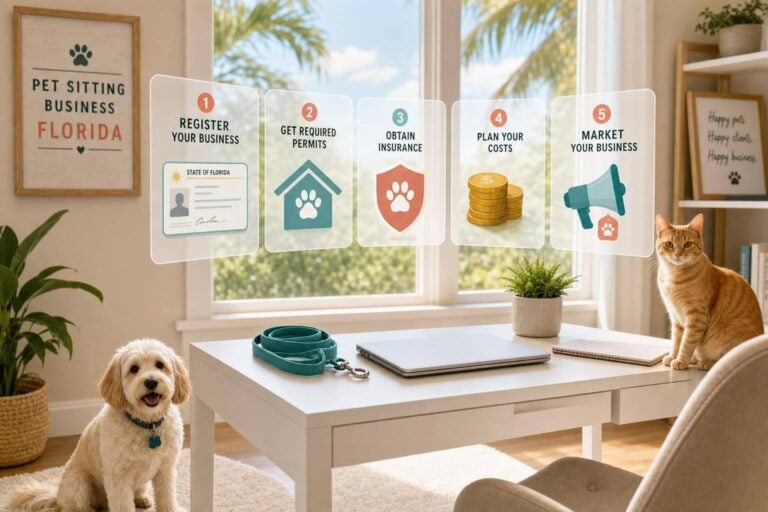
Business Formation Steps
- Research the service area, competitors, pricing, and whether you will provide only in-home visits or also boarding, transportation, grooming, or retail sales.
- Choose a structure—sole proprietorship for simplicity or an LLC for liability separation—and register the entity with the Florida Department of State, Division of Corporations (Sunbiz). File a fictitious-name registration if operating under a name that is not your legal name.
- Obtain an EIN from the IRS if you form an LLC, hire employees, or otherwise need one for federal tax and banking purposes.
- Contact the county tax collector and city clerk where the business is based or operated to obtain each required Local Business Tax Receipt. Requirements and fees vary by jurisdiction; home-based businesses should also confirm zoning and home-occupation rules.
- Register with the Florida Department of Revenue if your activities create a state tax-registration obligation—for example, selling taxable products—and establish bookkeeping for income, expenses, payroll, and applicable taxes.
- Verify the activity-specific rules before launch. In-home pet sitting generally does not require a Florida professional pet-sitter license, but boarding or keeping animals at a facility can trigger Florida Department of Agriculture and Consumer Services (FDACS) requirements and local zoning, sanitation, animal-care, or occupancy rules.
- Prepare client contracts, emergency/veterinary authorization forms, key-access procedures, incident documentation, privacy/security practices, and a written animal-care plan; then open a business bank account, launch a website and booking process, and begin marketing.
Legal Requirements
Register the chosen business structure and any fictitious name; maintain the required local Business Tax Receipt(s); comply with local zoning, home-occupation, noise, waste-disposal, parking, and occupancy rules; and register for applicable Florida taxes. A sitter who visits clients’ homes should not represent the business as a boarding facility. If animals are housed, boarded, or cared for at a business location, verify FDACS requirements and local animal-control, sanitation, recordkeeping, and facility rules before accepting animals. Use written contracts addressing services, fees, cancellation, access, keys, emergency veterinary authorization, medication, vaccinations, aggressive behavior, third-party care, liability limits, and incident reporting. Protect client keys, alarm codes, addresses, and personal information, and comply with general consumer-protection and employment laws.
Licensing and Permits
For pet sitting limited to visits in the client’s home, Florida generally has no dedicated state pet-sitter or professional license. The usual government authorization is the applicable city and/or county Local Business Tax Receipt, often called a local business license; verify with the exact jurisdiction because requirements and fees differ. A fictitious-name registration may be needed through Sunbiz. A home-based operator should check local zoning or home-occupation rules. Boarding, daycare, or housing animals at your premises is different: confirm FDACS licensing or registration requirements, local animal-control permits, zoning, sanitation, occupancy, and facility requirements before opening. A seller’s permit or Florida tax registration may be needed if you sell taxable pet products, while service-only pet sitting is generally not subject to Florida sales tax according to the cited industry/local guidance.
Insurance Requirements
Florida generally does not mandate a special pet-sitter insurance policy for a solo in-home sitter, but coverage is strongly recommended. Obtain commercial general liability insurance and specialized pet-care coverage that includes care, custody, and control/animal-bailee protection; ordinary general liability may not cover injury, illness, escape, or death of an animal in your care. Consider professional liability/errors-and-omissions coverage, non-owned or commercial auto coverage for transporting pets, bonding/crime coverage for employee or key-handling risks, and workers’ compensation if you hire employees. Confirm limits, exclusions, subcontractor coverage, and whether overnight care is covered.
Startup Costs
Estimated lean launch cost: approximately $550–$2,100 for basic supplies, a first-aid kit, pet-sitting insurance/bonding, background check, Florida LLC filing, website/marketing, key storage, platform fees, and optional first-aid training. This excludes a vehicle, staff, boarding facilities, and ongoing operating costs; insurance alone commonly runs about $300–$600 annually for a solo sitter, depending on coverage.
Typical Initial Investments
Pet supplies (crates, beds, bowls, leashes): $101–$505; pet first-aid kit: $30–$101; pet-sitting insurance and bonding: $151–$404 initially in the cited Florida estimate; background check: $25–$75; Florida LLC filing: $125 ($100 filing plus $25 registered agent); website and initial marketing: $101–$505; key-storage system: $20–$101; optional platform fees: $0–$202; optional first-aid course: $0–$50. Also budget for recurring insurance, local business-tax receipt fees, transportation, software, contracts, and replacement supplies.
Estimated Setup Time
Typical Time to Launch: Typically 2–6 weeks for a solo, in-home operation if local registrations, insurance, banking, contracts, and marketing materials are completed promptly. Allow 1–3 months if forming a more complex operation, hiring staff, adding a physical boarding location, or waiting for zoning, facility, or animal-care approvals. These are planning estimates rather than statutory processing times.
State Regulations and Compliance
Florida does not appear to require a special statewide pet-sitter license, but the owner should choose and register the business structure/name through the Florida Division of Corporations (Sunbiz), obtain an EIN where applicable, and check the county and municipality for a local business tax receipt; some locations may require both city and county receipts. Local requirements and fees vary, and home-based boarding or pet-care operations may trigger additional zoning or permitting rules. Florida local business tax receipts generally renew annually, with statutory due dates and delinquency penalties. An LLC requires a $100 filing fee plus a $25 registered-agent fee, and Florida LLC annual reports currently cost $138.75; late annual reports incur a substantially higher fee. Obtain pet-care-specific liability coverage, including care, custody, and control/animal-bailee protection; bonding is optional but useful, particularly when employees enter clients’ homes. If the business hires workers, evaluate workers’ compensation requirements and employment compliance.
Marketing and Growth Tips
Lead with trust and reliability rather than the lowest price: publish service boundaries, response times, meet-and-greet procedures, emergency protocols, testimonials, reviews, insurance information, and relevant training. Optimize Google Business Profile and local search for terms such as “pet sitter in [city]” and “holiday pet sitting [city].” Create useful local content about hurricane preparation, heat safety, medication visits, and travel-season planning. Systematize meet-and-greets, visit reports, GPS or photo updates where appropriate, scheduling, invoicing, and review requests. Grow by converting one-time vacation bookings into recurring walks, adding carefully vetted sitters or employees, expanding the service radius only when routes remain profitable, and developing referral agreements with veterinarians, groomers, trainers, apartment communities, and pet retailers. Recheck state and local requirements whenever adding boarding, transportation, grooming, employees, or retail sales.
Client Acquisition Strategies
Start with a tightly defined service radius and introductory packages for recurring dog walks, vacation visits, medication administration, and holiday coverage. Build trust with references, background-check disclosure, pet first-aid/CPR training, professional photos, clear service agreements, and proof of insurance. Claim and optimize a Google Business Profile, create neighborhood-specific service pages, and request reviews after every successful booking. Network with veterinarians, groomers, trainers, apartment communities, real-estate agents, and pet-supply stores for referrals; participate in local community and pet-owner groups without spamming. Use referral credits, repeat-client discounts, holiday prebooking, and recurring-service subscriptions to improve retention and utilization.
Helpful Local Resources
- Florida Department of State, Division of Corporations / Sunbiz — entity, fictitious-name, and business-registration filings.
- Open MyFlorida Business — Florida’s business-information portal and startup guide for identifying state and local licenses, permits, and registrations.
- County tax collector and municipal clerk — Local Business Tax Receipt applications and local operating requirements.
- Florida Department of Revenue — state tax-registration and tax-compliance information.
- Florida Department of Agriculture and Consumer Services (FDACS) — relevant animal-care, boarding, and facility requirements.
- Florida Small Business Development Center (SBDC) Network — no- or low-cost advising, business-plan assistance, and market research.
- Professional pet-care associations, including the Florida Pet Services Association — industry education, networking, and operational guidance.
- Local animal shelters, humane societies, veterinarians, groomers, trainers, and apartment/property-management groups — referral and partnership opportunities.