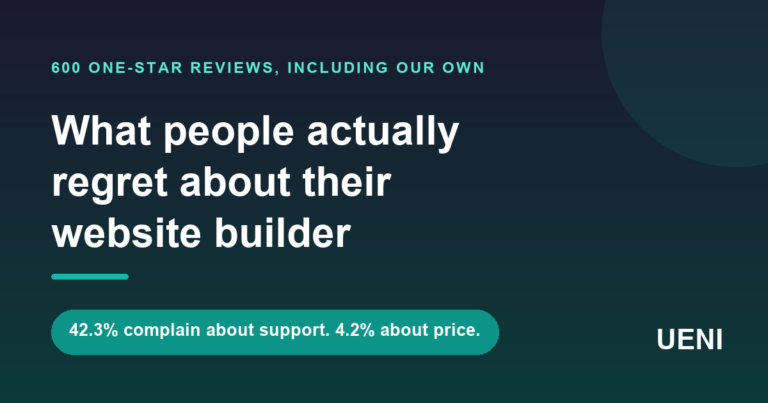
Ask someone why they left their website builder and you will usually hear about money. So we tested that. We read the 600 most recent one-star reviews of five website builders on Trustpilot, including our own, and counted what people were actually angry about. The price came up in 4.2% of them. Support came up in 42.3%. The most common website builder complaints are about what happens after something breaks, not what the plan costs.
For the full step-by-step, see our Squarespace vs WordPress guide.
For the full step-by-step, see our Wix vs WordPress guide.
Key takeaways
- Support is the single biggest complaint, at 42.3% of the 600 one-star reviews we read (254 of 600, gathered 4 August 2026).
- Price is 4.2% (25 of 600). Support complaints outnumber price complaints roughly ten to one.
- Support was the number one theme on all five platforms, at every rating from 3.4 to 4.8.
- 11.7% mention a bot standing between the customer and a human (70 of 600), nearly three times the rate of price complaints.
- Only 3.0% said the product was hard to use (18 of 600), which is the thing every builder markets on.
What are the most common website builder complaints?
Support failures. The most common website builder complaints are not about money at all. Of the 600 most recent one-star reviews we read across five platforms on 4 August 2026, 42.3% describe support you cannot reach or support that could not help (254 of 600). Price appears in 4.2% (25 of 600). That is a ratio of roughly ten to one, and support led on every single platform we looked at.
We expected money to dominate, because money is the reason people give when they cancel. It barely registered. Even the billing complaints are not really about cost. They are about surprise: a renewal nobody was warned about, a second-year charge that arrived with no invoice. People are not saying it costs too much. They are saying they did not agree to it.
Look at where “hard to use” lands. Every website builder on the market sells itself on being easy. Only 3.0% of the angriest customers mention difficulty at all (18 of 600). Ease of use is what people choose on. It is almost never what they leave over.
Whose reviews did we read, and what do those platforms actually score?
Five builders, with a combined base of 254,262 reviews on 4 August 2026: Wix, Squarespace, GoDaddy, Hostinger and UENI. We read 150 one-star reviews each for Wix and Squarespace and 100 each for the other three, 600 in total. Sample sizes were fixed before we read anything.
This next table is the part most competitor comparisons skip, and skipping it is what makes website builder complaints misleading. One-star reviews are a self-selected minority. How big that minority is varies enormously.
| Platform | TrustScore | All reviews | Share one-star |
|---|---|---|---|
| Wix | 3.5 | 28,665 | 21.8% |
| Squarespace | 3.4 | 4,698 | 44.1% |
| GoDaddy | 4.4 | 140,925 | 9.1% |
| Hostinger | 4.7 | 70,914 | 6.7% |
| UENI (us) | 4.8 | 9,060 | 4.9% |
GoDaddy at 4.4 and Hostinger at 4.7 are well rated, and fewer than one in ten of their reviews are one-star. Quoting their angriest customers as though they were typical would be dishonest, and you could check it in thirty seconds. Their complaints below are a minority report and labelled as one. If you are weighing that platform specifically, our guide to GoDaddy alternatives for small businesses covers the trade-offs in detail.
Squarespace is the outlier of the whole study: 44.1% of every review it has on Trustpilot is a one-star. Not 44% of its complaints. 44% of everything. One caveat we cannot resolve, and will not paper over: a company that emails every customer asking for a review gets a healthier spread than one where only furious people arrive unprompted. We have not controlled for that, and it plausibly explains part of the gap. Our Wix vs Squarespace comparison weighs the two on features rather than review sentiment.
How many website builder complaints are about AI support?
More than are about price. Across all 600 reviews, 11.7% mention an AI or a bot standing between the customer and a human (70 of 600). That is nearly three times the rate of price complaints. It is the theme we did not expect to find at all. We have only this one snapshot, so we cannot say whether it is growing, only that it is already large.
The concentration is what makes it interesting. Hostinger carries the largest single share, 31 of those 70 reviews: 31% of its own one-star reviews are specifically about being handled by an AI instead of a person (31 of 100). That is more than twice the next platform: 15% for Wix (23 of 150), 8% for GoDaddy (8 of 100), 5% for Squarespace (7 of 150) and 1% for UENI (1 of 100).
“There is no real support, just AI repeating the same answer again and again.” Hostinger review, 27 July 2026
Read that next to Hostinger’s TrustScore of 4.7 across 70,914 reviews, because both are true at once. Most Hostinger customers are happy. Among the ones who are not, though, the complaint has changed shape. It is no longer “I waited on hold”. It is “I could not get to a person at all”. Its unhappy minority also reports the harshest outcomes in the study: 29% describe an account suspended or a site taken down (29 of 100). One reviewer said an entire VPS was suspended over a complaint about a single site on it.
What does each platform get criticised for?
The themes are not evenly spread. Each platform has a signature complaint, and reading them side by side is more useful than any single score. Every figure below comes from the same 600 reviews gathered on 4 August 2026, and each platform’s overall rating sits next to it.
Wix, which scores 3.5 across 28,665 reviews, has a money problem that is not a price problem. A third of the Wix reviews we read involve a refund asked for and refused (50 of 150), by far the highest in the study. Another 18% fall under unexpected charges, duplicate charges or auto-renewals (27 of 150).
Squarespace, at 3.4 across 4,698 reviews, has the most concentrated support story of the five: 45% of its reviews are about support (67 of 150) and 33% about domains, DNS or email going wrong (49 of 150). Refunds barely appear, at two out of 150. These people are not asking for their money back. They are asking for help and not getting it.
GoDaddy scores 4.4 across 140,925 reviews, comfortably well rated, so treat what follows as a minority report. Inside that minority, 49% are about support (49 of 100), the highest rate anywhere in the study. The particular complaint is being passed between agents rather than ignored outright, which is its own kind of exhausting.
Hostinger, 4.7 across 70,914 reviews, is the AI story above plus a second one: 29% of its one-star reviews describe an account suspended or a site pulled offline (29 of 100), the highest rate of that complaint in the study.
What do people complain about with UENI?
We would have no business publishing this if we left ourselves out. UENI scores 4.8 across 9,060 reviews, and 4.9% of them are one-star, the best figures in the study. That is the good news and it is genuinely the smaller half of the story.
Our criticism is different in kind, and not in a way that flatters us. 23% of our one-star reviews say we promised something and did not deliver it (23 of 100). That is the highest rate of that complaint of any platform here, including the ones scoring 3.4. The other four get criticised for being absent. We get criticised for what we committed to and then did not do. Support is still our own largest theme too, at 35% (35 of 100), so on the headline finding we are not the exception. We are just smaller.
One honest caveat about our own row. UENI has only 384 English one-star reviews in its entire history, so our 100 most recent stretch back to September 2023. The other four platforms produce 100 one-star reviews in two to eight weeks. Our percentages cover a much longer window than theirs, which is what happens when you have fewer complaints, but it does mean the comparison is not like for like.
How should this change how you pick a builder?
Stop leading with price. On the evidence of 600 one-star reviews gathered on 4 August 2026, the cost of the plan accounts for 4.2% of what makes someone angry enough to write a public review. Support accounts for 42.3%. So the question that predicts regret is not what a builder charges you. It is who picks up when something breaks.
The checks that would actually have caught these complaints, roughly in order of how often they came up:
- Open a support ticket before you pay, not after, and time the reply. If a bot answers and there is no visible path past it, you have just reproduced the single most common complaint in this study.
- Work out who controls your domain and your email, because domain, DNS and email problems are the second biggest theme at 24.7% (148 of 600). Learn how to move a domain out before you move it in.
- Read the renewal terms rather than the sticker price. Refunds requested, refused or disputed make up 18.0% of the reviews we read (108 of 600), and 11.5% describe a billing surprise such as an auto-renewal nobody was warned about (69 of 600). We counted those as two separate themes and did not measure how far they overlap. Our breakdown of the cheapest website builder options in 2026 covers where the introductory rates stop.
None of that shows up in a feature comparison, which is why website builder complaints are worth reading before a pricing page. The features are broadly similar. The failure modes are not.
How we did this
We read the 600 most recent one-star English reviews across five website builders on Trustpilot’s public pages on 4 August 2026: 150 each for Wix and Squarespace, 100 each for GoDaddy, Hostinger and UENI. Sample sizes were fixed before any review was read, and nothing was dropped for what it said. Themes were counted with keyword rules over each review’s title and body, one count per review per theme, so a review can carry several and the percentages do not total 100%. We hand-checked a random sample of 36 classified matches: 35 were correct and one was borderline.
What this does not show, stated plainly. Nothing about overall satisfaction, because one-star reviews are a self-selected minority and a very differently sized one per company. Nothing causal either: these are complaints, and we verified no accounts and contacted no platform. The sample is English only, which excludes non-English complaints. And 15.8% of the reviews matched no theme at all (95 of 600), mostly very short ones, and they remain in every denominator.
Sources
Every figure in this article comes from UENI’s own analysis of public Trustpilot reviews. There is no third-party statistic here, so there is nothing to take on trust that you cannot re-count yourself.
- Primary data: the 600 most recent one-star English reviews of Wix, Squarespace, GoDaddy, Hostinger and UENI, collected from Trustpilot’s public review pages on 4 August 2026. 150 each for Wix and Squarespace, 100 each for the other three.
- TrustScores and review counts: each platform’s own Trustpilot profile page, read on 4 August 2026. These move daily, so treat every score here as a dated snapshot rather than a live figure.
- Theme counts: UENI analysis, keyword rules applied to review titles and bodies, one count per review per theme. Precision hand-audited on a random sample of 36 classified matches, of which 35 were correct.
- Method and full figure list: UENI Trustpilot one-star study, findings frozen 4 August 2026. Available on request, including the raw review dataset.
Frequently asked questions
What are the most common website builder complaints?
Support. In the 600 most recent one-star reviews we read across five platforms on 4 August 2026, 42.3% were about support you cannot reach or support that could not help (254 of 600). It was the top theme on every platform in the study, regardless of price or overall rating.
Do people complain more about website builder prices or support?
Support, by roughly ten to one. Price appeared in 4.2% of the 600 one-star reviews we read (25 of 600) against 42.3% for support (254 of 600). Even the billing complaints centre on surprise auto-renewals rather than the cost of the plan itself.
Which website builder has the worst reviews?
By share of one-star reviews, Squarespace: 44.1% of its 4,698 Trustpilot reviews are one-star, against a TrustScore of 3.4, verified 4 August 2026. Wix follows at 21.8% of 28,665 reviews. Review-invitation practice differs between companies and we have not controlled for it.
Are AI chatbots making website builder complaints worse?
They are now a measurable share of them. Across the 600 reviews, 11.7% mention a bot standing between the customer and a human (70 of 600), nearly three times the rate of price complaints. Hostinger is the outlier at 31% of its one-star reviews (31 of 100), against a 4.7 TrustScore.
Is a hard-to-use website builder a common complaint?
No, and that is the surprise. Only 3.0% of the 600 one-star reviews mention difficulty using the product (18 of 600), despite ease of use being the main marketing claim of nearly every builder. Ease of use drives the purchase. It rarely drives the regret.
The bottom line
If 42.3% of 600 one-star reviews are about support and 4.2% are about price, the competitive question in this category is not what a website costs. It is who picks up when something goes wrong. Those 600 come from five builders holding 254,262 reviews between them, but the percentages describe the 600 we read, not the quarter of a million.
That is an uncomfortable thing to publish when your own top complaint is that you promised something and did not deliver it. But a study you only publish when it flatters you is marketing, and this was meant to be a study. The full dataset behind these website builder complaints, including every UENI review we read, is available on request.