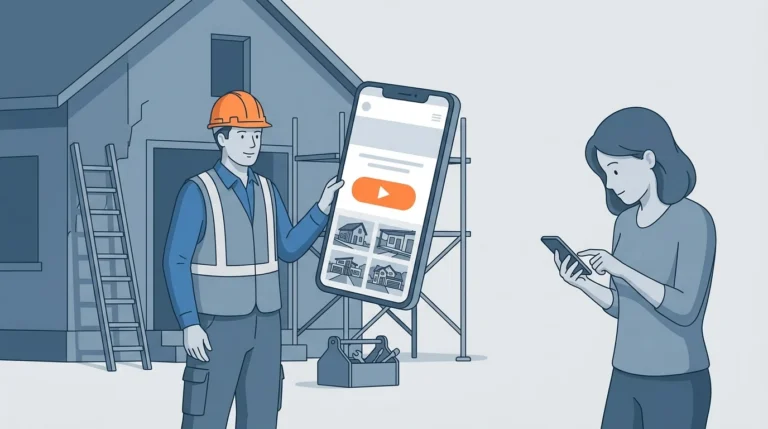
Good contractor website design does three things: it proves you did the work, it makes calling you easy on a phone, and it loads fast enough that nobody backs out. Building it yourself runs about $204 a year on Wix Light or $228 on Squarespace Basic. Having it built for you is $379 in year one.
Key takeaways
- Google Ads in LocalIQ’s Home & Home Improvement category cost $8.33 a click and $90.92 a lead in its 2026 benchmarks, against $5.42 and $66.69 across all industries. Paid leads in this trade are expensive, which is what makes owning the ranking worth the effort.
- Photos of finished jobs are the asset. Not stock images of somebody else’s kitchen.
- Only 48% of mobile sites pass Core Web Vitals, per the Web Almanac’s 2025 analysis. A slow site loses the call before anyone reads a word.
- Reviews close the gap: 68% of consumers will only use a business rated four or more stars, and 31% hold out for 4.5 or better.
- Construction is a big, growing market. The Bureau of Labor Statistics counted 1,649,100 construction laborer and helper jobs in 2024 and projects 7% growth to 2034, much faster than average.
What contractor website design actually has to do
A contractor site has one job: turn a stranger who is worried about being ripped off into someone willing to let you into their house. Everything else is decoration. That framing settles most design arguments, because it tells you what belongs on the page and what does not.
Homeowners are not comparing your typography. They are looking for evidence that you have done this exact job before, that other people were happy, that you are licensed and insured, and that you will actually pick up the phone. Contractor website design is the practice of putting those four proofs where someone can find them in about ten seconds.
This is also why generic small business advice underserves the trades. A restaurant sells an experience you can photograph in advance. You are selling a promise about work that has not happened yet, to someone who has heard horror stories. Proof beats polish every time.
The pages contractor website design has to get right
Most contractors need six or seven pages, not twenty. The order below is by how much each one contributes to getting the call, based on what the page has to prove.
1. A homepage that answers where and what
Trade, service area and phone number, all visible without scrolling. A homeowner in your town needs to know in two seconds that you serve their town. Vague copy about “quality craftsmanship” answers nothing and every competitor says it.
2. A project gallery with real photos
Before and after shots of jobs you did, with a line about the problem and what it took. Six real projects beat sixty stock photos. If you can name the neighbourhood, name it, because that is also a local relevance signal.
3. Individual service pages
One page per service you actually want more of, rather than one page listing all twelve. Someone searching for a specific job wants a page about that job. This is also how you rank for those searches instead of competing with yourself on a single overloaded page.
4. Reviews and credentials on the page, not just on Google
Pull your best reviews onto the site with the reviewer’s first name and the job. Add your license number, insurance status and any manufacturer certifications. These are the two proofs that most often decide it.
5. A quote form that asks for four things
Name, phone, job type, ZIP code. Every extra field costs you submissions, and you can ask the rest when you call back. Keep the phone number clickable next to the form, because plenty of people will just call.
6. An about page with a face
A photo of you or the crew, how long you have been doing this, and where you are based. Anonymous contractors are indistinguishable from lead-resale sites, and homeowners have learned to be suspicious of both.
What contractor website design costs in 2026
There are four routes and they differ more in what you spend of yourself than in what you spend in cash. Prices below are current US rates read on 14 August 2026.
| Route | Cash cost | Your time | Best for |
|---|---|---|---|
| DIY builder | Wix Light $17/mo, Squarespace Basic $19/mo, both billed yearly | A weekend to a month | You enjoy this, or the budget is genuinely zero |
| Self-hosted WordPress | Hosting from $3.99/mo on a 36 month term, renewing at $9.99 | Ongoing, forever | You have someone technical |
| Done-for-you service | $79 setup plus $24.99/mo | An hour of answering questions | The site keeps not getting built |
| Local agency or freelancer | Low four figures upward, plus maintenance | Weeks of back and forth | Custom functionality or a large brand build |
The route people regret is the one where nobody finishes. A half-built site on a cheap plan costs you every lead it never captured, which in this trade is not a rounding error. See affordable website design for what a suspiciously low quote usually leaves out, and how much a website costs for the full breakdown.
Why the ranking is worth more to contractors than to most trades
Home improvement work is one of the most expensive categories in paid search. LocalIQ’s 2026 Search Advertising Benchmarks put its Home & Home Improvement category at $8.33 per click and $90.92 per lead, with a 6.47% click-through rate and an 8.05% conversion rate. The all-industry averages in the same report are $5.42 per click and $66.69 per lead, so contractors pay roughly a third more per lead than the typical advertiser.
That gap is the argument for organic. Every lead your site earns from a search result is a lead you did not pay $90.92 for. It is also why competitors are bidding: the work is worth enough to justify the cost.
Mobile speed is where contractor sites lose the job
Homeowners look for a contractor from the room that has the problem, on a phone, often while standing next to a leak. A site that takes six seconds to show a phone number has already lost to the one that took two. This is not a niche concern: the Web Almanac’s 2025 performance chapter found only 48% of mobile websites achieve good Core Web Vitals, with 62% managing a good Largest Contentful Paint and 77% a good Interaction to Next Paint.
The usual culprits in contractor website design are the easiest to fix. Enormous unoptimised job photos straight off a phone camera. A slider on the homepage nobody scrolls through. Four tracking scripts added by three different marketers. A theme built for a photography portfolio.
Test it the way a customer would. Open your site on your own phone, on cellular data rather than the shop wifi, and time how long until you can tap the phone number. If that is more than about three seconds, fix it before you spend anything on advertising.
Reviews and Google decide who gets the call
Your site rarely wins the job alone. It confirms a decision that started somewhere else, and increasingly that somewhere else is not a search box. BrightLocal’s Local Consumer Review Survey 2026, run on a representative panel of 1,002 US adult consumers via SurveyMonkey, found 97% of consumers read reviews for local businesses.
Two shifts in that data matter for contractors. Google’s share as a review source dipped from 83% in 2025 to 71%, so a Google-only review strategy now covers less ground than it did. And use of ChatGPT and other generative AI tools for local recommendations rose from 6% to 45%, making AI the third most popular source of business recommendations. Whether an AI names you depends on the same signals: consistent details, real reviews, and a site that explains plainly what you do and where.
Star ratings then act as a filter. 68% of consumers will only use a business rated four or more stars, and 31% will only use one at 4.5 stars or more. Below four stars, better contractor website design will not save you. Above it, the site is what converts the visit.
Practically, that means the website work and the review work are one project. Our guides to asking customers for reviews and local SEO for small business cover the routine, and why your website does not show up on Google covers the case where the site is live and still invisible.
Five mistakes that cost contractors work
These come up repeatedly, and all five are cheap to fix once you see them.
Hiding the phone number
It belongs in the header on every page, as a tappable link rather than an image or plain text. Plenty of homeowners would rather call than fill in a form, and a number they cannot tap is a number they will not dial.
Using stock photography
Homeowners recognise stock images, and recognising one tells them you have nothing of your own to show. A slightly crooked photo of your actual work outperforms a perfect photo of somebody else’s.
No service area named on the page
Write the towns and counties you cover as text. It answers the visitor’s first question and it is the clearest local signal you can give a search engine.
One page for every service
A single “Services” page listing twelve trades ranks for none of them well. Split the three or four you want more of into their own pages with their own photos.
Treating the site as finished
Add a project every month or two. It takes ten minutes, it keeps the site fresh, and it gives you something to point a customer at. Sites that never change tend to drift down. Our note on website maintenance cost covers what upkeep actually runs.
Getting it built without it taking over your month
If you have the time and the inclination, a builder will get you there. Wix Light is $17 a month and Squarespace Basic is $19, both billed yearly, and either can run a solid contractor site.
If the honest situation is that this has been on the list for a year, the constraint is not the tool. UENI’s Website Launch plan is $24.99 a month plus a $79 setup fee, and we build the site rather than handing you an editor. The plan lists a custom-designed website built for you, a custom domain and SSL, a professional email address, fast secure hosting, mobile-optimised and SEO-ready pages, and 30 days of done-for-you edits.
Either way, send the photos. That is the part nobody can do for you, and it is the part that gets you hired. For examples in adjacent trades, see our roofing website, HVAC website and landscaping website roundups.
Frequently asked questions about contractor website design
How much should a contractor pay for a website?
Between $0 and low four figures, depending on route. A DIY builder is $17 to $19 a month billed yearly. A done-for-you service is $79 setup plus $24.99 a month. A custom agency build starts in the low four figures. Given a Home and Home Improvement lead costs $90.92 in paid search, most routes pay back quickly.
What pages does a contractor website need?
Six is usually enough: a homepage naming your trade and service area, a project gallery with real photos, individual pages for the services you want more of, reviews and credentials, a short quote form, and an about page with a photo of you or the crew.
Do contractors really need a website if they have Google and Facebook?
Yes, because those profiles send people somewhere to be convinced. Reviews and listings start the decision, and the site is where a homeowner checks your work and licensing before calling. BrightLocal found Google’s share as a review source has already dipped to 71%, so depending on one platform is getting riskier.
What is the most important thing on a contractor website?
Photos of finished jobs, with a tappable phone number nearby. Everything else supports those two. Homeowners are buying evidence that you have done their job before, and your own photos are the only proof that cannot be faked by a competitor with a bigger budget.
How fast should a contractor website load?
Aim to make the phone number tappable within about three seconds on cellular data. Only 48% of mobile sites pass Core Web Vitals according to the Web Almanac’s 2025 data, so this is a genuine differentiator. Compress your job photos first, since they are almost always the cause.
Is it worth writing separate pages for each service?
Yes, for the three or four services you want more of. A page about one job answers that searcher directly and gives you something specific to rank. A single page listing twelve services competes with itself and satisfies nobody who arrives on it.
Sources
- LocalIQ, 2026 Search Advertising Benchmarks, last updated 1 June 2026.
- BrightLocal, Local Consumer Review Survey 2026, representative panel of 1,002 US adult consumers via SurveyMonkey.
- Web Almanac 2025, Performance, HTTP Archive and Chrome UX Report data.
- US Bureau of Labor Statistics, Occupational Outlook Handbook: Construction Laborers and Helpers, 2024 data.
- Wix, Pricing Plans, read 14 August 2026.
- Squarespace, Pricing Plans & Features, US pricing read 14 August 2026.
- Bluehost, WordPress Hosting, read 14 August 2026.
- UENI, Pricing, read 14 August 2026.