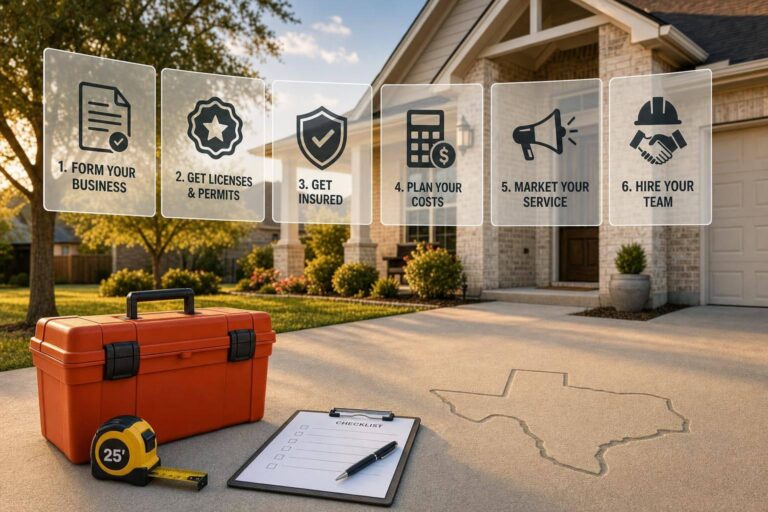
About This Guide
A Texas home repair service is a residential maintenance and repair business handling defined non-specialty work—such as drywall and trim repair, painting, flooring, doors, cabinets, minor carpentry, and property punch-list work—while referring or subcontracting regulated trades. Texas does not have a single general business license; registration and activity-specific state or local authorizations still apply. Texas’s official startup guidance directs owners to choose a structure, register the business, address tax responsibilities, and verify licenses and permits.
sbb-itb-5b82b38
Business Formation Steps
- Define the service scope and choose a structure (sole proprietorship, partnership, LLC, or corporation); consider an LLC for liability separation.
- Search and register the entity with the Texas Secretary of State through SOSDirect, or file an assumed-name (DBA) certificate with the appropriate county clerk if operating under a name different from the owner/entity name.
- Obtain an EIN from the IRS if required or useful for banking, employees, and vendors.
- Register with the Texas Comptroller when the business sells taxable services or tangible personal property; determine applicable sales-tax, franchise-tax, and local tax responsibilities.
- Check the city and county where work will be performed for zoning, home-occupation rules, contractor registration, building permits, and sign/business requirements.
- Identify every trade the service will perform and hire or subcontract appropriately licensed professionals before offering regulated electrical, plumbing, HVAC, or similar work.
Legal Requirements
Texas has no statewide general business license, but the business must be properly registered and comply with local requirements. Do not advertise or perform regulated work outside the appropriate licensed structure: electrical contractors must employ a licensed Master Electrician; plumbing work requires the applicable TSBPE license; and companies installing, repairing, or maintaining air-conditioning, refrigeration, or heating systems must hold the applicable TDLR ACR authorization and employ an ACR contractor at each permanent location. Confirm building-code, permit, inspection, zoning, and home-occupation rules with the relevant city/county. Use written contracts, itemized estimates, change orders, receipts, warranty terms, and lien/ payment practices appropriate to the project. Correctly classify employees versus independent contractors and follow tax, wage, safety, and recordkeeping rules.
Licensing and Permits
For ordinary non-regulated handyman/home-maintenance work, Texas does not issue a single statewide general contractor or handyman license, but cities and counties may require contractor registration, permits, or inspections. A building permit may be required for structural, remodel, electrical, plumbing, mechanical, roofing, or other work under the local building code. Electrical work requires the applicable TDLR electrician/electrical-contractor licensing framework; plumbing work requires a TSBPE license; HVAC, refrigeration, and heating work requires a TDLR ACR contractor license. Obtain a Texas sales-and-use-tax permit if selling taxable services or tangible personal property, and check local permit and registration rules before each job.
For the full step-by-step, see our electrician website examples guide.
Insurance Requirements
Texas generally does not require most private employers to carry workers’ compensation, but coverage is required for employees on government contracts and may be required by a general contractor, property manager, or customer contract. Buy it only from a carrier licensed by the Texas Department of Insurance. Carry commercial general liability insurance for bodily injury and property-damage claims, commercial auto coverage for work vehicles, tools/equipment or inland-marine coverage, and a bond if a city, customer, or contract requires one. Consider workers’ compensation even when optional, plus hired/non-owned auto and umbrella coverage as the crew and contract size grow. Verify subcontractors’ certificates of insurance.
Startup Costs
Typical Texas startup cost: approximately $1,840–$30,360, with a median estimate around $9,200 for a solo handyman operation. A more comprehensively equipped business may require roughly $10,000–$30,000, depending primarily on whether the owner already has a vehicle and tools.
Typical Initial Investments
Professional tools and equipment: about $920–$13,800, with approximately $3,680 as a mid-range estimate; vehicle: roughly $2,760–$13,800 in the Texas cost model, or about $8,000–$20,000 for a used cargo van in broader estimates; business license/insurance: approximately $276–$4,600 in the Texas model, with general liability commonly around $800–$1,500 annually and commercial auto around $800–$1,500 annually; LLC formation, if selected, costs $300 in Texas. Also budget for branding/marketing, software, permits, phone, fuel, and working capital.
Estimated Setup Time
Typical Time to Launch: Typically 2–6 weeks for a solo, non-regulated home-repair launch: several days for name/entity, banking, EIN, and insurance; roughly 1–3 weeks for local registrations, supplier accounts, estimating systems, and marketing. Allow 1–3 months or longer if adding electrical, plumbing, HVAC, structural, or major remodeling work because trade licensing, permits, inspections, and experience requirements may apply. This is a planning estimate, not a state processing-time guarantee.
State Regulations and Compliance
Texas has no general statewide business license and generally does not require a state contractor license for ordinary handyman or general home-repair work, but cities and counties may require contractor registration, local permits, or a home-improvement license. Specialized work must comply with trade licensing rules: plumbing and HVAC/electrical work may require the appropriate state-licensed professional or trade authorization. Form the business through the appropriate structure; sole proprietors and partnerships generally file an assumed name with the county clerk, while LLCs and corporations register with the Texas Secretary of State. Obtain an EIN, check local zoning and permits, and carry appropriate general-liability and vehicle insurance; workers’ compensation is generally optional for private Texas employers but may be required by contract or client. Tax treatment depends on the job: residential repair/remodel labor is generally not taxable to the customer, while the contractor pays tax on incorporated materials under a lump-sum contract; nonresidential repair, restoration, and remodeling are taxable services, requiring collection of state and local sales tax. Confirm current requirements with the Texas Business Permit Office, the relevant municipality, and the Texas Comptroller.
For the full step-by-step, see our plumbing website design examples guide.
Marketing and Growth Tips
Position the company around reliability, a clear service radius, rapid response, clean job sites, and documented workmanship. Optimize local search with consistent name/address/phone information, service-specific pages, project photos, and review requests. Publish fixed-price examples or diagnostic/estimate policies, but avoid promising regulated work without the required license. Create maintenance plans for landlords and repeat customers; use CRM reminders for seasonal work and warranties. Add technicians only after measuring profitable job types, travel time, callbacks, gross margin, and lead cost. Maintain current permits, tax registrations, insurance certificates, and license information in proposals to increase trust with homeowners and referral partners.
Client Acquisition Strategies
Start with a narrowly defined service menu and service area; create a Google Business Profile with service-area coverage, before-and-after photos, pricing ranges, hours, and a call/text option. Ask every satisfied customer for a review and referral. Build referral relationships with real-estate agents, property managers, landlords, home inspectors, hardware stores, and restoration companies. Use neighborhood groups, Nextdoor, local Facebook groups, targeted search ads, and door hangers where permitted. Win early jobs with fast estimates, written scopes, transparent change orders, workmanship guarantees, and proof of licensing/insurance. Track lead source, estimate-to-job conversion, average ticket, repeat work, and review volume.
Helpful Local Resources
- Texas Economic Development & Tourism Business Permit Office and the Texas Business Licenses & Permits Guide
- Texas Secretary of State—SOSDirect and business-entity filings
- Texas Comptroller of Public Accounts—tax registration and sales-tax guidance
- The city building/development department and county clerk in each service area
- Texas Department of Licensing and Regulation (TDLR)—Electrical and Air Conditioning & Refrigeration programs
- Texas State Board of Plumbing Examiners (TSBPE)
- Texas Department of Insurance and Division of Workers’ Compensation
- Local Texas Small Business Development Center (SBDC) for no- or low-cost startup counseling