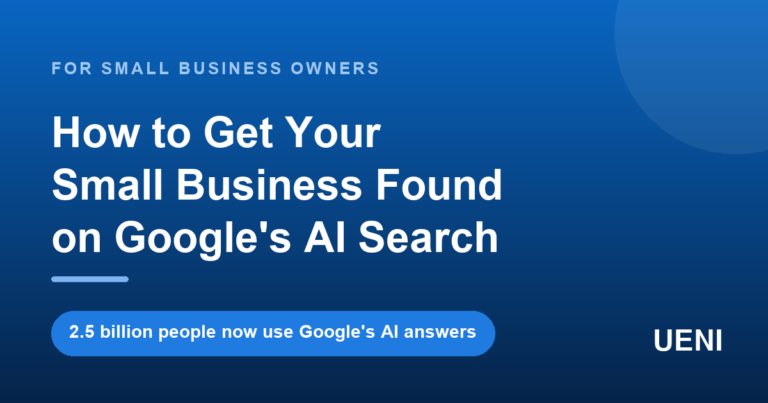
Google AI search has quietly become the front door to the internet. At Google I/O 2026, the company said its AI answers in Search now reach billions of people a month, and a new conversational AI Mode passed a billion users in its first year. For a small business owner with no marketing team, that raises a simple and slightly nervous question: if Google now answers people’s questions for them, will customers still find you? This guide explains what Google announced in 2026 in plain language, and what it actually means for getting your business found on Google.
Key takeaways
- Google AI search is now mainstream. AI Overviews reach over 2.5 billion people a month and AI Mode passed 1 billion users in a year (Google, 2026). Search increasingly answers the question instead of just listing links.
- Fewer of those answers end in a click. Pew Research found people clicked a result link on 8% of visits when an AI summary appeared, versus 15% without one (Pew Research, 2025).
- The buying journey is shortening from “search, browse, compare, choose” toward “ask AI, get a recommendation, act”. The question is no longer only where you rank, but whether the AI knows you exist and trusts you.
- Trust signals now do the heavy lifting. 97% of consumers read reviews for local businesses, and Google is still the top place they read them (BrightLocal, 2026).
- The practical response is unglamorous: a clear, complete website, a fully filled-in Google Business Profile, steady reviews, and consistent business details everywhere. That is how you stay found on Google and become the business its AI recommends.
What changed about getting found on Google in 2026?
The headline is scale. At Google I/O 2026, Google said AI Overviews now has over 2.5 billion monthly active users, and AI Mode, its conversational version of Search, surpassed 1 billion users within a year of launch (Google, Sundar Pichai’s I/O 2026 keynote, 2026). AI answers are no longer an experiment bolted onto the results page. They are how a large share of people now use Google.
Google runs two big events each year. Google I/O is where it shows new consumer and developer products. Google Marketing Live, a few days later, is where it tells advertisers how to work with those changes. In past years the two felt separate. In 2026 they told one story: Google is rebuilding Search, shopping, and ads around its Gemini AI, and around assistants that can research and act on your behalf.
The same week, the Gemini app passed 900 million monthly users, up from 400 million a year earlier (Google, I/O 2026 keynote, 2026). So people are getting answers in two places at once: inside Google AI search, and inside a separate assistant they open on purpose. Both habits pull attention away from the old routine of scanning ten blue links.
Why is Google sending fewer visitors to your website?
Because the answer often lives on the results page now. Pew Research found that when an AI summary appeared, people clicked a traditional search result on just 8% of visits, compared with 15% when no summary was shown, nearly half as often (Pew Research Center, 2025). The summary scratches the itch, so the visit ends.
Two more numbers from the same study matter. About one in five Google searches in March 2025 already produced an AI summary, and people ended their session on 26% of pages with a summary, versus 16% without one (Pew Research Center, 2025). More answers, more dead ends for the websites underneath.
If you sell information, that hurts. A recipe blog or a generic “what is X” page loses the click to the summary. But most small businesses don’t sell information. They sell a haircut, a tax return, a leaking-tap repair, a table for four. Someone searching “emergency plumber near me” still has to pick a real plumber and call them. Google AI search can answer a fact for free. It can’t fix the tap.
So the threat is narrower than the scary headlines suggest, and the opportunity is specific: stop competing for clicks on questions a summary can answer, and start being the business the summary recommends when someone is ready to act.
How do customers find a small business now?
Increasingly, by asking instead of browsing. With 900 million people on the Gemini app and over 2.5 billion on AI Overviews (Google, I/O 2026 keynote, 2026), a growing share of buyers now pose a full question and expect a shortlist back, not a page of links to sift through. The businesses that get found on Google now are the ones its AI can confidently name.
At Google Marketing Live 2026, Google leaned hard into this idea of conversational, assistant-led shopping, where the AI helps narrow options and guides the next step. Marketing analyst Neil Patel, whose recap prompted this article, sums up the shift as the funnel collapsing. The old path looked like this:
Search → Website → Research → Compare → Buy
The emerging path looks more like this:
Ask AI → Get a recommendation → Act
Think about how you’d ask: “best CRM for a one-person agency”, “reliable dog groomer in Leeds with evening slots”, “who can re-tile a bathroom under a grand”. The interesting part isn’t the answer. It’s that the AI picks who to name. So the question every owner should sit with is blunt: does the AI know my business exists, and does it have a reason to trust me over the shop down the road?
Why your reviews and reputation matter more than keywords
Because AI recommends what it can verify. The signal it leans on most is the same one people lean on: reputation. 97% of consumers read reviews for local businesses, and Google remains the top place they read them at 71% of review readers (BrightLocal Local Consumer Review Survey, 2026). The same reviews that reassure a human also tell the AI you’re real and well regarded.
For years, small business marketing rewarded clever wording: the exact phrase in the page title, the right keyword stuffed in the right spot. Google’s 2026 systems care less about the precise words you typed and more about what you clearly are. A well-known, consistent, well-reviewed business is easy for AI to recognize and safe for it to recommend. A thin, inconsistent one is a risk it would rather skip.
What we see at UENI: the businesses that get surfaced are rarely the ones with the cleverest SEO. They’re the ones whose story is the same everywhere, with the same name, the same phone number, the same services, and a steady trickle of recent reviews across their website and their Google profile. Consistency reads as credibility, to people and to machines.
Neil Patel puts it neatly: in an internet curated by AI, authority becomes distribution. You don’t earn a recommendation by gaming a ranking. You earn it by being the obvious, trustworthy choice in your category and your town.
How do you get your small business found on Google now?
Start with the basics that AI reads, not with tricks. With over 2.5 billion people now using AI answers in Search (Google, I/O 2026 keynote, 2026), your job is to be clearly understandable and clearly trustworthy, so you get found on Google for the work you actually do. Here’s the short, non-technical checklist.
- Have a real, complete website. Say plainly what you do, who you do it for, where you operate, and how to book or call. Vague or half-finished sites give AI nothing solid to repeat.
- Claim and fill in your Google Business Profile. Category, hours, service area, photos, and a current description. This is the record Google AI search leans on most for local recommendations. Our Google Business Profile guide walks through it.
- Collect reviews, steadily. Ask every happy customer. Recent, genuine reviews are the trust signal both people and AI weigh most heavily.
- Keep your details identical everywhere. Same business name, address, and phone number on your site, your Google profile, and any directory. Mismatches make you look unreliable.
- Answer the real questions in plain words. Put the questions customers actually ask, and short honest answers, on your site. Clear answers are exactly what AI extracts and quotes.
- Skip the keyword games. Don’t stuff phrases or spin thin pages. Spend that energy on being genuinely useful and genuinely consistent.
None of this needs a developer or a marketing degree. It needs your business to be present, complete, and consistent online, which is exactly the gap most owners haven’t closed yet. If building and maintaining that feels like one job too many, UENI builds a done-for-you small business website in seven days, with a custom domain, hosting, professional email, and local SEO setup so you can be found on Google and its AI answers.
Is SEO dead for small businesses?
No, but it’s changing shape. The click figures are sobering, with result-link clicks dropping from 15% to 8% of visits once an AI summary appears (Pew Research Center, 2025). Chasing rankings on broad informational queries is a worse bet than it was.
What replaces it isn’t mysterious. Be the business AI can identify and vouch for. Traditional rankings still matter for the moments people do click, but being found on Google’s AI answers and recommended by them is the new prize. The good news for small businesses: that prize rewards being a real, reputable local operator, which is something you already are. For broader inspiration, browse our small business website examples, and when you’re ready to bring people in, our guide to small business advertising covers the channels that work.
Frequently asked questions about getting found on Google
The questions we hear most from owners trying to make sense of Google’s AI changes.
Will my website still get traffic now that Google uses AI?
Some informational traffic will drop, since people clicked a result on only 8% of visits when an AI summary appeared, versus 15% without (Pew Research, 2025). But buyers searching for a local service still need to choose and contact a real business. A clear, complete website is how you win those higher-intent visits.
How do I get my business recommended by Google’s AI?
Be easy to recognize and trust. Fill in your Google Business Profile, keep your business details identical everywhere, and collect steady reviews, which 97% of consumers read for local businesses (BrightLocal, 2026). AI surfaces businesses it can verify as real, relevant, and well regarded.
Do I still need a website if AI answers questions directly?
Yes, arguably more than before. The AI builds its recommendation from somewhere, and a clear website is a primary source it reads. With over 2.5 billion people using AI Overviews (Google, 2026), a complete site is how you stay quotable rather than invisible.
What is Google AI Mode and how is it different from normal search?
AI Mode is Google’s conversational version of Search, which passed 1 billion users within a year (Google, 2026). Instead of returning links, it holds a back-and-forth: you ask, refine, and compare in one place. It treats search as an ongoing conversation rather than a list of single queries.
How important are reviews for getting found on Google now?
Very. 97% of consumers read reviews for local businesses, and 71% of review readers use Google to do it (BrightLocal, 2026). Recent, genuine reviews are among the strongest trust signals both customers and AI systems use when deciding whom to recommend.
Next steps
Google AI search is the biggest change to how people find businesses in two decades, but the response for a small business owner is reassuringly old-fashioned. Be present. Be complete. Keep your details consistent, and keep the reviews coming. The tactics that win in 2026 aren’t clever tricks. They’re just the marks of a real business that takes itself seriously online.
If you’d rather not piece it together yourself, UENI builds your website, sets up your Google presence, and gets you found, so you can be the business the AI recommends while you get on with the work.
Sources
- AI Overviews, AI Mode, and Gemini user numbers: Google, Sundar Pichai’s opening keynote at Google I/O 2026 (blog.google), May 19 2026. Retrieved 2026-06-02.
- Click-through and session data with AI summaries: Pew Research Center, Google users are less likely to click on links when an AI summary appears in the results, July 22 2025. Retrieved 2026-06-02.
- Review-reading behavior and platforms: BrightLocal, Local Consumer Review Survey, 2026 edition. Retrieved 2026-06-02.
- Trend framing adapted from Neil Patel, Key Updates from Google I/O and Marketing Live 2026, May 21 2026. Embedded videos: Google I/O 2026 Keynote and Google Marketing Live 2026 (both Google, via YouTube).