You’ve just launched your business, and alongside all the work that comes with a new venture, you may be wondering:
Should I get a website for my business?
Maybe you already have a website, but you’re starting to worry it’s outdated or doesn’t reflect the current direction of your business. Perhaps you’re exploring new options to improve your site’s performance, attract more customers, and build lasting customer loyalty. Keep in mind that sometimes, updating your website means starting from scratch. While that may sound daunting, it can actually be a fantastic opportunity to refresh your brand, leverage the latest design trends, and incorporate cutting-edge functionality to boost your business’s online presence.
Whether you’re launching your first website or updating an existing one, if you’re curious about how much it will cost to build a website for your small business in 2026, you’ve come to the right place.
Understanding Website Costs in 2026
The process of determining the cost of building a website can be tricky, because there are so many different options to choose from. That’s why we’ve compiled a detailed breakdown of the various approaches and their associated costs, so you can find the best solution for your business.
No matter what your budget is, this guide will help you understand the average cost of building a website in 2026 and how to make an informed decision about your website’s future.
Table of Contents
Professional Website Done-For-You in 7 Days
Get a custom-built website tailored to your small business, built and managed for you by our experts.
START TODAY
How much does it cost to build a website on average?
Instead of asking, “How much does a website cost?”, it might be more helpful to ask, “How much should a website cost?”
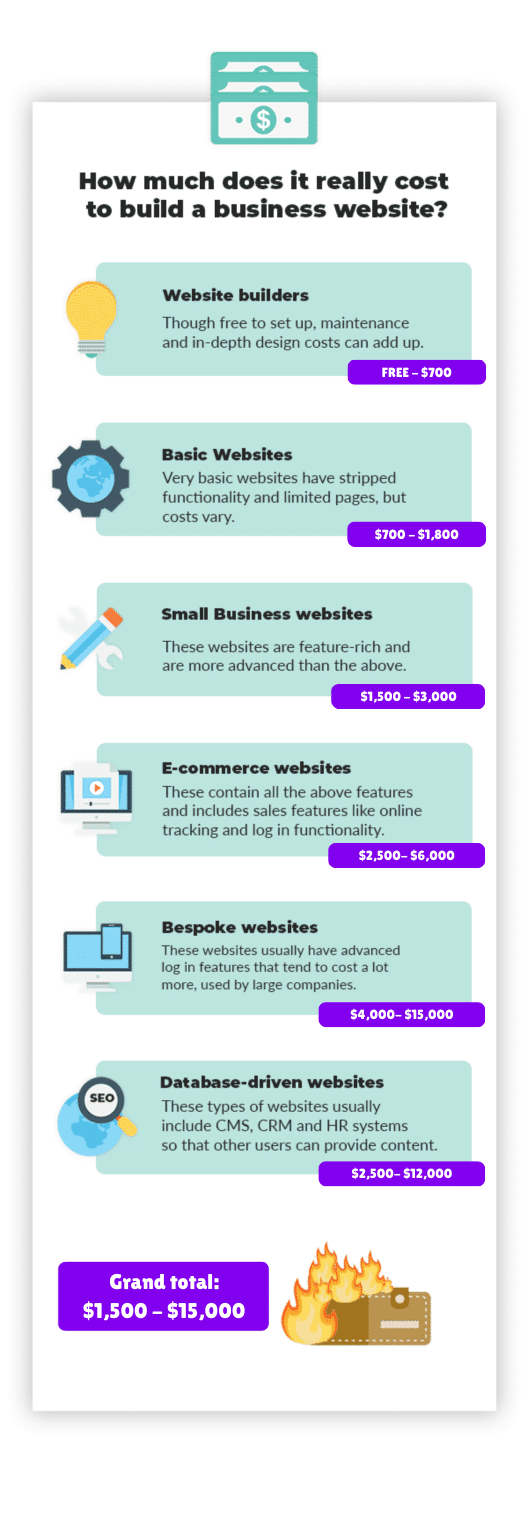
In 2026, the average cost of a website for a small business ranges from $3,000 to $10,000, depending on the complexity, features, and design choices. This estimate assumes you’re not building the website yourself and are working with a professional team.
It’s important to note that this cost typically reflects a basic to mid-range website with limited functionality. The price covers the development of the website itself but doesn’t account for ongoing costs like maintenance, content updates, or subscription fees (e.g., for domain names, hosting, or software integrations).
The reason it’s difficult to specify an exact cost is that there are many different types of websites to choose from—each with its own pricing structure. You may be considering:
- Basic one-page sites for simple informational purposes.
- E-commerce websites designed for online shopping with integrated payment systems.
- Database-driven websites that offer dynamic content or user-specific features.
Each type of website requires different levels of customization, technical expertise, and functionality, which can significantly impact the final cost.
Breakdown of Average Website Costs and Development
|
Website Type |
Approximate Development Time |
Price Range |
|
Website Builders |
1-2 weeks |
Free – $700 |
|
Basic Websites |
2-4 weeks |
$700 – $1,800 |
|
Small Business |
4-8 weeks |
$1,500 – $3,000 |
|
E-commerce Websites |
8-16 weeks |
$3,000 – $6,000 |
|
Data Driven Websites |
8-16 weeks |
$3,000 – $12,000 |
|
Custom Websites |
16-24+ weeks |
$4,500 – $15,000 |
We hope this approximate data helps you with understanding the costs of building a website. Remember that these prices represent rough estimates and can differ significantly depending on the website complexity, required customization, and the web developer’s expertise.
When requesting a quote for a website, it’s essential to supply ample information, enabling the provider to generate an accurate estimate closely reflecting the true cost before making a commitment.
Common Website Development Pro’s & Con’s:
|
Website Type |
Pros |
Cons |
|
Website Builders |
|
|
|
Basic Websites |
|
|
|
Small Business |
|
|
|
E-commerce Websites |
|
|
|
Data Driven Websites |
|
|
|
Custom Websites |
|
|
Probably goes without saying – finding the perfect equilibrium between expenses and quality is key.
Website Price Averages by Industry
To give you a clearer understanding of website costs across different sectors, here’s an updated compilation of average website prices by industry for 2026.
|
Industry |
Price Range |
|
Retail and E-commerce |
$2,500 – $6,500 |
|
Professional Services |
$1,800 – $5,000 |
|
Restaurants and Food Services |
$1,500 – $4,000 |
|
Health and Fitness |
$1,800 – $5,000 |
|
Real Estate |
$2,500 – $6,500 |
|
Nonprofit Organizations |
$1,500 – $4,500 |
|
Technology and IT Services |
$1,500 – $12,000 |
|
Arts and Entertainment |
$1,800 – $5,000 |
|
Travel and Tourism |
$2,500 – $6,500 |
|
Education |
$2,500 – $6,500 |
Bear in mind that while the presented figures offer a valuable starting point for understanding website expenses across various industries, these numbers are not set in stone. Factors such as the complexity of the website, the degree of customization, and the experience of the developer can all influence the final cost.
As a bonus, here are some common suggestions for each industry to consider when creating or updating websites:
- Retail and E-commerce:
-
- Focus on user experience (UX) and easy navigation
- Prioritize secure payment processing and trust signals to get the most out of your website.
- Showcase high-quality images and detailed product descriptions
-
- Professional Services:
-
-
- Highlight expertise through testimonials and case studies
- Clearly present service offerings and pricing structures
- Incorporate a strong call-to-action (CTA) for lead generation
-
- Restaurants and Food Services:
-
-
- Display an easy-to-read menu with appealing food images
- Incorporate online ordering and reservation options
- Showcase the ambiance and atmosphere of the dining space
-
- Health and Fitness:
-
-
- Offer valuable health and fitness tips or blog content
- Clearly outline membership options, classes, and pricing
- Include before-and-after client transformations or success stories
-
- Real Estate:
-
-
- Implement an easy-to-use property search feature
- Showcase high-quality images, virtual tours, and detailed property descriptions
- Highlight local area knowledge and expertise
-
- Nonprofit Organizations:
-
-
- Clearly communicate the mission and impact
- Offer various donation options and volunteer opportunities
- Share success stories, testimonials, and updates on ongoing projects
-
- Technology and IT Services:
-
-
- Explain technical services or products in layman’s terms
- Showcase case studies demonstrating successful projects or problem-solving capabilities
- Include clear pricing structures and service level agreements (SLAs)
-
- Arts and Entertainment:
-
-
- Display a portfolio of work or past performances
- Offer an event calendar or booking information
- Share artist biographies or background stories
-
- Travel and Tourism:
-
-
- Present visually appealing images and videos of destinations
- Offer helpful travel tips and local insights
- Incorporate customer reviews and testimonials
-
- Education:
-
-
- Clearly outline course offerings, schedules, and pricing
- Share student success stories, testimonials, or alumni achievements
- Provide easily accessible resources and learning materials
-
Get your website in a few clicks
UENI is the #1 solution for small business owners who need a website
START NOW
Equally important to take these pointers for a spin with a real-world example: Village-Gardener.
Want to see what you get for the money? Browse 30 photographer website examples built on UENI.
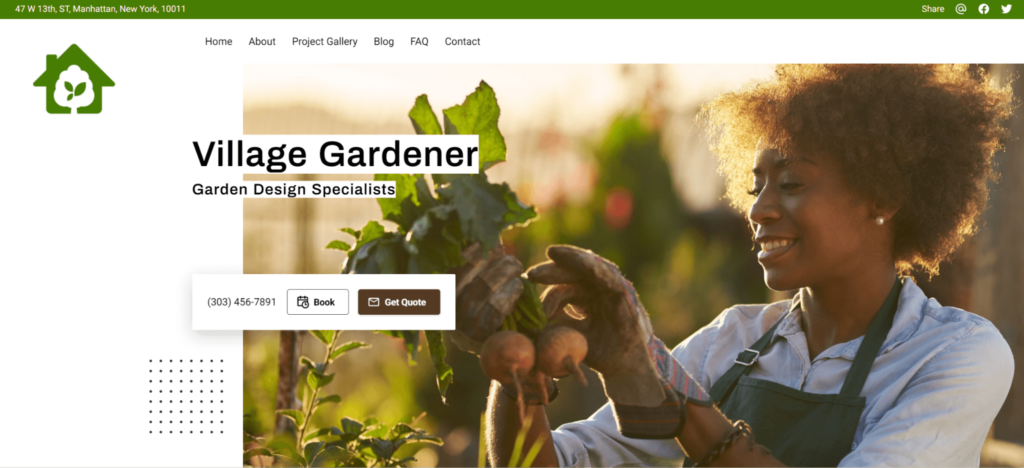
They’re in the professional home services industry, and they’ve nailed the art of building trust online. They’ve established their expertise by linking to well-respected sources like the BBB. Their website design does an awesome job drawing your attention to their call-to-action, a bold “Get a quote” button right on the homepage. And we love how clearly they present their service offerings, making it easy for visitors to understand what they provide.
This is a fantastic example of how to create a professional and user-friendly website.
Next up a great restaurant example: Rock Salt Restaurant.
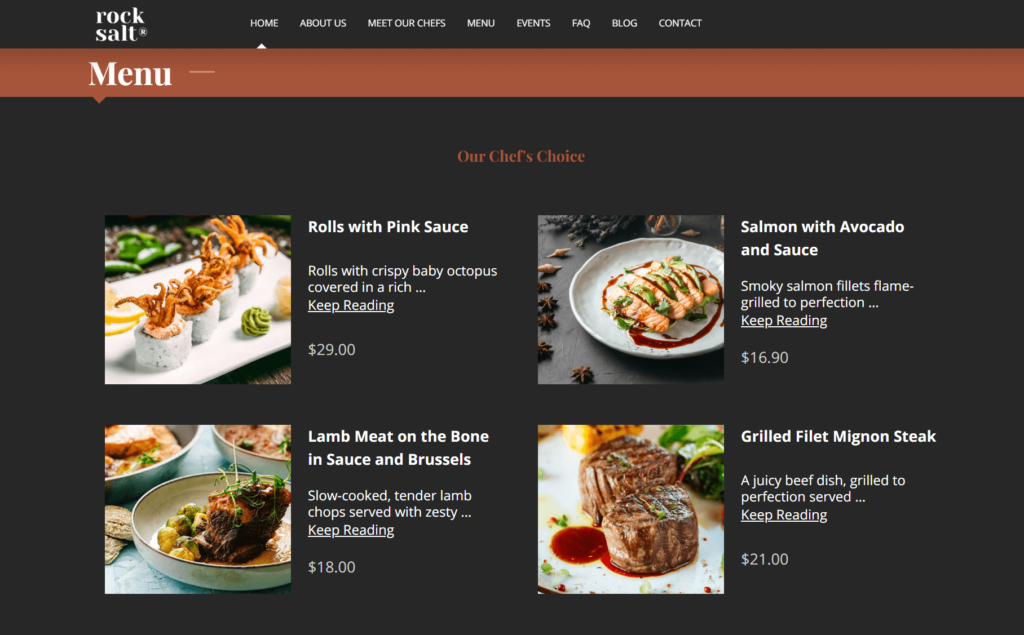
This example checks all the boxes we mentioned for restaurants.
The menu is super easy to read and those delicious food pictures? They’re impossible to resist!
Additionally, the website got this handy online reservation system so you can book your table in a jiffy. The dark tones of the website really set the mood, giving you a feel of the restaurant’s cozy ambiance right from your screen. It’s a great example of how paying attention to the small details can make a website a real winner!
Now for a final quick example, let’s take a closer look at the Monroe Flix Studio.
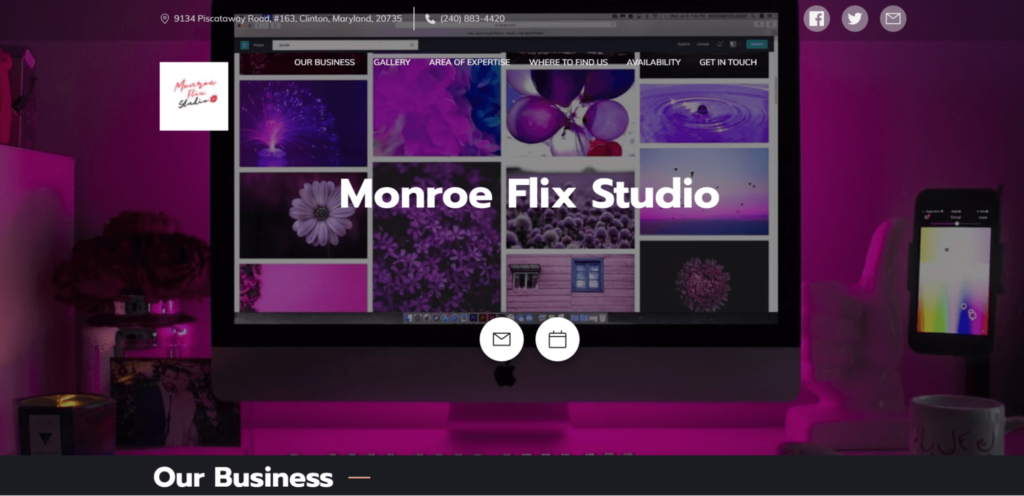
This arts and entertainment site totally nails it! They have this neat booking module that lets you reserve their services without any fuss.
And, have you seen their design? The bold black, punchy purple and subtle gold color scheme is simply stunning. Plus, they do a fantastic job showcasing their expertise and work.
This site is a great example of how to flaunt your craft and make your audience feel welcome.
Considering these industry-specific suggestions beforehand will help make your website to better meet the needs of your target audience, ultimately leading to a more engaging and effective online presence.
As you consider building or updating your website, keep these factors in mind and ensure to provide comprehensive information when requesting a quote
Quick Tips to Minimize Average Cost of Building a Website
- For small business owners aiming to stay within budget, reducing website creation costs is crucial. Here are some strategies to help minimize expenses while still getting a high-quality website:
- Opt for a website builder to craft a basic site affordably or even free of charge
- Leverage pre-designed templates or themes to decrease design expenditures
- Restrict your website’s functionality and features to the necessities
- Be transparent about your annual budget when soliciting a quote from a developer or agency
- Receive a Ready-Made Website in a Mere Seven Days
For those seeking a swift and uncomplicated approach to procuring a business website, explore our Ready-Made Website service. Our adept team of web designers and developers can fashion a tailor-made website for you in just one week.
Now, let’s take a detailed look at all the website features that matter for small local businesses, so you can approximate what you’d spend to have a bespoke website built for you.
Building your own website (DIY)
Building your own website is a good way to cut down on costs.
With all the different web-building platforms available today, you don’t need to be particularly tech-savvy to build a website all on your own. You don’t have to code, or manage hosting, or even know what a responsive web design is.
Just follow these steps:
- Step 1: Choose your website builder – Wix and Weebly are popular and it’s free to get started.
- Step 2: Choose your domain (though to get a custom domain, you’ll need to pay for a subscription)
- Step 3: Pick a template that you like from the available options
- Step 4: Select images, customise the layout, and add the content (writing the descriptions of your services, your contact information, etc.)
This process is technically free. But, although you’ll get your website, you won’t necessarily get the maintenance your website will need to perform in the long-term.
Also, be aware: just because you have a website, doesn’t mean your customers can see you!
To get your business in front of customers, you need to plant more than just one seed. Your website is where it starts, but you should also create profiles for your business on social media (such as Facebook), search engines (such as Google and Google Maps), and on other local directories. Writing good Facebook posts, of course, still remains essential. Each of these gives your business more credibility and visibility, meaning it’s easy for customers to find you and to believe you’re a legitimate business.
Professional Website Done-For-You in 7 Days
Get a custom-built website tailored to your small business, built and managed for you by our experts.
START TODAY
Website Builders
Wix
Wix is one of the most popular drag-and-drop website builders out there, and for good reason: their editor is easy to use and very powerful. The problem with Wix however, is that just building an attractive website isn’t enough to start attracting customers. You need to incorporate strategies such as SEO (Search Engine Optimisation) to ensure the right keywords, the correct sizing of images, and other technical aspects of your website are all in place to ensure it ranks on the first page of Google and other search engines. And how Google evaluates websites to select which ones appear on the first page of results is always changing, so regular updates are a must.
For a fully-functional business website, Wix’s paid plans start at $17 a month for Light and run to $159 a month for Business Elite. Wix bills those rates yearly, paid in full up front, so budget the annual figure rather than the monthly one.
WordPress
Although the basic WordPress package is also free, it will demand more technical know-how than Wix when it comes to making the most out of your site. WordPress offers business owners a short-term solution, but it’s not a good option for businesses without a large budget to spend on developing and managing their website.
Squarespace
Unlike WordPress, you need to enroll in a paid subscription to use and access Squarespace, but you do get a free trial for 14 days. That said, their templates are stunning, and their editor allows you quite a bit of freedom.
The cost of operating your website on Squarespace ranges from $19 to $99 a month on annual billing, depending on the features you choose (if you need an online store or a professional email account, for example).
Many Squarespace users tout the nice-looking templates available on Squarespace. Indeed, the options available on SquareSpace are aesthetically focused and they do look very slick and appealing. But once you begin to customise the template of your choice, you may run into problems. You really need a professional to ensure the layout is optimised for all devices (mobile phones as well as computers) and that it’s easy to navigate.
Shopify
Shopify is one of the most widely used platforms for e-commerce businesses, offering a straightforward way to set up and manage an online store. Shopify’s pricing ranges from $29 to $299 per month, depending on the features and level of service you need. Shopify is ideal if you plan to sell products online, as it provides essential e-commerce tools such as payment gateways, inventory management, and shipping integration.
It’s an excellent choice for small businesses with plans to grow their e-commerce operations, but it can get pricey as your business scales, especially if you need more advanced features or apps from the Shopify store.
Sitebuilder.com
Similar to Squarespace, Sitebuilder offers a variety of templates and e-commerce features, allowing businesses to create professional-looking websites without a lot of technical expertise. However, Sitebuilder’s pricing is also $30 to $300 per month, depending on the services and features you need. Like Squarespace, Sitebuilder may not be ideal for businesses that require highly customized designs or robust functionality outside the available templates.
One of the common limitations with Sitebuilder (and similar platforms) is the lack of an all-in-one package. You may find yourself needing additional services or features that require third-party integrations, which could add extra costs down the line.
Custom-made website solutions
Now that you’re familiar with the various website-building options available, let’s explore the world of custom-made website solutions—ideal for businesses that need tailored functionality and design.
When opting for a custom-built website, it’s important to clarify your specific needs and goals before making a decision. Here are three key areas to focus on to ensure you get the most out of your investment:
- The type of content you’re planning to publish
Are you looking to only list your services and prices, to regularly publish blog articles, tutorials or contests, or to share media content such as pictures, videos or slide desk?
- The overall layout of your website
How much content will be hosted on your website, and how will you structure it to be as clear as possible?
- The role you’re willing to play
Are you planning to get involved during the conception phase or would you rather have someone else help you with it?
Once you’ve answered these questions, it’ll be easier to decide which website solution is best suited to your professional activity. Here are 18 small business website examples you can learn from to help you make a decision.
GET YOUR WEBSITE IN A FEW CLICKS
We’ll create your small business website to help you grow your business online
START TODAY
Basic Websites Costs
Basic websites are typically one-page landing sites that serve essential functions, providing businesses with a simple yet professional online presence. These sites are ideal for small businesses that just need to display core information, such as About Us descriptions, contact details, business hours, and Google Maps locations.
In 2026, building a basic website is still an affordable option, but it’s important to keep in mind that even simple sites can incur some costs. You can choose to build it yourself using a website builder, hire a freelancer, or work with an agency for a more customized approach. While the cost can vary, a basic website typically falls within the $300 to $1,000 range depending on the platform, customization, and additional features.
While these basic websites may not have all the bells and whistles, they provide a solid digital presence and serve their purpose well. They give you the opportunity to establish your business online without the complexities of advanced functionality.
If you don’t need to frequently update your site or include advanced features like e-commerce or customer login portals, a basic website is a great starting point. It may be simple, but it’s far more valuable than not having a website at all. In fact, for small businesses with limited budgets or those just beginning to establish their online presence, a basic site can be an ideal solution.
Small Business Websites Costs on Average
Small business websites are more advanced than basic one-page sites and typically offer a more comprehensive online presence. These websites are designed to provide essential information while also adding features that enhance user experience, such as employee bios, downloadable resources, store locators, and service descriptions. They often consist of several pages and include integrations with tools like social media, Google Maps, and Google Analytics. Mobile responsiveness is also a priority, as an increasing number of users access websites from smartphones and tablets.
In 2026, small business websites are typically built by freelance web developers, website builders, or agencies, with costs varying based on the complexity of the site and the level of customization required. Hiring a freelance developer allows for more control over the design and visual identity of your brand, offering a more personalized approach compared to DIY website builders.
You can expect to pay between $1,500 and $3,500 for a small business website, depending on the features and customization. Costs could go higher if you opt for a developer or agency, particularly if you require additional functionality, ongoing support, or premium features like e-commerce integration, advanced SEO, or custom-designed graphics.
Typical Cost for E-commerce Websites
E-commerce websites go beyond the basics of a small business site by incorporating robust shopping features that allow customers to browse, select, and purchase products or services online. These websites typically include:
-
Order management systems to handle purchases and inventory.
-
Shopping cart functionality for adding items, calculating totals, and managing discounts.
-
User account and login systems to track customer preferences, order history, and shipping details.
-
Delivery tracking systems to keep customers informed about the status of their orders.
-
Live chat or customer support integrations to provide instant assistance and improve user experience.
In 2026, e-commerce websites require much more sophisticated functionality, which typically results in higher costs. You can expect to pay anywhere from $4,000 to $8,000 for a standard e-commerce site, depending on the features, customization, and integrations required. More advanced sites—such as those with complex product catalogs, custom checkout flows, or multiple payment gateways—can cost even more.
Additionally, securing your e-commerce site with an SSL certificate is critical to protect customer data and build trust. SSL certificates are now considered a basic necessity, with annual costs ranging from $20 to $300 depending on the level of encryption and the certification provider.
Advanced or Bespoke Websites
A bespoke website is a fully custom-built solution designed specifically for a company’s unique needs. Unlike websites built from templates, bespoke websites are crafted from scratch, providing complete flexibility in design and functionality. These sites are ideal for businesses that require advanced features or a highly tailored user experience.
Bespoke websites are particularly beneficial for companies with specialized requirements, such as e-commerce platforms, membership sites, or websites that integrate with complex databases and third-party systems. They offer a higher level of customization, including unique design elements, specialized functionality, and integration with various tools and services, all of which make them perfect for larger businesses or those in industries like finance, healthcare, or technology.
In 2026, bespoke websites cater to mobile design in ways that are more sophisticated than traditional templates. With the increasing importance of mobile-first experiences, these websites often feature distinct desktop and mobile versions, ensuring optimal user experience across all devices. For example, mobile layouts may feature simplified navigation or adaptive content to improve speed and accessibility.
Given the complexity and customization involved, bespoke websites generally come at a higher price point. Prices for bespoke websites in 2026 typically range from $5,000 to $15,000, depending on the level of functionality, design requirements, and ongoing maintenance needs.
Database-driven Websites Costs
Database-driven websites are a type of bespoke website that are designed to be dynamic and interactive. These sites update content automatically based on user interactions, allowing for personalized experiences, such as user accounts, product recommendations, or real-time updates. These websites are typically built to store large amounts of data securely and retrieve it efficiently as needed.
Because they involve complex programming, data management, and advanced functionality—such as integration with databases, user management systems, or live content feeds—database-driven websites require more setup, testing, and ongoing maintenance compared to simpler websites. As a result, they come with a higher price tag.
In 2026, prices for database-driven websites typically range from $6,000 to $15,000, depending on factors such as the complexity of the database, required integrations, security measures, and the amount of data being handled. Sites with highly complex data structures, real-time data processing, or sophisticated user interactions may cost even more.
Choosing your website solution is an important decision. That’s often the first glimpse users will get from your business, so you want to make sure to choose well for your investment to pay off.
A breakdown of other website costs
When budgeting for your website, it’s essential to understand the additional costs beyond the basic development. Here’s a breakdown of the key components you should factor in:
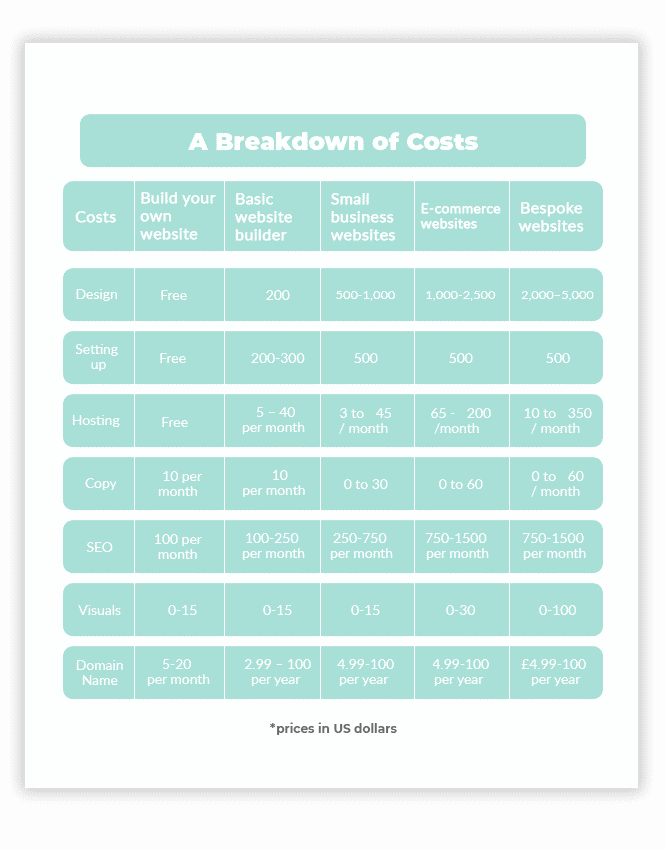
1. Design
The design of your website is crucial as it’s the first impression customers will have when they visit. It’s your opportunity to showcase your brand, so you should have a significant say in the visual aspects of the site. In 2026, template customization typically ranges from $300 to $6,000, depending on whether you choose a DIY builder or hire a professional designer. The complexity and level of customization—such as advanced UI/UX design or interactive features—can impact this cost.
2. Set Up Costs
Set-up costs typically include the initial creation of your site, excluding ongoing expenses like hosting, content updates, and maintenance. You can expect to pay $300 to $800 for set-up costs, which may include domain registration, initial theme/template customization, and integration with tools like Google Analytics.
3. Hosting
Web hosting is essentially the “rented space” where your website lives on the internet. There are various types of hosting available, including shared hosting, VPS (Virtual Private Server), and dedicated hosting, each with different price points. For small businesses, shared hosting typically costs between $5 to $25 per month, while more robust hosting options such as VPS or dedicated servers can range from $30 to $200+ per month.
4. Written content created by professional copywriters
Second to visual design, the copy is another extremely significant factor in website creation. You can, of course, create the written content yourself, but professional copywriters are highly trained in what they do and address the audience in an appealing way. Whether you go with a freelancer or an agency, hiring a professional writer is a sure way to ensure your website’s content is high quality. Integrating effective email marketing into your overall strategy, in addition to carefully crafted copywriting, can significantly boost your website’s reach and customer engagement.
If your website requires regular content updates (e.g., blog posts, product updates, or landing pages), costs for ongoing content creation can range from $50 to $200 per month, depending on the frequency and complexity.
5. SEO
SEO is crucial for improving your website’s visibility on search engines like Google, especially for local businesses. In 2026, effective SEO strategies ensure that your website ranks well for relevant searches, which can be highly competitive. SEO services range from $300 to $2,500 per month, depending on the scope of services (on-page SEO, content creation, backlinking, etc.).
Many web design agencies include basic SEO in their packages, but for businesses looking to fully optimize their site, hiring an SEO expert or agency might be necessary for sustained growth.
6. Images and visuals
Images are key to creating an engaging and visually appealing website. You can either use stock photos from websites like Shutterstock or Unsplash, or invest in custom photography. The cost for stock images ranges from $15 to $150 per image. Custom photoshoots with a professional photographer can cost between $500 and $5,000, depending on the number and complexity of the images required.
For e-commerce sites, product photography can be more expensive, particularly if high-quality images or 360-degree views are necessary.
7. Domain Name
A custom domain name is critical for branding and credibility. It serves as the first point of contact for potential customers, so it’s worth investing in a memorable, relevant domain. The cost of domain names typically ranges from $10 to $50 per year, but premium domains—those with highly desirable keywords or short, memorable names—can cost upwards of $1,000 or more.
Common Costly Website Design & Development Mistakes to Avoid
As website design and development experts, we’ve seen numerous mistakes that can severely impact your site’s performance, user experience, and ultimately, its success. Here are some of the most common costly mistakes to avoid in 2026:
- Ignoring Mobile Responsiveness
-
- Ignoring mobile responsiveness is one of the most prevalent blunders in the realm of today’s web design. When a site is not optimized for handheld devices, it can yield a subpar user experience, reduced engagement, and ultimately, inferior rankings on search engines.
- Complex Website Navigation
-
-
In today’s fast-paced digital world, clear and intuitive navigation is critical. Overcomplicating your website’s structure with excessive menus, nested links, and confusing layouts can frustrate visitors and cause them to leave your site.
In 2026, it’s more important than ever to simplify your navigation, limit the number of menu items, and avoid cluttering the interface with too many dropdown menus. Your goal should be to help users find what they need quickly and easily. A straightforward navigation layout increases engagement and improves the overall user experience.
-
- Slow Web Page Loading Speeds
-
-
Page load speed continues to be one of the most important factors affecting both user experience and SEO rankings. Slow-loading websites frustrate users, resulting in a high bounce rate and a poor customer experience.
In 2026, the expectation for fast-loading websites is higher than ever. Search engines like Google factor page speed into their rankings, so it’s crucial to optimize your site’s load time by reducing image sizes, leveraging browser caching, using a Content Delivery Network (CDN), and minimizing unnecessary scripts. Aim for a loading time of under 2-3 seconds to keep your visitors engaged and improve your SEO performance.
-
- Neglecting Web Security
-
-
Website security is more critical than ever, particularly as cyber threats continue to evolve. Neglecting security can result in data breaches, compromised user information, and damage to your brand’s reputation.
In 2026, investing in SSL certificates, multi-factor authentication (MFA), and regular security audits is vital to ensure that your website is secure from hackers and data leaks. Not only does strong security protect your business and customers, but it also boosts trust and credibility—key factors for increasing conversions and retaining customers.
-
- Poor Search Engine Optimization (SEO)
-
-
Even if your website looks great and offers valuable content, it won’t succeed if it doesn’t rank well in search engines. SEO remains essential for ensuring your website appears in search engine results pages (SERPs) when potential customers are looking for your products or services.
Effective SEO in 2026 involves keyword optimization, quality content creation, technical SEO, and mobile optimization. If your website isn’t optimized for search engines, you risk being buried beneath competitors who have invested in SEO. Focus on creating user-centric content, improving site speed, and building quality backlinks to increase your visibility.
-
Achieving the right balance between website development costs and the revenue your website can generate is crucial. Avoiding these costly mistakes ensures that your website performs well, delivers a positive user experience, and ranks high on search engines.
When you invest in a well-optimized, secure, and user-friendly website, you set yourself up for long-term success and growth in the digital space.
Get your website in a few clicks
UENI is the #1 solution for small business owners who need a website
START NOW
Website design and hosting for small businesses from UENI
At UENI, we redefine the concept of website building by combining top-tier agency-style support with unbeatable pricing. We understand the unique challenges of small businesses, and that’s why we bring affordable and business-centric online solutions for entrepreneurs who may lack the time or resources to create their own websites.
UENI-built websites are secure, search-engine-optimized, can feature a custom domain name and fully responsive design.
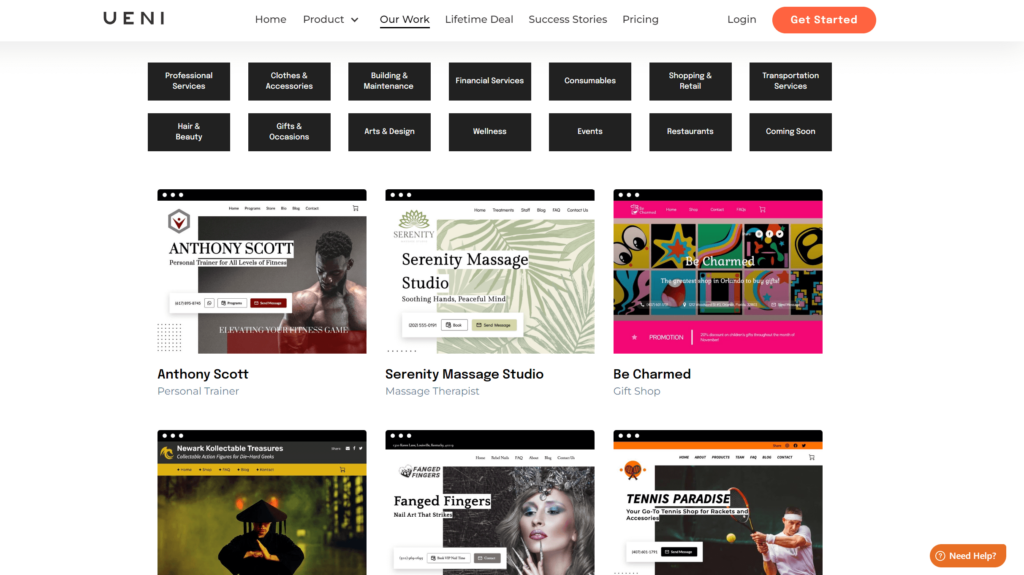
Have a look at the plenty of successful projects we have delivered – our work speaks volumes about our proficiency and commitment.
Here’s the deal: if you’re a small business owner, you need a website.
At UENI we believe that creating a digital presence for your business shouldn’t be complex or expensive. We make the journey from offline to online smooth and hassle-free. Get your own UENI-built website today and become a part of our impressive portfolio.
Witness firsthand how we simplify the process and amplify your business online.
Power up your game – start your journey with UENI today!
Website design cost is not the same as website cost
People search for “website design cost” and get quoted a website. Those are different purchases, and conflating them is why quotes look wildly inconsistent. Design cost is the labour to decide what the site looks like and how it is laid out. Website cost is that labour plus the platform, the hosting, the domain, the content and the upkeep.
Split any quote you receive into those two halves before comparing it with another. A $500 quote that covers design only and a $500 quote that covers design plus a year of hosting are not competing offers, and the cheaper-looking one is usually the first.
Why design labour costs what it does
The floor is set by wages rather than by software. The US Bureau of Labor Statistics puts the 2024 median pay for web developers and digital designers at $95,380 a year, or $45.85 an hour, across 214,900 jobs. Graphic designers sit at $61,300 a year, or $29.47 an hour.
Those are employed medians, so a self-employed designer has to charge meaningfully more than $45.85 an hour to cover their own tax, tools, insurance and unbilled hours. That single fact explains most of the quote range you will be given. If someone offers a bespoke multi-page site for a few hundred dollars, either the hours are not there or the work is templated, and it is fair to ask which.
The renewal cliff that most cost guides leave out
The single most common error in website design cost planning is budgeting the introductory rate as if it were permanent. Hosts advertise a low monthly figure tied to a long prepaid term and a materially higher renewal.
Take one worked example. Bluehost lists its Starter WordPress plan at $3.99 a month, stated “For 36 month term”, and “Renews at $9.99/mo”. Its Business plan is $6.99 renewing at $13.99, and eCommerce Essentials is $14.99 renewing at $21.99. So three years of Starter costs about $144 before tax, and the following three years cost about $360 for the identical site, which is two and a half times the first term. Two caveats the page makes you supply yourself: each price is printed with “VAT not included” and “GST not included”, and the page states the renewal rate without stating the renewal term, so the second-term figure assumes another 36 months.
Hosted platforms do the same thing, and the trap is which term you are looking at. WordPress.com opens on its yearly interval, where Personal shows $4 a month, $48 for the first year. Switch the toggle to Pay monthly and the same plan is $9. Both numbers are honest, they are just different products, so check which interval is selected before you compare a quote against it. On renewals, go and look rather than trusting any figure quoted elsewhere, including here: the renewal amount is injected into that page by a live pricing experiment, so the figure you are shown is not necessarily the figure anyone else is shown.
The practical rule: budget the renewal rate, and treat the introductory discount as a one-off saving rather than your ongoing cost. Then decide the term deliberately, because a 36-month prepay is only a saving if you are still going to want that host in year three.
The line items people forget when pricing a website design
The build is rarely what breaks a budget. These are the recurring items that turn a quoted number into a real annual cost.
| Item | Why it gets missed | When it lands |
|---|---|---|
| Domain renewal | Usually free for the first year | Month 13 |
| Hosting renewal | Advertised rate is the introductory one | End of the prepaid term |
| Premium theme or plugin licences | Bought once, renew annually for updates | Month 13 |
| Content and photography | Assumed to be your job, then is not | During the build, as a delay |
| Edits after launch | Quoted per change once the build is signed off | Continuously |
| Someone to keep it updated | Nobody owns it, so it drifts | Month 6 onward |
The last row is the expensive one. A site nobody maintains slowly stops working, and the cost shows up as leads you never hear about. Our note on website maintenance cost covers what that upkeep actually runs.
What a good quote looks like
Ask for four things in writing and most quote comparisons resolve themselves. What the design covers, page by page. Who supplies the text and images. What the total is in year one and in year two. And what happens when you want a change after launch.
A vendor who answers all four plainly is quoting the same thing as the next vendor who does. One who answers only the headline number is not being compared, they are being guessed at. For the low end of the market specifically, affordable website design covers what tends to be missing from a cheap quote.
Frequently asked questions about website design cost
What is the average website design cost in 2026?
It depends almost entirely on whose hours you buy. The BLS median for web developers and digital designers is $45.85 an hour and for graphic designers $29.47, and a self-employed designer charges above their employed equivalent to cover overhead. Ask how many hours a quote assumes rather than comparing totals.
Why do website design quotes vary so much?
Because they are quoting different scopes under the same name. Some include content, hosting and a year of edits, others cover design only. Split every quote into design labour and everything else before comparing, and the range usually turns out to be much narrower than it looked.
Is website design a one-time cost?
The design is. The website is not. Domain renewals, hosting renewals, plugin licences and edits after launch all recur, and hosting typically rises when the introductory term ends. Budget a year-two figure alongside your year-one figure.
What is the cheapest way to get a website designed?
Doing the design yourself on a builder template is the cheapest in cash and the most expensive in hours. The route that most often wastes money is the half-finished one, where you pay for a platform for months while the site never launches.
Do hosting prices really go up after the first term?
Usually, and the hosts say so on the page. Bluehost lists Starter at $3.99 a month “For 36 month term” and “Renews at $9.99/mo”, which is a two and a half times step. Prices are also shown before VAT and GST. Budget the renewal figure, not the advertised one.
Sources
- US Bureau of Labor Statistics, Occupational Outlook Handbook: Web Developers and Digital Designers, 2024 data.
- US Bureau of Labor Statistics, Occupational Outlook Handbook: Graphic Designers, 2024 data.
- Bluehost, WordPress Hosting, read 14 August 2026.
- WordPress.com, Plans & Pricing, read 14 August 2026.
- WordPress.com, public plans API, currency_code USD, read 14 August 2026.