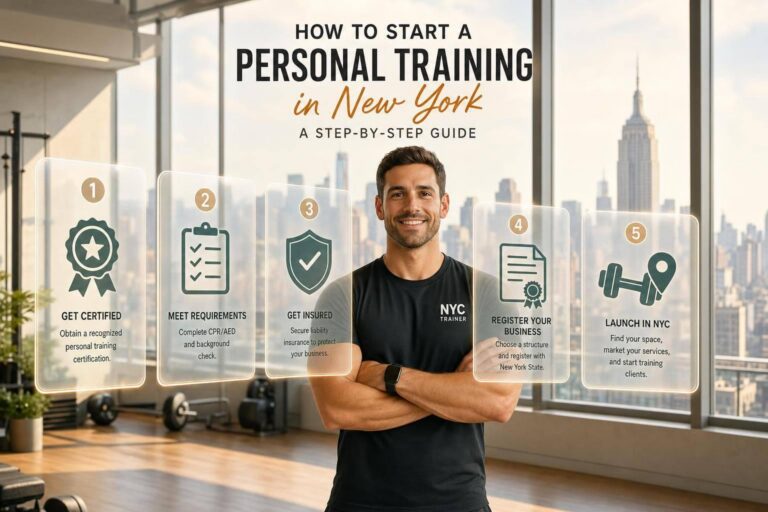
About This Guide
A practical New York-specific guide to launching a personal-training service, covering business formation, tax and insurance compliance, facility-related rules, licensing boundaries, startup planning, and client acquisition. New York does not appear to issue a dedicated state personal-trainer license; however, operating a gym or health club can trigger separate state and local obligations. New York defines a health club broadly to include businesses offering instruction, training, assistance, or facilities for physical fitness or well-being. In New York City, qualifying health-and-fitness facilities must register for sales tax and collect tax on covered charges; charges for facilities outside New York City are treated differently.
sbb-itb-5b82b38
Business Formation Steps
- Define the service model (mobile/in-home training, independent contractor, online coaching, or a studio) and check zoning and local requirements.
- Choose a structure—sole proprietorship, partnership, corporation, or LLC. File an assumed-name certificate with the county clerk if operating under a name other than the owner’s legal name; form an LLC or corporation with the New York Department of State.
- Obtain a federal EIN from the IRS (particularly if hiring, operating as an entity, or opening a business bank account).
- Register with the New York State Department of Taxation and Finance where required. If operating a New York City health-and-fitness facility, register to collect and remit applicable sales tax on facility charges.
- Obtain any city, town, village, county, or building approvals applicable to the premises, then open a business bank account and establish bookkeeping, contracts, waivers, and client-record procedures.
- If hiring employees, register for unemployment insurance and arrange workers’ compensation, disability benefits, and Paid Family Leave coverage as applicable.
Legal Requirements
Use a written client agreement covering services, fees, scheduling, cancellations, refunds, informed consent, health screening, emergency procedures, and assumption-of-risk language reviewed by New York counsel. Avoid diagnosing, treating, or representing that you provide medical services unless properly licensed; refer medical conditions to qualified clinicians. A New York LLC or corporation must be registered with the Department of State and maintain its required state filings and tax compliance. If operating a health club, New York Department of State financial-security requirements can apply based on membership-contract terms; the Department says it does not issue a general health-club license, but qualifying facilities must submit the required bond, letter of credit, or certificate of deposit. Comply with accessibility, fire, occupancy, zoning, consumer-protection, privacy, and employment rules applicable to the location and operating model.
Licensing and Permits
A dedicated New York State personal-trainer license is generally not required, although recognized CPR/AED and personal-training certifications are prudent industry qualifications and may be required by a facility, insurer, or client contract. If operating from a studio, gym, or health club, use New York Business Express and the local municipality’s permit tools to check zoning, certificate-of-occupancy, building, fire, signage, and any local business requirements. New York health clubs are not licensed by the Department of State, but qualifying clubs must register the required financial security. New York City facilities may have additional premises requirements, including Physical Culture Establishment or other location-specific approvals. Register for a sales-tax Certificate of Authority when the business’s taxable services or facility charges require it; NYC health-and-fitness facilities must register and collect tax on covered charges.
Insurance Requirements
General liability insurance is strongly recommended for injury and premises claims, along with professional liability/errors-and-omissions coverage for training advice and services. Consider equipment/property coverage, commercial auto coverage for mobile operations, and cyber/privacy coverage if collecting health or payment information online. New York requires workers’ compensation for covered employees and may require disability benefits and Paid Family Leave coverage; confirm whether any owner or worker exemption applies and file a CE-200 certificate of exemption when legally appropriate. A gym or landlord may also require specific limits and additional-insured status.
Startup Costs
Estimated launch costs range from approximately $6,950 to $139,000 statewide, with a median estimate of $34,750. For a New York City operation, an estimate of approximately $21,000–$162,000 is reported. The range depends primarily on whether the trainer operates as a mobile/independent trainer, rents space, or opens a dedicated studio.
Typical Initial Investments
Typical investments include: training equipment of about $1,390–$6,950 for a mobile or small operation, with private-studio equipment potentially reaching $41,700; professional/general liability insurance commonly around $240–$2,400 annually in startup estimates, with $1 million per occurrence and $2 million aggregate often used as a client-facing coverage baseline; New York LLC filing fee of $200; NYC LLC publication costs of roughly $1,000–$2,000 where applicable; plus studio lease deposit, build-out, utilities, booking/payment software, website and marketing, certifications/CPR-AED training, and working-capital reserves. A mobile trainer can substantially reduce costs by using portable equipment and client homes or rented gym space.
Estimated Setup Time
Typical Time to Launch: Approximately 2–6 weeks for a solo, mobile or contractor-based launch after obtaining certification, insurance, EIN, contracts, and any required tax registration. Approximately 2–4 months for a leased studio or health club because entity formation, premises/zoning/building reviews, equipment, insurance, hiring, and health-club financial-security filings may add time. These are planning estimates, not government processing guarantees.
State Regulations and Compliance
New York does not require a state-issued personal-trainer license, although recognized certifications (such as NASM, ACE, ACSM, ISSA, or NSCA) and CPR/AED certification are commonly expected by gyms and clients. Choose and register a business structure with the New York Department of State when applicable; an LLC filing fee is $200, and New York LLC publication requirements may apply. Use New York Business Express to identify state and local permits. If operating under a trade name in New York City, file the applicable county-clerk business certificate. A dedicated NYC studio may require an appropriate Certificate of Occupancy and building permits for alterations. Employers must address workers’ compensation, disability benefits, unemployment insurance, and Paid Family Leave requirements. Personal-training services performed independently are generally not subject to New York City sales tax, but NYC health-and-fitness facilities that sell memberships, facility use, classes, or personal training as facility services must register, collect, and report applicable NYC sales tax; retail merchandise and other taxable sales require a NYS Certificate of Authority.
For the full step-by-step, see our how to start a cleaning business guide.
Marketing and Growth Tips
Choose a profitable niche and service radius, then track leads, consultations, conversion rate, retention, average revenue per client, and referral rate. Use local search optimization, consistent educational content, email/text follow-up, and testimonials obtained with permission. Partner with employers, residential buildings, sports organizations, physical-therapy practices, and community groups for recurring workshops or referral arrangements. Grow through recurring packages, small groups, hybrid online/in-person coaching, and documented progress reviews. Recheck New York and municipal tax, facility, employment, and health-club rules when changing from mobile training to a studio or adding memberships, classes, childcare, massage, or retail products.
Client Acquisition Strategies
Start with a narrowly defined local offer—such as in-home strength training, beginner programs, senior fitness, or sport-specific coaching—and publish a clear package, intake process, and cancellation policy. Build a Google Business Profile and location-specific website pages; collect compliant reviews and before/after performance stories with client permission. Seek referrals from physical therapists, chiropractors, sports clubs, apartment buildings, employers, and complementary wellness professionals. Offer a low-cost assessment or introductory session, small-group sessions, and referral credits rather than relying only on paid advertising. For a studio, use local partnerships and community events to drive trial memberships; in New York City, price and advertise services with the applicable health-and-fitness sales-tax rules in mind.
Helpful Local Resources
- New York Business Express — state and local startup, licensing, and permit guidance
- New York Department of State, Division of Licensing Services — health-club services and financial-security filings
- New York State Department of Taxation and Finance — sales-tax registration and New York City health-and-fitness facility guidance
- New York State Department of Labor — unemployment insurance registration and employee coverage information
- New York City Department of Small Business Services / NYC Business — health-club startup guidance and local requirements
- County clerk and the relevant city, town, or village clerk — assumed-name and local registration questions
- New York State Small Business Development Center — counseling and business-plan assistance